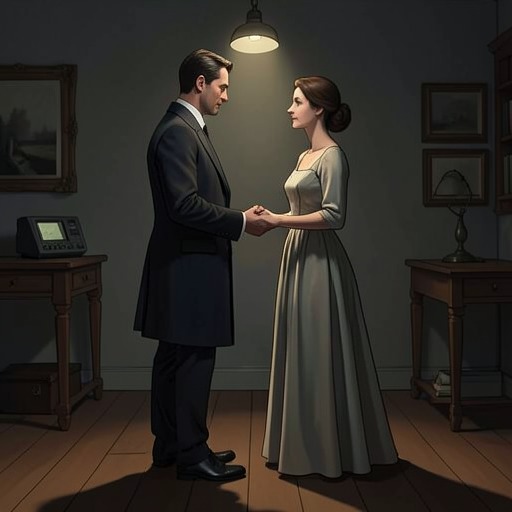
Zaen’s thousand proposals to Della
One Thousand and One NightsZaen’s thousand proposals to Della are a long-running courtship ritual whose failure and eventual transformation reveal the difference between romantic persistence and love that recognizes another person. Zaen proposes to Della every week from childhood, but the thousand declarations do not win her trust; a modest bracelet, given as a sign of friendship rather than a prize or claim, finally helps them understand one another and agree to marry.
The Weekly Proposals
Della describes the courtship as a routine that began when she was six and Zaen was seven. She had only just learned to read, while he had barely learned to write, when his weekly love letter and marriage proposal began. She says that each week brought another declaration, regardless of the weather or occasion and regardless of how often she refused him. By the time she tells the story to her companions, the tally has reached about a thousand.
Her answer to the latest letter is emphatic: she rejects the roles Zaen assigns her in his poetry—as his cream tart, fairest moon, galaxy of stars, and fulfilled wish—and refuses his invitation to escape with him into a supposedly happy ending. She sends the response back in the original envelope through a servant, then sighs that she wishes he would stop. The regularity has made his suit predictable, but not welcome: for Della, a proposal repeated every week is still a proposal she has not accepted.
What Persistence Conceals
Della’s friends interpret the pattern differently. Prudence sees an extraordinary devotion and imagines the appeal of a man who has loved one woman so long; Cordelia finds the repetition disturbing, as if Zaen assumes he has a claim on Della. Della rejects the idea that the count proves love. She says Zaen has convinced himself that he is smitten, but that she has given him no reason to think highly of her, much less fall in love with her. She calls them friendly acquaintances, even as Prudence observes that Della expects his suits and speaks as if they have never been apart.
That contradiction is central to the courtship. Della does enjoy their familiar encounters, including her daily rides, but she has hardened her heart against romance because she cannot trust that the poetry refers to her as she understands herself. She later explains that Zaen’s words described how he saw her, not how she saw herself. His persistence therefore keeps repeating the offer without answering her real concern: whether he can treasure Della as a person rather than pursue an ideal or win a trophy.
The proposals also unfold against a larger danger. Della’s father explains that the jinn’s claim threatens to erase her memory and, when she turns twenty-one, to take her and her inheritance. Zaen’s years of courtship have not resolved that peril, and the number of proposals cannot substitute for the action and trust needed to meet it. In this context, Della’s question is not simply whether Zaen has tried hard enough; it is whether his understanding of her can withstand the stakes attached to her future.
The Bracelet Changes the Meaning
The turning point comes when Zaen prepares to leave Della be if she does not love him, but offers her a gift before he goes. He places a handmade friendship bracelet in her hand. Its strands preserve specific memories: white horsehair recalls the pony Della received when they met; red recalls the stallion that threw her and Zaen catching her, the first time she smiled at him; black comes from the mare he gave her, chosen for the contrast between a regal exterior and a sweet spirit. A bead for each of them bears their carved initials.
Zaen explains that he had searched for a perfect gift for years but could find no amount of gold or jewels worthy of what Della meant to him. The bracelet instead gathers their shared history into something personal and tangible. He calls their friendship the most important treasure of his life and describes the Della he knows through the precious moments of their daily rides. The gesture does not ask her to reward his effort with marriage. It offers evidence of attention and gives Della room to decide what their bond means.
Della’s response makes clear why the object succeeds where the thousand proposals did not. She says she had not believed Zaen truly loved her: his poetry sounded beautiful, but he had not done anything she could recognize as enduring love. She wanted someone willing to trust her with everything he did not have and believe she could love him in return, particularly when others assumed she cared only for gold and jewelry. The bracelet answers that need not by being expensive, but by showing that Zaen remembers who she is and trusts her with his vulnerability.
From Courtship to Commitment
Della tells Zaen that his thousand proposals had not shown her that he understood how she saw herself. The bracelet represents the kind of person she wants to be to the man she marries: not a prize won through valiant effort or a trophy celebrating his greatness, but someone treasured always. She admits that she had taken the poetry for insincerity and deliberately kept their daily pleasure from turning into romance because she never expected him to love the real her.
Zaen answers that he has loved the real Della more each day, recalling her talking to her horse and jumping hedges when her mother was not looking. When he insists that he proposed a thousand times, Della laughs that she thought he was not counting and distinguishes romance from love. Zaen makes the count itself a playful measure of persistence: it took a thousand and one tries to find her heart. This time the proposal follows, rather than replaces, an act that has made his understanding credible.
He slides from the fountain onto one knee and asks Della to be his friend for life and marry him. She accepts without gold or jewels, on the condition that he promise first and forever to be her dearest friend. Their embrace and Zaen’s repeated assent complete the change: the thousand proposals had treated marriage as the hoped-for answer to repeated pursuit, while the final one rests on friendship, mutual trust, and Della’s freely given agreement.