
The Book’s Critical Argument
OrientalismThis thread traces the book’s movement from colonial examples toward a critique of representation and a call for critical inquiry.
increasing Bearing strength in each event
 decreasing
Bearing strength in each eventdecreasingPowerful Speakers

Powerful Speakers
Parliamentary Authority
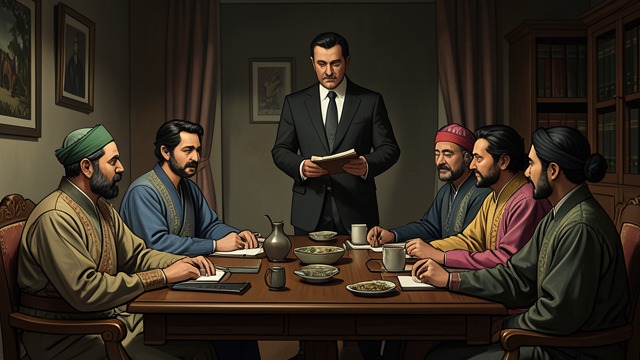
Arthur James Balfour speaks for Britain about Egypt while presenting British knowledge as a basis for rule.
Egyptian Silence
The people being governed are not treated as equally authoritative speakers about their own political future.
The Book’s Opening Example
The scene makes the link between representation and political power visible.
The Textual Tradition
The Textual Tradition
Prior Accounts Shape Perception
European readers approach unfamiliar societies through inherited religious, literary, and scholarly descriptions.
Familiarity as Control
New information is often fitted into existing expectations rather than allowed to unsettle them.
A Written Orient
The Orient becomes recognizable through repeated representations as much as through direct contact.
The Institutional Turn

The Institutional Turn
Organized Study
Modern Orientalism develops through schools, scholarly societies, and major publications.
A Wider Claim
Its authors move from specialized findings toward sweeping statements about whole cultures and societies.
The Analytical Method
Said reads these works alongside the institutions and political circumstances that give them authority.
The Modern Crisis

The Modern Crisis
Political Change
Nationalist movements and changing international power challenge the picture of a passive, timeless Orient.
Adaptation Rather Than Abandonment
Old assumptions can return in new policy vocabularies and social-scientific forms.
A Persistent Mismatch
The distance between changing societies and fixed descriptions becomes central to Said’s critique.
A Humanistic Alternative

A Humanistic Alternative
Critical Scrutiny
Said calls for scholars to question the categories and institutions that shape their work.
Exchange Across Difference
He rejects both imperial domination and a simple reversal of East–West hostility.
An Open-Ended Practice
Historical study, self-criticism, and humanistic exchange remain necessary rather than final solutions.
1910
From the Middle Ages to the eighteenth century
Late eighteenth and nineteenth centuries
From the interwar period through the 1970s
At the book’s conclusion and 1994 afterword
