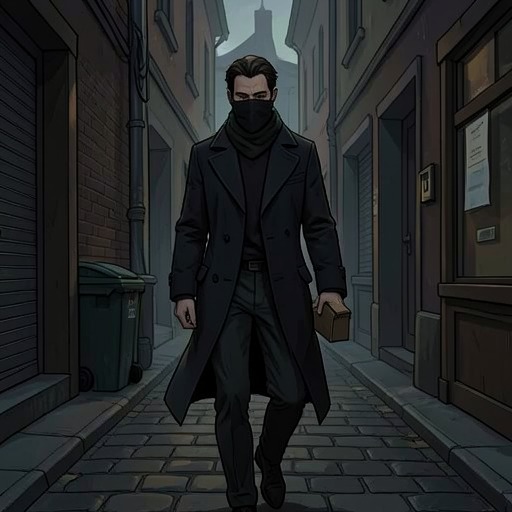
Jacques Collin (Vautrin) is arrested
Père GoriotJacques Collin (Vautrin) is arrested at Maison Vauquer when Bianchon’s mention of the alias Trompe-la-Mort triggers the exposure of his concealed identity. The scene turns the boarding house from a setting of everyday communal life into a sealed police operation: armed men and soldiers block the exits, Collin’s wig is knocked away, and the lodgers see the convict beneath the mask of good nature. His sudden fury gives way to deliberate submission, but the arrest does not settle the room’s moral judgment; afterward, the lodgers direct their disgust toward Mlle. Michonneau, whose part in the exposure is now plain to them.
Causes and Background
The arrest begins with a remark by Bianchon. He recalls that Mlle. Michonneau had spoken two days earlier about a man called Trompe-la-Mort, and suggests that the name suits Vautrin. The comment is not an official accusation, but Vautrin’s response makes its force unmistakable: he turns pale, staggers back, and fixes Mlle. Michonneau with a look so intense that she shrinks and collapses into a chair. The previously genial appearance has fallen away, and the lodgers witness a threat they do not yet understand.
The sudden change gives way to the sound of approaching force. Footsteps and the ring of rifles on the street announce that the police have arrived with soldiers nearby. An officer declares the arrest in the name of the King and the Law, while the room’s astonishment nearly swallows his words. The collision between the private conversation that names Trompe-la-Mort and the public authority now entering the house makes the arrest feel at once exposed and prearranged: the lodgers are present for the revelation, but most do not understand the danger until the officers appear.
The Arrest and Revelation
The police enter from the sitting room and secure the house rather than relying on a single approach. Three men advance with hands on cocked pistols; two policemen hold the sitting-room entrance, two more appear at the staircase doorway, and soldiers are heard in the garden. With the routes out covered, the lodgers’ attention turns instinctively to Trompe-la-Mort. The chief walks straight up to him and strikes his head, knocking off his wig and uncovering Collin’s face.
The exposed appearance makes the contrast between the assumed identity and the man beneath it physical. Collin’s short, brick-red hair and powerful frame accompany a look of unmistakable ferocity; the disguise no longer contains the force the lodgers had only partly perceived. He starts back with savage energy and a growl, while the police reach for their pistols amid the alarm. The arrest is therefore also a public unveiling: those gathered in the room are made to reinterpret Vautrin’s past conduct, present manner, and doctrines in light of the convict they now see.
Fury, Restraint, and Submission
For an instant Collin appears ready to turn the arrest into a violent confrontation. The narration figures his anger as a force capable of sending mountains flying, then shows it checked in a moment by a thought that crosses his mind. Rather than attack the armed men, he begins to smile and looks down at the wig that has just fallen. His self-command changes the immediate course of the scene: the police still hold the advantage, but the prisoner’s restraint is his own action, not simply the result of being physically overcome.
Collin addresses the chief with sardonic composure, remarking that the officer is not in the politest of moods. He then offers his hands to the policemen and calls on those present to witness that he makes no resistance. The room responds with admiration at the speed of the reversal—from explosive fury to controlled compliance. His submission does not erase the menace of the moment; instead, it displays a capacity to govern the same force that had just alarmed the lodgers. As the police and soldiers take him away, the arrest closes off escape without turning into the violent struggle the room seemed to anticipate.
The Lodgers’ Judgment Afterward
Once the authorities have left, Sylvie breaks the silence by observing that Vautrin was a man, for all that. Her remark releases the room from its immediate shock. The lodgers look at one another, then turn together toward Mlle. Michonneau, crouched beside the stove with her eyes lowered. Their reaction recasts her earlier fear and the exposure of Vautrin: the discovery of the convict’s identity has also made her own role visible to the household.
The response is collective and nearly unanimous. The lodgers’ repulsion, previously felt but unexplained, now gathers around Mlle. Michonneau; Bianchon tells Poiret quietly that he will leave if she remains to dine with them. Poiret is the exception to the room’s shared opinion, and Bianchon, strengthened by the majority, asks him to make her understand that she must go at once. Thus the arrest’s immediate consequence inside Maison Vauquer extends beyond the prisoner’s removal. The household turns its attention to the person whose disclosure helped bring the police to its door, and the scene ends with the community’s rejection of her.