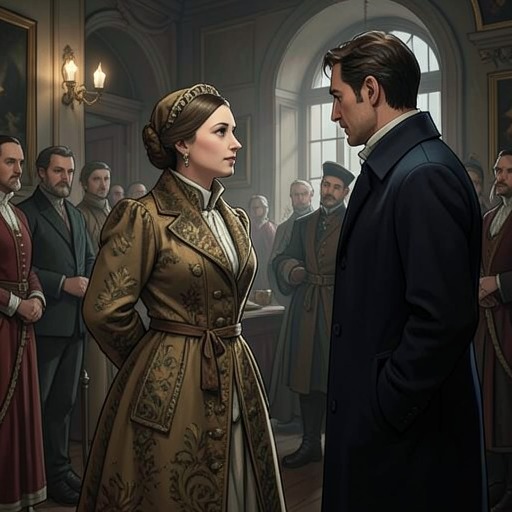
Maxime de Trailles
Père GoriotMaxime de Trailles is a fashionable, aristocratic lover whose pursuit of pleasure leaves financial and emotional wreckage in its wake. He is introduced as a polished presence in Parisian society, but his decisive function in the story is revealed through Anastasie de Restaud’s debts: she repeatedly pays his bills, sacrifices the family diamonds to rescue him, and is left with disgrace and loss when he flees. His limited direct appearances sharpen the contrast between social glamour and the damage it conceals.
Identity and Introduction
Maxime belongs to the fashionable Parisian circle whose members move among wealthy women and aristocratic salons. The young Eugène de Rastignac first notices him at Mme. de Beauséant’s ball and later encounters him at Anastasie’s house. There, Maxime’s carefully arranged curls, immaculate boots, and well-cut overcoat mark him as a practiced man of fashion. Against Eugène’s travel-worn appearance, he seems effortlessly equipped for the society the law student hopes to enter.
At their first encounter in Anastasie’s drawing room, Maxime looks between her and Eugène with unmistakable impatience. The narrative renders his unspoken wish as a demand that Anastasie send the intruder away. She retreats into another room, and Maxime follows; Eugène, recognizing their intimacy and interpreting Maxime as a rival, pursues them. The episode shows Maxime exercising influence without needing to make a formal claim: Anastasie’s manner shifts around him, while Eugène’s ambition and jealousy immediately take his measure.
Relationship with Anastasie de Restaud
Anastasie’s attachment to Maxime governs a series of increasingly costly choices. Mme. Vauquer’s lodgers infer early that Anastasie has pressing bills and that Maxime’s protested obligations are involved. Their deduction links the Countess’s elegant public appearance to private financial strain: even amid dancing and flirtation, she is preoccupied with debts connected to her lover. Eugène, alarmed by what he hears, identifies Maxime as a danger to Anastasie.
Anastasie later explains the extent of the burden. Around the beginning of January, Maxime owed one hundred thousand francs and, as he told her, intended to shoot himself. She implored him for two hours, kneeling at his knees until he disclosed the debt. She had already paid other bills for him, and her father, Jean-Joachim Goriot, had spent what he could to help her. Maxime’s reported despair becomes the immediate pressure behind Anastasie’s desperate effort to keep him alive and preserve his prospects.
The rescue brings a further sacrifice. Anastasie takes the family diamonds, including jewels belonging to her husband’s mother, and sells them to Gobseck for one hundred thousand francs. Her husband discovers what she has done, and the sale becomes a source of scandal as well as a private marital crisis. Even the proceeds do not settle everything: Anastasie says that twelve thousand francs remain due. She has staked her fortune, honor, peace of mind, and children on her attachment to Maxime, while pleading that he be spared prison and allowed to maintain a future in the world.
Social Glamour and Financial Consequences
Maxime’s polished appearance and place in elite society contrast with the bills and threatened ruin that gather around him. Anastasie’s sister, Delphine de Nucingen, hears that bills bearing Maxime’s name amount to nearly one hundred thousand francs and are overdue, with legal proceedings threatened. She also learns that Anastasie has sold the inherited diamonds. The report makes the family’s public standing precarious: Anastasie is expected to appear at Mme. de Beauséant’s ball in gold and diamonds, turning conspicuous display into a response to damaging talk.
The gap between Maxime’s fashionable surface and his debts also shapes Eugène’s early education in society. At Anastasie’s house, Maxime’s spotless clothes and composed bearing seem to give him the advantage over the less polished student. Yet the social contest has a material underside. Eugène’s first impression of Maxime as a rival gradually gives way to a clearer recognition that Anastasie’s devotion finances a way of life whose costs she cannot indefinitely absorb.
The salons discussed by the characters treat beauty, introductions, money, and reputation as resources that can be deployed for advantage. Maxime’s position within this world is therefore more than a romantic attachment: the obligations he incurs travel through Anastasie’s household, threaten her marriage, and reach her father’s remaining means. His offstage prominence is measured by those consequences rather than by an independent account of his own fortunes or motives.
Flight and Narrative Significance
By the time Anastasie returns in anguish, Maxime has fled and left enormous debts behind him. She has also discovered that he was deceiving her. Her husband controls the fortune she has left, and she recognizes that she abandoned the one person who loved her faithfully—her father—while treating his affection lightly. Her confession makes the consequences of Maxime’s dependence unmistakable, though it does not establish the details of his deception beyond Anastasie’s discovery or explain what becomes of him after his departure.
Maxime’s story is consequently told chiefly through other people’s observations and Anastasie’s successive disclosures: first the fashionable rival at a drawing-room hearth, then the source of bills and urgent appeals, and finally the absent lover whose flight leaves her exposed. That progression turns him into a measure of the distance between appearances and obligations in Parisian society. His elegance opens doors and commands attention; the debts attached to him close those possibilities for Anastasie, while her father is left trying to help with almost nothing remaining.