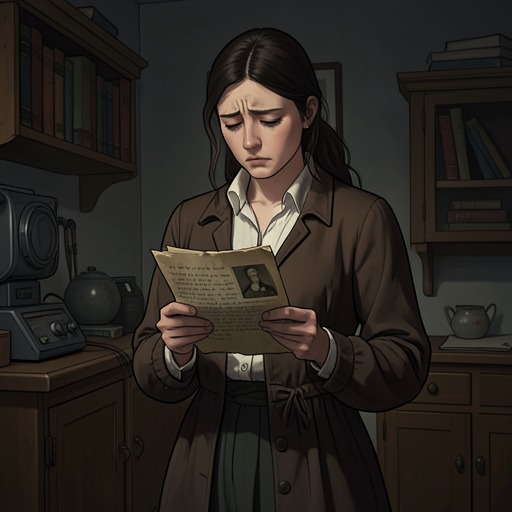
Victorine’s Appeal to Her Father
Père GoriotVictorine’s Appeal to Her Father is a repeated plea for recognition that ends in a fresh rejection. Victorine Taillefer goes with her guardian, Mme. Couture, to see M. Taillefer, carrying her dead mother’s farewell letter and asking not for wealth but for her father’s affection. He refuses to acknowledge her as his daughter, treats the letter with indifference, and leaves her without support. The visit turns an intimate family appeal into a public measure of the powerlessness of a young woman dependent on a father who will not claim her.
Background and Purpose
The appeal is not a first attempt. Mme. Vauquer learns that Victorine and Mme. Couture have gone to see M. Taillefer on the day they are accustomed to make their visit; later, Mme. Couture describes his fatigue with their annual application. The repetition gives the journey a ritual quality, but not a hopeful outcome: each return renews Victorine’s exposure to refusal rather than bringing her nearer to reconciliation.
Before the visit, the two women have prayed at Saint-Etienne du Mont. Mme. Couture says Victorine is trembling, and the details establish the emotional cost of approaching a father who has already withheld both recognition and material help. Vautrin frames the encounter in terms of money and social position, remarking that M. Taillefer is said to possess three million and that a young woman needs a dowry. Victorine answers that her father’s affection and her mother’s honor matter more to her than all the money in the world. Her stated objective is therefore distinct from the financial argument surrounding her: she wants acknowledgment and a little tenderness, not merely a portion of her father’s fortune.
Mme. Couture has brought the dead woman’s last letter but has never dared send it by post, because M. Taillefer would recognize her handwriting. That withheld letter becomes the essential object of the visit: it carries the mother’s appeal into a meeting that Victorine and her guardian have otherwise struggled to arrange. The account does not disclose the letter’s contents; it does show that the two women regard delivering it as a possible means of reaching M. Taillefer.
The Visit and Refusal
M. Taillefer grants them a personal interview, but his conduct makes clear that an audience is not the same as a welcome. He does not ask Victorine to sit down, leaving her standing throughout the encounter. He says they should spare themselves further visits and complains that the young woman is injuring her cause by importuning him, although, as Mme. Couture emphasizes, she comes only once a year. He also invokes Victorine’s mother’s lack of property when he married her as a reason Victorine should expect nothing from him.
Victorine nevertheless speaks for herself. She falls at her father’s feet and explains that she persists in visiting for her mother’s sake; she says she will obey him without complaint, but begs him to read the farewell letter. Mme. Couture remembers Victorine’s words as eloquent and moving, and says they brought her to tears. The plea is at once submissive and morally forceful: Victorine accepts her father’s authority, yet asks him to face the mother’s final appeal and acknowledge the bond he denies.
M. Taillefer’s response makes the rejection concrete. As Victorine speaks, he cuts his nails. He takes the letter, which Mme. Couture describes as soaked with the dead woman’s tears, and throws it onto the mantelpiece, responding only that it is all right. He then holds out his hands as if to raise Victorine, but she covers them with kisses and he withdraws them. The brief gesture offers the appearance of contact and then cancels it: the father is physically near enough to receive his daughter’s devotion, yet refuses the intimacy she offers.
The son’s arrival deepens the isolation of the scene. According to Mme. Couture, he takes no notice of his sister. Father and son then leave, bowing to Mme. Couture and pleading urgent business. Their conventional politeness toward the guardian contrasts with the refusal of kinship shown toward Victorine. The visit thus closes without a reconciliation, a promise of support, or any indication that M. Taillefer has read the letter.
Witnesses and Aftermath
Victorine and Mme. Couture return to the boarding house with the appeal unanswered. At four o’clock, when Jean-Joachim Goriot comes in, he sees that Victorine’s eyes are red. Mme. Couture is recounting the morning’s visit to Mme. Vauquer; her account makes the private humiliation available to the other residents, turning the failed meeting into a shared scene of judgment.
Jean-Joachim Goriot reacts with indignation, calling M. Taillefer and his son inhuman. The response sets his own intense attachment to his daughters against the rejection Victorine has experienced, without changing her material circumstances. Mme. Couture, meanwhile, concludes that M. Taillefer has at least seen his daughter and cannot understand how he can refuse to recognize her, since Victorine and her father look very much alike. His decision to deny the relationship is therefore presented not as a mistake arising from uncertainty, but as a deliberate refusal in the face of their visible resemblance.
Vautrin has earlier interrupted Mme. Couture’s account of the withheld letter by promising to look into Victorine’s affairs and put matters right. Victorine responds eagerly, asking him to find a way to communicate with her father and to tell him what she values. The promise supplies a possible route beyond the annual appeal, but the visit itself offers no evidence that M. Taillefer has relented. It also places Victorine’s hope in another person’s intervention: despite her direct plea, the decisive power remains with her father and with those who may be able to reach him.
Significance
The episode contrasts the value Victorine places on affection and her mother’s honor with the monetary language used to describe her situation. Vautrin points to the fortune attributed to M. Taillefer and to the importance of a dowry; M. Taillefer, in turn, uses Victorine’s mother’s lack of property to justify denying his daughter support. Victorine’s plea resists that calculation. Her wish to be acknowledged is not equivalent to a request for money, even though material dependence makes the refusal consequential.
The farewell letter and the withdrawn hands concentrate the scene’s emotional structure in two acts of attempted contact. The letter carries the dead mother’s words to the father, but he sets it aside; the daughter kisses his hands, but he draws them away. Neither object nor gesture can compel recognition. Through the repeated annual journey and its unchanged result, the appeal shows how family ties may be asserted by the vulnerable yet withheld by the person who controls acknowledgment and assistance. The scene leaves Victorine still devoted to her father, while making the cost of that devotion—and the distance between filial reverence and paternal responsibility—plain.