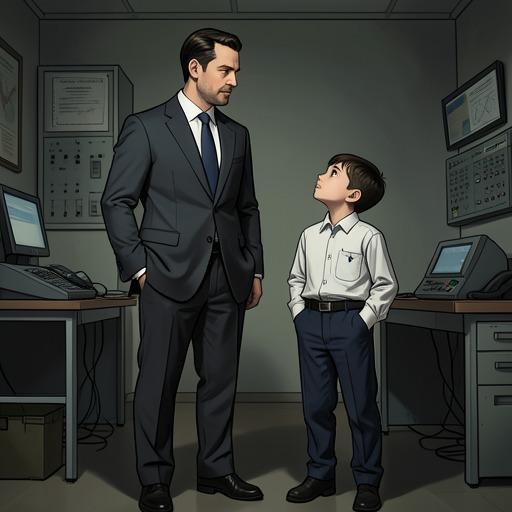
Blunt's Brilliant Detectives office
Partners in CrimeBlunt's Brilliant Detectives office serves as both the public workplace of Tommy Beresford and Tuppence Beresford and the private stage for their experiments in detective fiction. Books line its cupboards; clients bring mysteries to its desk; and, as the struggle with No. 16 closes in, the office becomes a watched and penetrable site where professional performance and real danger meet.
The office as a working base
The office is identified as Mr. Blunt’s private office, adjoining a room marked for the clerks. When Tuppence enters from that adjoining space, she finds Tommy with his eye fixed to a private peephole looking into the outer office. He warns her to be quiet: the buzzer has sounded, and Albert is telling a prospective client that he is engaged with Scotland Yard. Even before the case is heard, the office is shown as a place where access, observation, and the presentation of a professional identity are carefully managed.
The couple’s work is also shaped by the books they keep there. After Tommy falls from a chair while trying to arrange volumes on a high shelf, he explains that he wants to spend half-hours studying the “Great Masters” of detective fiction. He regards himself and Tuppence as amateurs and hopes to acquire technique by trying different styles and comparing their results. Tuppence tests the ambition against practical limitations: Tommy lacks medical and legal experience, and she doubts that science is his strength. Tommy answers that he has bought a camera to photograph footprints and enlarge negatives. The office’s books are not merely decoration; they furnish a working syllabus, while the camera represents his attempt to convert fictional method into usable evidence.
Fiction as method and play
The couple repeatedly turn the office’s books into a storehouse of assumed identities. When Tuppence suspects that their opponents have realized Tommy is not the real Mr. Blunt and are seeking to harm them, Tommy opens the side cupboard and selects a role from the detective stories: they will be the Okewood brothers, with Tommy as Desmond. Tuppence would rather play Francis, whom she considers the more intelligent brother and the one who arrives in time to save Desmond from trouble. Their exchange makes role-playing both a joke and a tactical response to danger: the borrowed characters offer a script, but the Beresfords’ own partnership determines who will take which part.
That habit of borrowing detective conventions also gives their investigations a comic, self-conscious edge. Tuppence urges Tommy to use his “little grey cells,” while Tommy invokes the language of fictional detection and imagines himself as Hercule Poirot. His performance is not proof of mastery; it is an openly theatrical attempt to think through a case by adopting a familiar model. The office consequently holds two kinds of detective work at once: the practical business of interviewing clients and pursuing evidence, and the couple’s playful rehearsal of the genre’s famous methods and personae.
Cases brought to the door
The office functions as a point of entry for investigations beyond its walls. When Lois Hargreaves explains her concern about an intruder at her home, she cannot identify who used a piece of brown paper bearing printed handwriting, and fears the culprit may not be a servant. Tommy decides that he must be present at the location. The office is therefore not the scene of every crime it handles; it is where a client’s uncertainty becomes an investigative plan, which the Beresfords then carry into the world outside.
The couple’s later account of their work makes the office the hub of a much wider record of cases. After a meeting with the Chief, they hurry back to Blunt's Brilliant Detectives, hoping they have not missed a particularly interesting new case. Tuppence counts up their results: four baffling murder mysteries, a gang of counterfeiters, and a gang of smugglers. The list presents the agency as a small, energetic operation whose domestic partnership has accumulated serious investigative experience under a deliberately theatrical business name.
A watched and vulnerable space
The office’s apparent ordinary business becomes part of the counter-espionage struggle. The Chief explains that an enemy may lure Tommy away to Hampstead and then search the empty building at night, believing the Blue letter might have been filed as routine business by someone who bought the agency. The letter’s uncertain whereabouts and the office’s business procedures thus create an opportunity for intrusion. The Chief advises Tommy and Tuppence to remain at the office that night, turning their own workplace into the ground on which the expected search can be intercepted.
The danger intensifies when the Chief warns that No. 16 may come to the office under the pretext of offering a case and test them with passwords. The first involves the number sixteen; the second asks whether they have crossed the Channel, with the prescribed reply, “I was in Berlin on the 13th of last month.” A dictaphone has already been installed so that an officer in the room below can hear what passes in the office and alert the Chief. The arrangement makes the office an instrument of surveillance as well as a target: its rooms are wired into a wider protective operation, while Tommy and Tuppence are instructed to sustain the deception and keep their guard up.
That security proves incomplete. After Tuppence disappears, Tommy finds her black coat, walking dress, and hat bundled beneath a sofa, along with a long fair beard. He reconstructs how the Russian agent and his accomplices used disguise and a hypodermic needle to take her away, concluding that she was drugged and carried out in boy’s clothes. The hidden bundle converts familiar office furniture into evidence of a breach: the place from which the couple have managed cases and performed identities has also been used to conceal the mechanics of an abduction. Its significance lies in that reversal. The office is their chosen base and a stage for controlled masquerade, yet the enemy can exploit the same disguise, access, and theatrical expectation to turn it against them.