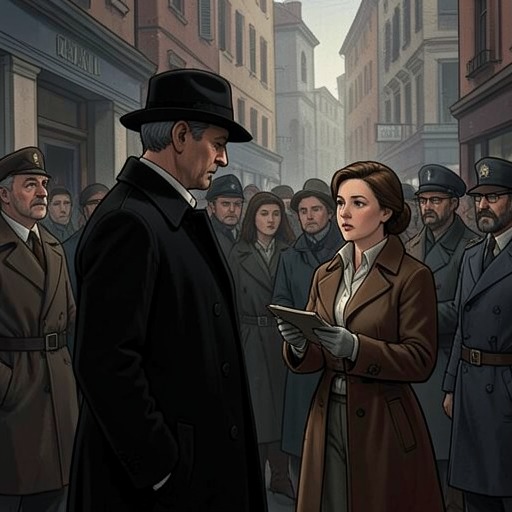
Finessing the King
Partners in CrimeFinessing the King, also known as the Three Arts Ball murder case, begins with a cryptic advertisement that leads Tuppence Beresford to a costume ball and ends with the exposure of Sir Arthur Merivale as his wife’s murderer. The case turns on the gap between costume and identity: a newspaper-dressed figure appears to implicate Captain Bingo Hale, but the torn scrap that seems to prove his guilt is part of Sir Arthur’s attempt to frame his friend.
The advertisement and the Beresfords’ methods
Tommy Beresford has already begun treating detective fiction as practical instruction. He gathers books by leading detective writers, proposes trying their different styles and comparing the results, and buys a camera to photograph and enlarge footprints. His declared study of technique is both earnest and comic: Tuppence points out that he lacks the medical and legal experience associated with one of the models he hopes to emulate, while Tommy urges her to use her “little grey cells.” The case will put that language of literary imitation to work, though the decisive clue comes not from a borrowed technique but from Tuppence’s close attention to physical evidence.
The immediate prompt is a short notice in the Daily Leader, phrased as a bridge-hand: “I should go three hearts. 12 tricks. Ace of Spades. Necessary to finesse the King.” Tuppence says she is intrigued by the advertisement and persuades Tommy to take its implications seriously. Their investigation is framed from the outset as a game of interpretation: the words appear to be a coded invitation, and “Necessary to finesse the King” will later connect the notice to a planned meeting at the Ace of Spades.
Their preparation at home adds another layer of detective-story play. Tuppence lays out a complete fireman’s kit, prompting Tommy to wonder whether he has joined a fire brigade; she tells him to use his “little grey cells” and invokes Watson before explaining her own costume plan. For the ball she intends to wear Tommy’s old clothes, an American hat, and horn spectacles. The scene establishes the couple’s habit of using disguises and borrowed detective roles, but the disguise that matters to the murder is the one worn by the killer.
The discovery at the Ace of Spades
At the Ace of Spades, Tuppence senses that something is wrong and enters the neighbouring booth, with Tommy following. A woman dressed as the Queen of Hearts sits motionless in the corner. The costume’s red-and-white pattern is disturbed by a patch of extra red; a jewelled dagger lies just below the heart. Tuppence recognizes that the woman is still alive and sends Tommy to get the manager and a doctor. The injured woman’s faint final words identify the name Bingo, a clue that initially points toward Captain Hale.
Inspector Marriot later identifies the victim as Lady Merivale and contacts her husband. Sir Arthur recognizes his wife and describes Captain Hale, known to their friends as Bingo, as his closest friend and a frequent guest in his home. He insists that Hale could not have harmed her and suggests that the name his wife uttered may have been misunderstood. Tuppence answers that there was no mistake: Lady Merivale said that Bingo did it. The apparent certainty of the dying accusation and Sir Arthur’s defence of Hale set the case’s central question: whether the accusation identifies the killer or has been made to point toward one.
Marriot’s first explanation treats the advertisement as Captain Hale’s signal to Lady Merivale. In his reconstruction, the pair had arranged to meet at the Ace of Spades, but the Beresfords’ decision to attend came too late for the woman to be warned; the phrase about finessing the King therefore served as a last-minute message. Marriot says Hale wore a home-made costume as the Gentleman Dressed in Newspaper, and that a piece of newspaper was found clasped in the dead woman’s hand. He expects the missing part of Hale’s costume to match it, which would make the evidence appear conclusive. Sir Arthur rejects that expectation, insisting that Marriot will not find the tear on Hale’s clothes.
The newspaper clue and the reversal
Photographs give Tuppence a way to test the apparent match. One shows a small fragment bearing the partial legend DAILY LE; the other shows the front sheet of the Daily Leader, with a small round tear near its top. The pieces fit together exactly. Tuppence notices stitches along the side of the paper, showing that the newspaper sheet had been sewn to other sheets as part of a costume. What first looks like an incriminating scrap torn from Hale’s outfit is therefore evidence to examine in relation to the paper’s construction, not merely a proof of its wearer’s guilt.
Tuppence compares the fragment with the relevant newspaper and observes that it was not torn from Tuesday’s paper. Although Tommy cautions that different editions might account for the difference, she recognizes that the discrepancy is not coincidental and asks him to summon Sir Arthur and Inspector Marriot. Her reasoning turns a detail that could have been dismissed as variation into the prompt for a new reconstruction. The advertisement, the newspaper dress, and the scrap now have to be read together rather than as separate pieces of a case against Hale.
When Sir Arthur arrives, Tuppence sets out her theory. The newspaper costume could be worn over an executioner’s outfit, allowing its wearer to approach Lady Merivale in disguise. Before the meeting, a note could be passed to Hale telling him not to speak to her, supposedly because her husband suspected something; the woman herself would know nothing of the note. She would still go to the Ace of Spades at the appointed time and mistake the disguised figure for the person she expected. In Tuppence’s account, the apparent meeting and the accusation against Hale were staged to make the true killer look like his friend.
The scrap in Lady Merivale’s hand is the key to the framing. Tuppence argues that Sir Arthur could create an exact duplicate of the tear in Hale’s newspaper costume, then destroy his own costume and behave as the loyal friend defending an innocent man. The plan depends on the two men living in the same house: Sir Arthur could inspect Hale’s outfit closely enough to reproduce the damage, while the matching fragment would direct suspicion toward Hale. Marriot’s expected comparison would then seem to confirm a case that Sir Arthur had manufactured. The evidence does not merely clear Hale by removing a match; it reveals how the match itself could have been forged.
Exposure, motive, and ending
Sir Arthur does not remain to face arrest. With a slight smile, he says that he prefers to take his own way out, then climbs over the window sill and jumps. His sudden departure ends the confrontation and prevents the authorities from bringing him to trial. Tuppence reacts with distress, while Marriot recognizes that they should have considered the window and goes downstairs to attend to what has happened. The ending is abrupt: the murderer’s exposure is followed not by a courtroom resolution but by his self-inflicted death.
Tommy wonders whether Sir Arthur had been fond of his wife. Marriot redirects the question to the financial pressure behind the crime: Lady Merivale had a large fortune of her own, and it would all have gone to Sir Arthur. If she had left him for the younger Hale, Sir Arthur would have lost access to that money. Marriot’s explanation gives the murder a motive distinct from the staging that concealed it: the false trail protects Sir Arthur from suspicion, while the fortune explains what he stood to lose.
The case also tests the Beresfords’ playful borrowing from detective fiction against the practical demands of an investigation. Tommy’s shelves of classic mysteries, camera, and repeated appeals to the little grey cells make detection look like a set of styles that can be tried on; the false newspaper costume literalizes that idea by giving the murderer a disguise and a role. Yet the resolution depends on Tuppence’s attention to the specific paper fragment, its lettering, its tear, and its stitches. The apparent theatrical clue becomes reliable only when she questions how it was made and whose interests its supposed certainty serves.