International Detective Agency
Partners in CrimeThe International Detective Agency is a failing private-investigation firm revived as the professional front for Tommy Beresford and Tuppence Beresford. Operating under the borrowed name of Theodore Blunt and advertised as Blunt’s Brilliant Detectives, it turns a modest office into both a working base and a stage for performances of authority—an identity that can win clients, conceal an operation, or itself become the object of a criminal ruse.
Acquisition and Cover
The agency enters the story through a newspaper advertisement. Mr. Carter points out its listing in the Daily Leader: Theodore Blunt is named as manager, the service offers private inquiries and confidential agents, and consultations are free. Carter explains that the agency has been on its last legs and that a friend acquired it cheaply. The proposed revival is a six-month trial, with Tommy and Tuppence placed in charge.
The arrangement also provides Tommy with a period of leave from his regular office, officially attributed to ill health. Carter makes clear that Tommy may run the detective agency under Theodore Blunt’s name without this being treated as office business. The borrowed identity is thus part of the arrangement, not an incidental flourish: the couple can present themselves to the public as private investigators while their connection to Carter’s work remains discreet.
Offices and Working Performance
A few days later, the Beresfords take possession of the agency’s offices on the second floor of a dilapidated Bloomsbury building. The layout separates public reception from the supposed chief’s domain. Albert, formerly playing a Long Island butler, becomes the office boy, his paper bag of sweets, inky hands, and tousled head supplying an artfully ordinary appearance.
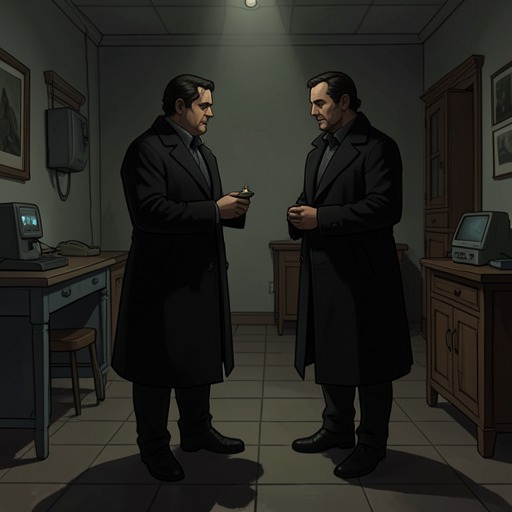
Two doors lead from the outer office, marked “Clerks” and “Private.” Behind the latter is a comfortable room with a large businesslike desk, empty but impressively labelled files, leather-seated chairs, and a telephone. Tommy sits there as the pseudo Mr. Blunt, trying to look like a lifelong agency manager; he and Tuppence rehearse telephone effects, and Albert receives his own instructions. The adjoining room belongs to Tuppence, with a typewriter and plainer furniture, while a gas ring provides tea. The arrangement is carefully suggestive of a functioning business, although the files are empty and the office initially lacks the one thing it needs most: clients.
The agency’s title acquires a more exuberant public form in the toast to the “success of the International Detective Agency” and the hope that “Blunt’s Brilliant Detectives” will never know failure. That slogan gives the enterprise a jaunty, self-fashioned identity, but the gap between its confident presentation and its uncertain beginnings remains visible in the staged furnishings and the search for work.
The Agency as Information Channel
The Daily Leader is more than the place where prospective clients can find the agency. In the investigation involving a suspicious Russian letter, Tommy and Tuppence compare a message supposedly sent by Gregor Feodorsky, who claims to want news of his wife and says he cannot leave Russia because of a crisis in the pork trade. Tommy treats the letter as a possible coded communication and proposes checking whether the number 16 lies beneath its stamp. The agency’s ordinary business of tracing people is thereby entangled with a hidden channel of communication and the couple’s connection to Carter.
Another newspaper clue depends not on the printed words but on tiny changes in their appearance. Tommy observes that a white dot moves among the letters of “DAILY” and “LEADER” from one issue of the Daily Leader to the next. The shifting marks suggest a recurring signal concealed in the newspaper’s typography. Across these cases, the agency operates in a world where a newspaper advertisement can establish a public identity, a letter can disguise a message, and the smallest mark in a daily paper can carry information beyond its apparent contents.
The same reliance on apparently routine communications produces a warning about trust. Gabriel Stavansson reports receiving a telegram said to be from Hermy, announcing that she has changed her plans and gone to Monte Carlo for a week. Its reassuring message does not settle the question of her whereabouts: Stavansson remains concerned, and the telegram’s claimed provenance becomes part of the mystery. For an agency charged with tracing people, such documents are not answers in themselves; their wording and circumstances must be tested against what is known.
Disguise, Deception, and Risk
The agency’s most important resource is not its furniture but the credibility its performance can create. In a later case, Tommy explains that a woman used a paper hidden in the lining of a boot belonging to Randolph Wilmott. The paper seemed to contain Bible verses until water revealed a concealed tracing resembling a harbor mouth, possibly a plan of harbor defences. The hidden document had been carried away from its first hiding place and later recovered by accident when a passenger used it to make a toy boat. A material transformation, rather than an official report, exposed the message.
Tommy’s account of the associated smuggling scheme shows how the agency’s apparent professionalism is used to manipulate an investigation. He reasons that the important luggage was not necessarily the Ambassador’s bag: someone may instead have wanted another bag placed in the Ambassador’s possession, since diplomatic luggage avoids a Customs examination. That reversal points him toward smuggling drugs. He also recognizes that a staged attack and an elaborate story were meant either to divert him or remove him from the way. Tommy plays the credulous detective, delays his arrival under pretexts, and leaves instructions for assistance; the agency’s role is therefore an active piece of investigative theatre, not merely a place where clues are discussed.
But a convincing performance can be turned against the investigators. In another confrontation, a man who had appeared as Inspector Dymchurch suddenly reveals himself as a well-educated foreigner with flawless English and no trace of an accent. Tommy, bound and gagged, cannot act on the change in identity. The episode reverses the agency’s own use of impersonation: a persona that seemed to guarantee official authority proves to have been a disguise, and the supposed investigator becomes the prisoner.
That danger reaches the agency’s domestic front in the later abduction of Tuppence. Tommy discovers a bundle under a sofa containing the long black coat she had worn, her walking dress, hat, and a long fair beard. He concludes that the Russian criminal escaped with her after accomplices used the appearance of a hospital nurse and a boy to establish themselves at the hotel; Tuppence had been drugged with a fragment of a hypodermic needle. The discarded clothes disclose the switch only after the disguise has succeeded. The agency’s world of assumed names and staged appearances can expose fraud, but it also leaves its members vulnerable when an opponent controls the costume, the timing, and the scene.
Significance
The International Detective Agency is at once a business, a cover, and a recurring theatrical device. Its advertised promise of discretion and confidential inquiry gives the Beresfords a plausible public role; its divided offices, telephone routines, office boy, and borrowed manager’s name make that role tangible. Yet each element can be read in two ways: the empty files reveal the makeshift nature of the enterprise, while the carefully arranged rooms help sell its legitimacy; the agency investigates false identities, even as its own work depends on one.
Its recurring cases also place it at the intersection of publicity and secrecy. The Daily Leader brings the agency into view and carries shifting marks; a letter and a telegram claim to explain absences while raising doubts about who sent them; a wet sheet brings a concealed harbour tracing to light. The firm’s significance lies in that tension between what communications and appearances claim to show and what close attention eventually reveals. It supplies Tommy and Tuppence with a recognizable professional identity, but its greatest value is as a flexible instrument for testing identities, reading clues, and staging investigations—one whose risks become undeniable when deception reaches the people running it.