International Detective Agency offices
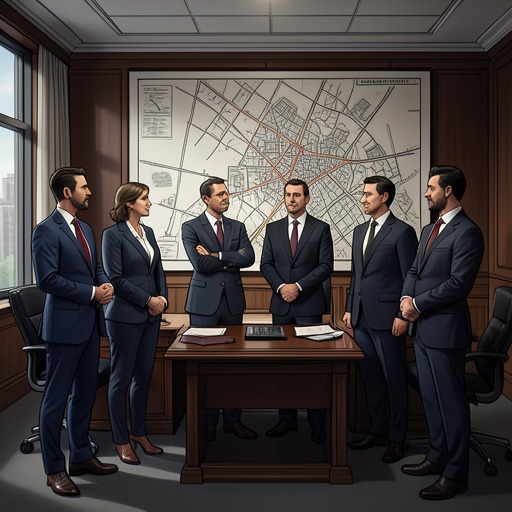
Partners in CrimeThe International Detective Agency offices are the Beresfords’ Bloomsbury headquarters, a modest, carefully staged workplace whose emptiness is as important as its furnishings. Established at 118 Haleham Street under the name of Theodore Blunt, the agency gives Tommy and Tuppence a public identity and a base for their cases; within its rooms, they rehearse detective roles, handle clues, and confront the danger of being mistaken for the genuine proprietors of a business that criminals have begun to watch.
Premises and Arrangement
The agency had been failing for some time when a friend of Mr. Carter acquired it cheaply. Carter proposed reopening it on a six-month trial and needed a manager. The printed description promised private inquiries, a large staff of discreet and highly skilled agents, and free consultations, but the reality initially fell far short of the advertisement: the rooms had no clients, and the supposed staff amounted to the people helping the Beresfords sustain the fiction.
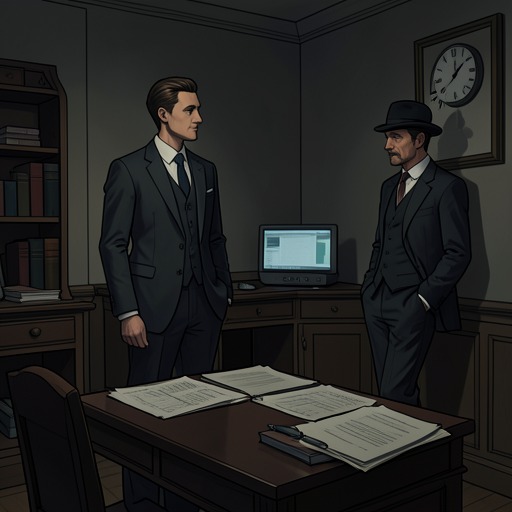
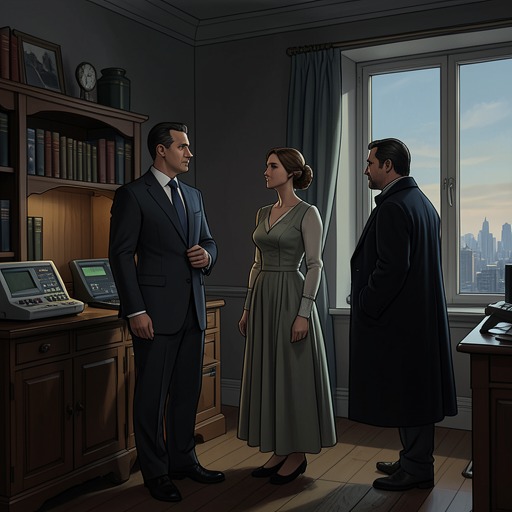
A few days after taking possession, Tommy and Tuppence moved into offices on the second floor of a somewhat dilapidated Bloomsbury building. The outer office was small. Two doors led from it into the inner rooms, one marked “Clerks” and the other “Private.” Behind the private door, an immense businesslike desk, artistically labelled but empty files, and solid leather-seated chairs supplied the atmosphere of an established detective chief’s office. A telephone stood beside Tommy, who played the pseudo Mr. Blunt; he and Tuppence had rehearsed telephone effects, and Albert had also been given instructions.
Tuppence worked in the adjoining room, with a typewriter and ordinary tables and chairs, as well as a gas ring for making tea. The contrast between Tommy’s imposing furniture and Tuppence’s plainer workroom makes the office a small stage set: its authority rests on appearance, rehearsal, and the division of labour, not on an established organization. Albert’s transformation from a Long Island butler into an office boy completes the performance. His paper bag of sweets, inky hands, and tousled head are his own idea of the part, turning the outer office into a convincing everyday front.
A Headquarters for Learning and Performance
The office is also where Tommy tries to turn amateur enthusiasm into technique. He fills a cupboard with detective stories by celebrated writers and explains that he intends to work through different styles and compare their results. Tuppence questions whether he can reproduce the methods of a detective who depends on medical, legal, or scientific expertise. Tommy answers with practical ambition: he has bought a camera and plans to photograph footprints and enlarge the negatives. The books and camera make the office part classroom, part laboratory, though the couple’s talk also exposes the distance between literary models and their own uncertain practice.
That gap becomes a running source of comedy and a working instrument of investigation. When Tommy and Tuppence suspect that enemies have recognized the false Mr. Blunt, he chooses the roles of the Okewood brothers, taking the part of Desmond. Tuppence prefers Francis, whom she regards as the more intelligent brother and the one who appears in time to save Desmond from trouble. In another exchange, she urges Tommy to use his “little grey cells” and invokes Watson and the bull in the arena. These borrowed detective identities give the couple a shared vocabulary for interpreting danger, but their role-playing does not guarantee that their deductions are right or that they control the situation.
The office’s objects repeatedly invite that play between fiction and practical risk. A Russian-stamped blue letter arrives in the post, recalling Mr. Carter’s instructions to watch for such correspondence. Tuppence treats it as the long-awaited arrival of a real case, while the routine task of obtaining milk for tea continues alongside the excitement. The letter is not merely a clue: it is also a reason for an enemy to search the premises. The agency’s ordinary filing system and business address become liabilities because an adversary may assume that a letter received in the course of business has been filed there.
Exposure and the Threat of Intrusion
A warning at the office turns the premises from a convenient base into a potential trap. The Beresfords are advised to be there at eleven that night rather than follow a plan designed to draw them away to Hampstead. The anticipated intruder wants time to search the building after it has emptied. He may suspect that Tommy is not the original Mr. Blunt, but could still believe that he is a legitimate purchaser of the business; on that assumption, the blue letter would naturally have been kept among the agency’s regular papers. The office’s disguise works in both directions: it helps the Beresfords act under a professional identity, while giving their opponents a plausible idea of where to find the evidence.
The threat is reinforced by the possibility that trusted appearances conceal hostile identities. In a later confrontation, a man who had appeared to Tommy as the thoroughly English Inspector Dymchurch changes into a well-educated foreigner speaking English without an accent. Tommy is bound and gagged as the impostor addresses an accomplice. The scene demonstrates how little the agency’s professional setting can guarantee: titles, manner, and apparent authority may all be performances, and the people who enter the orbit of the investigation may be part of the danger.
The office’s doors and adjoining spaces likewise cannot be treated as secure simply because they are familiar. At one house investigated by the Beresfords, a door handle first rattles without opening; Elise suspects that someone has locked it from the other side, but it then turns easily and the bedroom is empty. The episode occurs away from the headquarters, yet echoes the uncertainty that defines the agency’s own rooms: a door may suggest obstruction, access, or concealment without immediately explaining which. Across the cases, rooms are practical instruments for arranging searches, disguises, and surprise, rather than neutral backdrops.
A Recurrent Stage in the Cases
The agency’s headquarters gathers the Beresfords’ habits of theatrical interpretation into one place. Fireman’s equipment laid out for a disguise prompts Tuppence to challenge Tommy to guess its purpose, again turning a clue into a role-playing exercise. In discussing a possible transformation at Sunningdale, the couple examine how a person could wait in a turf shelter behind the sixth tee, wear a skirt over plus fours, and change back into men’s clothing in about a minute and a half. Although this reasoning concerns a golf course rather than Haleham Street, it reflects the office’s investigative method: reconstruct a space, identify what a watcher could see, and test how costume might exploit the limits of distance and attention.
The same habit of reading rooms for hidden access appears in the Beresfords’ inquiry at the Red House. After meeting Monica Deane, Tommy observes that she is out of breath and infers that she has run down the back stairs after breaking a jug and basin. He suspects that Crockett has secretly admitted her nephew, allowing him to stage poltergeist activity while she appeared innocently with the family. A later offer to buy the house is raised by £150. Here, as at the agency, the telling evidence is not an official explanation but the relation between a person’s movement, a damaged object, and the arrangement of rooms.
By the time a new case brings the Beresfords back to their desk, their detective-fiction play has become an immediate response to danger. Tommy invokes the criminal they had believed he crushed in the Dolomites, declares that he has returned as No. 16, and assigns himself the role of Hercule Poirot; Tuppence accepts the part, while correcting its details. The office thus remains both a workroom and a theatre, the place where they turn fear into a familiar script. But the final crisis exposes the limits of that confidence. A bundle hidden under a sofa contains Tuppence’s black coat, walking dress, hat, and a long fair beard. Tommy realizes that she has been abducted; the apparent nurse and boy were accomplices, and Carter identifies a fragment of hypodermic needle on the carpet as evidence that Tuppence was drugged. The headquarters can support their disguises and deductions, but it cannot make them invulnerable: its ordinary furniture and concealed corners become part of an enemy’s escape plan, and the professional front cannot prevent the loss of the person who helped animate it.