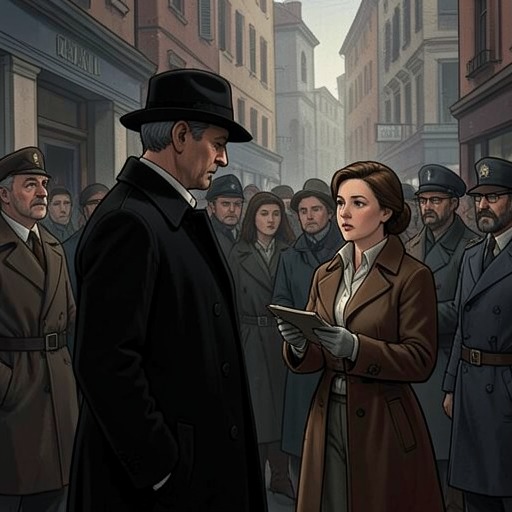
James Reilly
Partners in CrimeJames Reilly is a pacifist poet whose declarations of devotion to Gilda Glen turn abruptly into threats when he fears she may choose another man. His arrest after a crime brings that distinction between violent speech and violent action into sharp relief: his solicitor insists that Reilly had always spoken fiercely, but that this was all.
Introduction and self-presentation
Reilly first appears in shabby clothes, with flaming red hair and a pugnacious jaw. He strides about muttering, then sits near Tommy Beresford and Tuppence Beresford and announces his despair in forceful terms. His agitated entrance makes him conspicuous before he has explained either his identity or his grievance.
He introduces himself as James Reilly and says he has written a volume of pacifist poems, which he considers good work. The self-description sets up a striking contrast: he identifies himself as a man committed to peace, yet his speech is combative and his emotions quickly take a threatening form.
Attachment to Gilda Glen
Reilly says his anger is directed at one particular person: Gilda Glen. He describes having worshipped her and insists that she once cared for him. In his account, that past affection means there is still a possibility of winning her back; he speaks as though her feelings ought to remain recoverable through his persistence.
The immediate source of his distress is his suspicion that Gilda may sell herself to Leconbury. Reilly responds not with a measured account of their relationship but with a threat to kill her himself. He then rises and rushes out, leaving Tommy to register his alarm. The scene connects his professed pacifism to a possessive and dangerous outburst without establishing that the threat itself proves what he later did.
Arrest and the force of his words
The day after the crime, while Tommy and Tuppence are still at the Grand Hotel, Reilly has been apprehended and is in custody. Tommy has discarded his clerical disguise, and Reilly's solicitor, Mr. Marvell, has just spoken with him at length about the crime. The arrest marks the consequence of the investigation, though the available account does not set out the evidence or the specific act for which Reilly was taken into custody.
Mr. Marvell says he would never have believed Reilly capable of it, describing him as a man of violent speech but insisting that speech was all. His reaction reframes the earlier threat: Reilly's anger had sounded like a declaration of intent, while the solicitor remembers a longstanding pattern of words that did not, in his view, translate into action. That gap between threatening language and presumed character makes Reilly a figure of suspicion, but the evidence here does not disclose the crime's full resolution.
Narrative role
Reilly's brief encounter with Tommy and Tuppence establishes a plausible emotional motive and a conspicuous threat before his arrest. The contrast between pacifist poetry and violent rhetoric, and between his solicitor's confidence in his harmlessness and the fact that he is in custody, keeps judgment unsettled. His role in the account rests on that tension: his words make him look dangerous, while the retrospective defense of his character cautions against treating the words alone as proof.