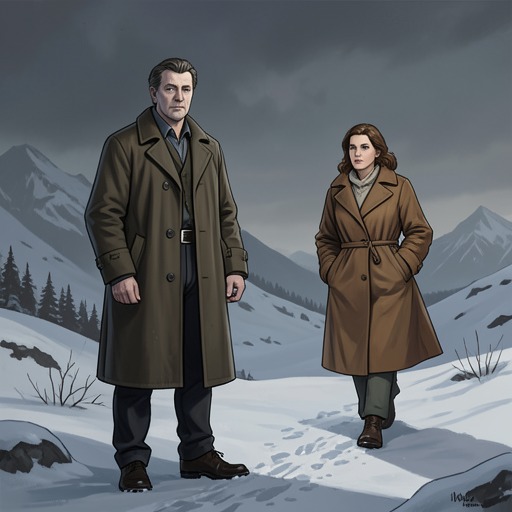
Maldon, Sussex
Partners in CrimeMaldon, Sussex, is the tiny hamlet that turns a mistaken place-name into a practical lead in Tommy Beresford and Tuppence Beresford’s search. Its distance from the railway and its handful of cottages, shops, and public houses make it a setting where small details matter: the telegraph office distinguishes it from its Surrey namesake, and the local inquiry points toward Dr. Horriston’s Nursing Home.
Identity and Setting
The hamlet first enters the investigation through a post-office inquiry. Tommy and Tuppence learn that there are two places called Maldon: one in Surrey, and a second in Sussex. The Sussex settlement is described as a tiny hamlet, but it has a telegraph office—the detail that helps identify it as the destination relevant to their search.
The following day, the pair find a place markedly unlike its Surrey counterpart. Maldon, Sussex, lies four miles from a railway station and has two public houses, two small shops, a combined post and telegraph office that also sells sweets and picture postcards, and about seven small cottages. This inventory gives the hamlet its narrative character: it is neither an anonymous wilderness nor a substantial town, but a close-set community with few commercial and informational points of contact.
The Inquiry in the Village
Tommy and Tuppence divide their search between the hamlet’s modest public spaces. Tuppence takes on the shops, while Tommy goes to the Cock and Sparrow. When they meet again half an hour later, Tommy can report only that the beer is quite good and that he has learned nothing. His pub visit produces atmosphere rather than information; the more fruitful lead comes from Tuppence’s conversation in a shop.
Tuppence uses a plausible personal pretext to ask about a supposed sister whose address she has lost. She gives the name Leigh Wood and says the woman is staying nearby. The shop girl does not remember such a name, explaining that few letters come through the village and that she probably would have noticed it had it appeared on a letter. She adds that, apart from the Grange, there are not many large houses in the area. The exchange establishes both the limits of local knowledge and the hamlet’s small number of places that might matter to the inquiry.
From Local Clue to Nursing Home
The distinction between the two Maldons supplies the first turning point. Tuppence reasons that Stavansson knew Maldon in Surrey and therefore may have barely examined the word beginning with S after Maldon. Rather than treating the name as settled, the pair test the ambiguity by going to the Sussex village the next day. The place-name error thus becomes a method: attention to a small written detail sends them away from the obvious destination and into a more specific search.
In the village, Tuppence hears that Dr. Horriston’s car is approaching and hurries to the shop door. She sees a tall, dark man with a neat black beard and a powerful, unpleasant face driving a small two-seater. Once Tommy has crossed the road to meet her, she connects the local information with the purpose of their visit and identifies Dr. Horriston’s Nursing Home as the lead they may have found. The hamlet’s sparse landmarks, especially the Grange and the local shop, have turned a broad geographical question into a concrete possibility.
Narrative Significance
Maldon, Sussex, works as a place of verification rather than a mere backdrop. Its difference from Maldon, Surrey, matters because the inquiry depends on distinguishing two names that could easily be confused; its four-mile separation from a railway station and its few local businesses then give the search a tightly bounded geography. The post office, pub, and shops are not interchangeable scenery: each offers a different chance of learning something, and the failed pub visit contrasts with Tuppence’s more purposeful conversation at the shop.
The village also makes the investigation’s progress feel incremental. The shop girl cannot confirm the name Tuppence offers, but her account of the rare letters and the scarcity of large houses narrows the local picture. A passing car then provides a visual clue that Tuppence links to the nursing home. Maldon, Sussex, is decisive not because it yields a complete answer, but because its small scale lets a mistaken address, a shopkeeper’s limited knowledge, and a single vehicle converge into a promising lead.