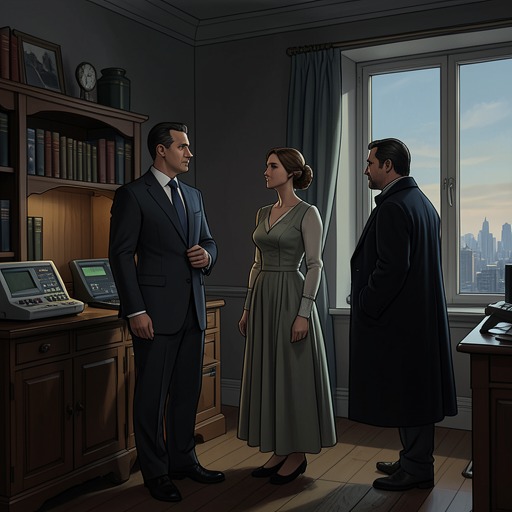
Mr. Carter
Partners in CrimeMr. Carter is the senior intelligence official known to Tommy and Tuppence as “the Chief,” and the government’s link to their undercover work at the International Detective Agency. He turns a failing private detective business into a distributing centre for a counterespionage operation, instructs the couple in its codes, and directs the precautions that ultimately help bring the elusive No. 16 into custody. His role joins administrative authority to practical care: he entrusts the Beresfords with danger, but repeatedly arranges protection and mobilizes the Department when that danger becomes immediate.
Identity and Introduction
Mr. Carter first appears at the Beresfords’ office as a tall, grey-haired man with piercing eyes and a tired smile. Tommy is surprised by the arrival, while Tuppence greets him warmly; the familiar title “the Chief” establishes that Carter is already an important figure in their professional world. His manner is both personal and official. He asks after their lives, then tests whether Tuppence is willing to accept risks before disclosing that the Department has work suited to them.
Carter’s authority rests on access to government intelligence and the ability to convert that intelligence into assignments. He does not initially lay out the full operation in one announcement. Instead, he points to the Daily Leader on their table and uses the newspaper’s advertisement for the International Detective Agency to introduce a ready-made cover. The episode presents him as a recruiter who reads his prospective agents’ circumstances and interests before offering them a task.
The Agency and the Assignment
Carter explains that the International Detective Agency has been failing and that a friend has acquired it cheaply. The proposal is to put it back into operation for a six-month trial, with Tommy serving as manager. The agency’s former manager, Theodore Blunt, has been detained by Scotland Yard after becoming indiscreet in foreign business, and Carter indicates that Blunt has withheld information the authorities want. The apparently ordinary business of private inquiries therefore begins under the shadow of an unfinished intelligence investigation.
Carter gives Tommy a precise procedure for handling suspicious correspondence. The letters are to be blue, bear a Russian stamp, and ostensibly come from a ham merchant searching for a wife who arrived in the country as a refugee years earlier. When the stamp is moistened, the number 16 appears beneath it. Tommy must copy the letters, send the originals to Carter, and report immediately if anyone visiting the office refers to that number. The instructions turn an otherwise innocuous stamp into a signal and make the agency a monitored point of contact.
The work depends on maintaining the business cover while observing its coded traffic. Carter’s instructions are concrete rather than merely strategic: preserve the originals for him, make copies, and treat a spoken reference to sixteen as an urgent warning. In this way, the Beresfords’ new managerial role gives them access to the very communications that Carter wants tracked, while their office becomes part of the Department’s intelligence network.
Counterintelligence and the No. 16 Protocol
After the Beresfords’ earlier success, Carter commends them in private, reporting that they have helped the Department lay hands on five people and obtain valuable information. But the operation has begun to attract attention. A reliable source tells him that Moscow headquarters is alarmed by the agents’ failure to report, and he suspects that the enemy may recognize the International Detective Agency as a compromised distribution centre. His praise is therefore accompanied by a warning: success has made their cover more vulnerable.
Carter describes the expected adversary as a Russian-born specialist who caused trouble during the war, speaks enough languages to pass as several nationalities, and is exceptionally skilled at disguise. The agent devised the No. 16 code, possesses considerable intelligence, and may approach the agency under the pretext of offering a case. Carter adds a significant limitation to the threat’s knowledge: the agent was never personally acquainted with the real Theodore Blunt. The impostor may exploit the agency’s name and routines, but cannot rely on firsthand recognition of its former manager.
Carter supplies a second challenge-and-response test. A reference to the number sixteen is to receive an answer containing the same number; the newly learned second password is an inquiry about whether the Beresfords have crossed the Channel, answered with the sentence, “I was in Berlin on the 13th of last month.” He advises them to answer correctly and sustain the fiction in order to gain the agent’s confidence, while emphasizing that apparent success must not be mistaken for safety. The instructions establish a double game: the Beresfords are to deceive the visitor, but must assume that he is equally capable of deceiving them.
Carter responds to that danger with surveillance and a layered security plan. A dictaphone has already been installed in the office, allowing one of his men in the room below to hear what passes there and alert him. He also promises special precautions to safeguard both Tommy and Tuppence while securing the man he is pursuing. The listening device makes the agency’s rooms not just a cover and a point of contact, but an extension of Carter’s command and observation.
Protection, Crisis, and Capture
When Tommy reaches the Palm Court of the Blitz, Carter is waiting with a reassuring report. The suspected man and a young woman are at lunch in the restaurant, where two agents have been placed as waiters. Two more men are watching the suspect’s suite, while others are positioned outside to follow anyone who leaves. Carter does not claim certainty about whether the quarry suspects the surveillance; he says he is fairly sure he does not. His plan is to maintain observation without forcing a premature confrontation, and he specifically assures Tommy that Tuppence will be kept in sight.
That confidence is tested when the apparent hospital nurse and invalid boy have already left the hotel in a taxi. Carter’s response is immediate: he tells Tommy that he will leave no stone unturned, return to his office, and have every Department resource working within minutes. Tommy recognizes the Russian’s escape as a cunning coup and fears that the abducted girl may be in grave danger. Carter cannot promise an instant recovery, but he does promise a full mobilization; the scene measures his official competence against a crisis that has briefly escaped even a carefully watched net.
The pursuit ends with Carter’s capture of No. 16. When Tommy later reports the result, he says that Carter has got the agent, and credits the little grey cells before adding that he is raising Albert’s wages. The outcome confirms that Carter’s surveillance operation and departmental resources have secured the central adversary, even though Tommy’s account to Tuppence is a spirited narrative with some omissions. Carter’s success is not presented as a solitary feat: it completes a chain involving the Beresfords’ undercover position, intelligence gathered at the agency, and the Department’s coordinated watch.
Relationships and Narrative Role
Carter’s relationship with the Beresfords combines command, trust, and familiarity. He gives Tommy operational instructions and addresses Tuppence as an agent whose appetite for risk is already apparent. He is also frank about their limitations: after the pair’s successes, he teases them for excessive self-confidence and declines to decide how much of their immunity comes from cleverness and how much from luck. The remark tempers their triumph without diminishing his willingness to rely on them again.
His working style is defined by preparation followed by rapid response. Before the No. 16 encounter, Carter anticipates the likely approach, teaches the passwords, installs a listening device, and arranges watchers at the hotel. After the nurse-and-patient disguise succeeds in carrying the pair away, he switches from surveillance to a Department-wide search. The contrast makes his caution practical rather than absolute: he cannot prevent every deception, but he can build safeguards and expand the response when those safeguards fail.
As a recurring authority figure, Carter gives the Beresfords’ detective work an institutional scale. The International Detective Agency may look like a small private enterprise, but his instructions reveal its connection to foreign intelligence, coded communications, and a broader contest with Moscow. At the same time, the narrative preserves a personal dimension in his concern for Tuppence and his direct reassurance to Tommy. Carter is thus both the source of the dangerous assignment and the official who accepts responsibility for the people carrying it out.