No. 16
Partners in CrimeNo. 16 is a Russian-born intelligence operative whose fluency, disguises, and command of other people’s expectations make him a recurring danger to Tommy and Tuppence. He is the architect of the No. 16 code and can present himself as a foreign prince or an American woman; his final defeat comes when Tommy stops following the trail of appearances and tests whether the supposed events could physically have happened.
Identity and Background
Mr. Carter describes No. 16 as a Russian-born agent dispatched from Moscow to Britain, though the name under which he travels is unknown. He had caused considerable trouble during the war, appearing in places where the British least wanted him. His command of languages lets him pass as half a dozen nationalities, including English, and he is also an accomplished master of disguise. Carter singles out his brains as well as his skill: No. 16 devised the code that bears his number.
That history makes him more than a disguised visitor in an isolated case. Carter expects him to seek out the International Detective Agency, present a case as a pretext, and test the Beresfords with passwords. One is an exchange involving the number sixteen; the other asks whether they have crossed the Channel. The prescribed reply, “I was in Berlin on the 13th of last month,” is itself part of a system designed to verify identity while concealing it from outsiders.
The Prince at the Office
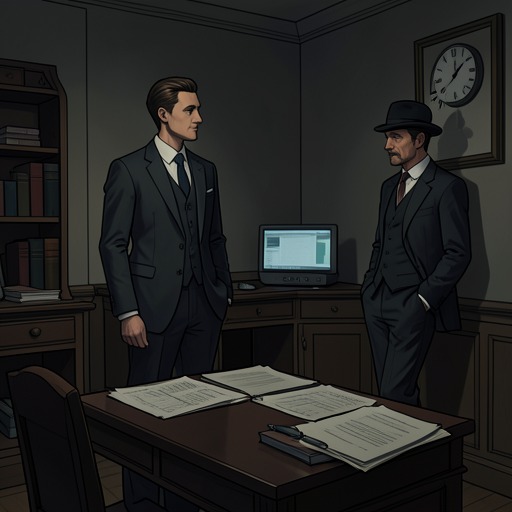
No. 16 arrives at the agency under the name Prince Vladiroffsky. He is described as a graceful, fair-bearded man of about thirty-five, and his English is perfect. Tommy answers the visitor’s question about crossing the Channel with the Berlin password. The stranger immediately recognizes that the exchange has exposed the truth: there is no need to maintain the pretext about his friend’s daughter, and Tommy has been warned of his arrival.
The encounter turns the agency’s ordinary theatricality into a dangerous contest. Tommy and Tuppence have built their detective business around performed roles, rehearsed telephone effects, and the distinction between the supposed Mr. Blunt and the real people behind that identity. No. 16 meets that performance with a more consequential one: he reads the password correctly, recognizes the trap, and treats the Beresfords’ cover as something that can be penetrated rather than trusted.
Escape and the Disguise of Mrs. Van Snyder
No. 16 later escapes the immediate danger of capture by exploiting the Beresfords’ attention to the wrong people. Tommy finds a compact bundle beneath the sofa: Tuppence’s long black coat, her walking dress and hat, and a long fair beard. The garments reveal that the apparent trail of the bearded man and the girl has been manufactured from clothing and changes of identity. No. 16 has taken Tuppence, drugged her, dressed her in boy’s clothes, and altered his own appearance to leave openly. A fragment of a hypodermic needle confirms that Tuppence was rendered unconscious rather than persuaded to accompany him.
The abduction depends on preparation and misdirection, not merely a quick change. According to Tommy’s reconstruction, the hospital nurse and the boy who had been around the hotel were accomplices who helped make their presence seem ordinary. No. 16 silenced Tuppence and a woman in the adjoining room, used the opportunity created by that room’s availability, and had clothing ready to conceal the transformation. Mr. Carter supplies the detail that Tuppence was drugged; Tommy recognizes the larger plan but initially cannot explain how she had been made to cooperate.
No. 16’s final disguise is Mrs. Van Snyder. When Tommy reaches her room, the woman claims the role of a victim bound by accomplices next door, while Tuppence is hidden beneath the bolster, laid horizontally across the bed and drugged. The bed’s concealment is a deliberate reversal of the search: Tommy recalls that they looked under it, but not in it. A wardrobe trunk stands ready to remove a supposed body, adding another piece to the staged scene. The apparent victim, hidden captive, and prepared trunk make the room look like the aftermath of a crime while concealing the crime still in progress.
Exposure and Capture
Tommy sees through the story not by accepting its sequence but by calculating its timing. The alleged events—drugging one woman, dressing Tuppence in boy’s clothes, gagging and binding the other woman, and changing the culprit’s appearance—could not all have been completed in five minutes. The supposed nurse and boy were decoys meant to draw the investigators away, leaving Mrs. Van Snyder to appear as a pitiable victim. The contradiction between the performance and the time available gives Tommy the grounds to search the bed itself.
Tuppence is found alive but unconscious. Tommy then seizes Mrs. Van Snyder by her elaborately arranged hair and pulls it away: the woman’s hair is a wig, and the disguise is No. 16. About half an hour later, Tuppence opens her eyes with a doctor and Tommy beside her. No. 16 has not simply been unmasked; he has been captured by Mr. Carter, while the person he meant to remove from the scene has been recovered alive.
Narrative Role and Significance
No. 16’s appearances make disguise a practical method of controlling what witnesses believe they have seen. He exploits language and costume to cross apparent boundaries of nationality, sex, and social role, while using prepared clothes, accomplices, and a hotel room’s arrangements to manage how his movements will be interpreted. The fair beard and the women’s garments are not incidental props: each helps direct attention toward a false identity and away from the person who is actually present.
His contest with the Beresfords also sharpens the story’s contrast between detective role-playing and criminal impersonation. Tommy and Tuppence knowingly borrow the mannerisms and conventions of famous fictional detectives; No. 16’s disguises are intended to make a false account pass for reality. The answer to his performance is therefore not a more elaborate counter-performance, but scrutiny of evidence and physical possibility. Tommy’s recovery of Tuppence and identification of No. 16 turn the disguise that had made escape possible into the clue that exposes him.