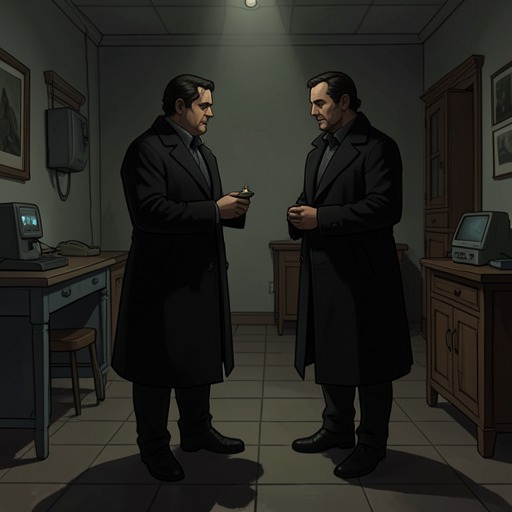
No. 16 code
Partners in CrimeThe No. 16 code is a paired verbal authentication procedure designed to identify agents in a covert network and to let them test a supposed contact. Its two challenges make casual talk carry operational meaning: the number sixteen prompts a reply containing the same number, while a question about crossing the Channel calls for the exact answer, “I was in Berlin on the 13th of last month.” The code helps the network recognize its own, yet the final encounter shows that correct answers do not guarantee trust or safety when the other party has already been warned.
Purpose and Intelligence
The code belongs to the clandestine organization whose agents report to headquarters in Moscow. After the apparent detective agency has helped capture five people and obtain valuable information, the Chief learns that Moscow has become alarmed by its agents’ failure to report. The agency’s office, operating under the name of Mr. Theodore Blunt, is understood as the network’s distributing centre; the emerging risk is that an agent will come to investigate the disruption.
The Chief has no name, arrival date, or travel identity for the expected agent. He does, however, know that the man is Russian-born, an accomplished linguist who can pass as several nationalities, and a master of disguise. The agent is also identified as the inventor of the No. 16 code. This combination makes the passwords more than a memorized pair of lines: they are a means of testing recognition in a world where names, accents, and appearances can be deliberately falsified.
The Two Challenges
The first test begins with mention of the number sixteen. The person being tested is expected to reply with a sentence that contains the same number. The exchange is deliberately simple enough to be folded into ordinary conversation, but its meaning depends on a shared convention: the number is not merely mentioned but answered in the prescribed form.
The second challenge concerns whether the listener has crossed the Channel. Its newly discovered response is the precise statement, “I was in Berlin on the 13th of last month.” The specificity of the date and place gives the otherwise conversational answer the character of a password. The Chief instructs Tommy and Tuppence to answer correctly if challenged, thereby encouraging the anticipated visitor to believe that they are legitimate contacts and to disclose more.
The procedure is therefore both a recognition device and a performance. A speaker must supply the expected words, while the listener interprets them as evidence of shared affiliation. But the exchange authenticates knowledge of the convention, not the speaker’s trustworthy intentions. The Chief explicitly warns that the agent is particularly astute and capable of playing a double game as well as, or better than, the people he is testing.
Precautions Around the Code
The Chief expects the agent to visit the detective agency under the pretext of offering a case and to test Tommy and Tuppence with the passwords. He orders them to return the correct answers and sustain the fiction if possible, while remaining guarded even if the visitor seems convinced. The plan aims to let the authorities identify and capture the agent through the encounter rather than drive him away through an obvious refusal.
A dictaphone has already been installed in the office. A man in the room below can hear what passes there, allowing the Chief to be informed immediately and to take steps to protect the couple while securing the expected visitor. The device supplies surveillance behind the spoken test: the code may open a conversation, but listening and intervention are intended to control what follows.
The expected danger is sharpened by the agent’s profile. He was not personally acquainted with the real Mr. Theodore Blunt, so the Chief thinks he may rely on an assumed case and the passwords rather than recognition of the genuine proprietor. The procedure is thus tied to a constructed identity: the office’s public role, its apparent owner, and the visitors’ replies all form parts of a test whose success depends on what the agent believes he is seeing and hearing.
The Encounter and Its Limit
When a stranger asks whether the agency has branches across the Channel, Tommy answers with the exact Berlin sentence. The visitor immediately drops the small fiction and says the daughter accompanying him can be dismissed; he recognizes that Tommy has been warned of his coming. His nod toward the calendar indicates that the clue to this warning is visible in the room, though the exchange itself does not explain it further.
The scene gives the second password a double effect. Tommy’s exact reply confirms that the agency knows the code, but it also tells the visitor that his arrival was anticipated. Instead of reassuring the agent, the correct response reveals a breach in his own approach. The code successfully identifies that the parties share secret information, yet it cannot conceal which side has acquired foreknowledge.
The wider plot demonstrates why verbal authentication alone is vulnerable. Earlier, an impostor presenting himself as Inspector Dymchurch has passed as a typical Englishman before his disguise is exposed by a dramatic change into the appearance and speech of a well-educated foreigner. Elsewhere, a proposed golf-course disguise depends on a skirt worn over plus fours and a rapid change back into men’s clothes. These episodes establish the same practical problem the code faces: identity can be staged, and a convincing sign may be deliberately manufactured or strategically deployed.
Operational Failure and Significance
The precautions surrounding the code do not prevent the larger deception. After Tommy discovers Tuppence’s clothes and a fair beard concealed beneath the sofa, he realizes that she has been taken and that the Russian agent has escaped. The Hospital Nurse and the boy were accomplices who had made themselves familiar at the hotel; the man had silenced both Tuppence and the woman next door, disguised himself, and left with Tuppence dressed as a boy. Mr. Carter finds a fragment of a hypodermic needle, establishing that Tuppence had been drugged. The escape shows how a network’s methods can extend beyond password exchange to disguise, planted familiarity, and physical incapacitation.
The code’s dramatic importance rests on this tension between exact words and unreliable identity. Its two answers seem to offer a crisp rule for recognition, but their force depends on secrecy, interpretation, and control of the encounter. Once the enemy knows that the other side is listening for the right phrase, a correct response can become a warning rather than a reassurance. The No. 16 code opens the door to contact; it cannot, by itself, tell the speakers who has mastered the performance or who is already arranging an escape.