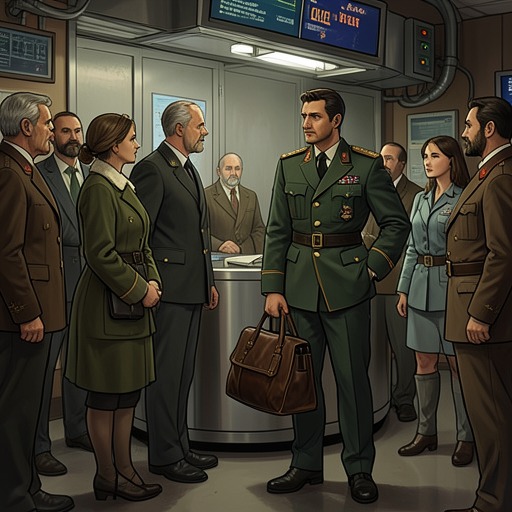
Randolph Wilmott's kitbag
Partners in CrimeRandolph Wilmott's kitbag is the material center of a puzzling exchange that appears to involve the American ambassador and Senator Ralph Westerham but resists the ordinary explanation of a luggage mix-up. Wilmott says a supposedly identical case was returned to him, yet Westerham denies taking it; the bag's contents, reported intact and consisting mostly of boots, leave the exchange's purpose unexplained.
Identity and Contents
The kitbag belongs to Randolph Wilmott, an ambassador who has recently arrived aboard the liner Nomadic. Its initials, R.W., match those of another gentleman, Senator Ralph Westerham, and the two bags are described as practically identical. That combination offers an immediate, plausible explanation for an accidental substitution, but it does not establish that Westerham ever possessed Wilmott's luggage.
When Tommy asks what the bag contained, Wilmott answers that it contained mostly boots. He says nothing was missing when the case came back into his possession, relying on his valet, Richards, to know its contents. The mundane answer makes the bag's role more perplexing rather than less: a case filled chiefly with boots seems an unlikely object for elaborate intrigue, yet its exchange is the detail that brings the mystery into view.
The Reported Exchange
Wilmott recounts that he and Westerham arrived in England a week earlier and that their cases were mistakenly exchanged. In his account, Westerham discovered the error immediately, sent Wilmott's kitbag around to the Embassy, and took away his own. Wilmott himself says he did not learn what had happened until Richards told him; he understood that Westerham had arranged the return and had sent for his own bag.
The account begins to unravel when Wilmott later meets Westerham and jokingly mentions the incident. Westerham, to Wilmott's surprise, says he does not know what Wilmott is talking about. He denies absolutely having taken Wilmott's case and says he did not travel with such an article among his luggage. This denial transforms what might have been a simple mistake into a substitution for which the apparent participants offer incompatible accounts.
The Man Who Collected the Bag
The supposed return was carried out by an unidentified man presented as a servant of Westerham. Richards recalls a middle-aged, grey-haired visitor of respectable appearance, whom he understood to be the senator's valet. The man left Wilmott's bag and took away the other one. Richards allows that he may have been mistaken about the visitor's identity, so his description establishes the man's appearance and the impression he made, not that he worked for Westerham.
Richards's account also distinguishes between the two cases. He believes that Wilmott's own kitbag, which he had strapped aboard the ship, had not been unpacked: the person who opened it seems to have realized it was not his and closed it again. Richards is quite sure that no small article had gone missing. As for the other case—the one brought back to the Embassy—he had just undone the straps when the visitor arrived. Richards and the man unfastened it together to check that no mistake had been made; the visitor pronounced it all right, strapped it up again, and took it away.
An Unresolved Clue
Wilmott sees no evident reason for anyone to steal the case by such a roundabout method, especially since it was returned. Nor does he accept a mistake as a sufficient explanation once Westerham has denied the exchange. He describes the business as apparently without rhyme or reason, but says he means to get to the bottom of it out of curiosity. Tommy agrees to undertake the inquiry and treats the reason for the substitution, if there was one, as the first problem to solve.
The kitbag's importance therefore lies less in its contents than in the conflicting chain of custody built around it: two matching sets of initials, an alleged mix-up aboard a named liner, a return attributed to a senator's servant, a valet who can describe the visitor but cannot verify his identity, and the senator's categorical denial. The case is tangible evidence that something was exchanged, but its apparently intact contents and uncertain handling do not reveal why. It remains an open clue rather than a solved piece of diplomatic intrigue.