Red House
Partners in CrimeThe Red House is an inherited home whose apparent haunting turns domestic space into a mystery and threatens the precarious livelihood of Monica Deane and her mother. Its rooms seem to defy ordinary order: furniture shifts, crockery flies, and objects crash to the floor. Yet the house’s uncanny reputation also draws the attention of a supposed investigator and buyer, while its garden and old household papers become clues in a search for buried treasure.
Inheritance and a precarious home
Monica Deane inherited the Red House from an aunt of her late father, whose family had long been estranged from the aunt. Monica’s father had been rector of Little Hampsley in Suffolk; after he died, Monica and her mother were left badly off. Monica went out to work as a governess, but when her mother became a confirmed invalid she returned home to care for her. The aunt’s legacy seemed to promise relief, but it consisted principally of the house. After a few small legacies had been paid, no money remained; Monica could only speculate that the aunt had lost her fortune during the war or lived on her capital.
An advantageous offer to buy the property arrived almost at once. Monica refused it, even when the prospective purchasers made a further tempting offer. She preferred to move into the house with her mother, hoping that its comfortable rooms would allow them to take paying guests and cover their expenses. The decision gives the house a double function: it is both family inheritance and an attempted source of income, so the disruption of its domestic life threatens their security directly.
For a time, the plan appeared to work. Monica advertised for guests, received several replies, and kept the aunt’s former servant in the household; the servant and Monica divided the work between them. That fragile arrangement ended when strange occurrences began. The house, which had seemed capable of sheltering Monica’s mother and supporting them both, became the source of a new and more damaging uncertainty.
The haunting and its human cost
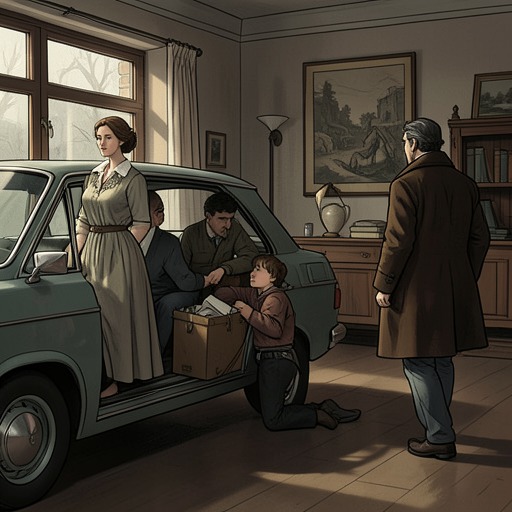
Monica describes the disturbances as impossible to dismiss as a practical joke. Pictures fell from the walls, crockery flew across rooms and smashed, and one morning the furniture had all been moved. At dinner, a tremendous crash might sound overhead; when the household went upstairs, no one was there, only a piece of furniture violently thrown down. The incidents turn familiar rooms and belongings into apparent agents of disorder, making the home difficult to trust even when its occupants are together.
Tuppence Beresford is immediately interested in the possibility of a poltergeist, a label Monica says Dr. O'Neill had applied to the phenomena. Monica herself admits that she does not know what the term means. The distinction matters: the supernatural explanation enters the account as a name supplied by an outsider, not as a solution established by Monica’s experience. What she can verify is the repeated disturbance and its effect on the people who try to live in the house.
The consequence is practical as well as frightening. Guests leave as soon as possible, and replacements depart just as quickly. Monica’s family income then suffers another blow when the company in which their small income was invested fails. The haunting therefore compounds an already precarious situation: the house cannot reliably attract paying residents, while the money that might have supported the household disappears by a separate route.
A buyer, an investigation, and a concealed past
Three days before Monica tells her story, Dr. O'Neill calls at the Red House. He claims membership in the Society for Physical Research and says he has heard about the manifestations. His interest is not merely observational: he is prepared to buy the property and conduct a series of experiments there. For Monica, the offer at first seems a way out of the family’s difficulties. The house’s troubling reputation has made it hard to earn a living, yet that same reputation appears to have made it desirable to a prospective buyer.
Tuppence proposes going to the neighborhood to investigate on the spot and writes down the address: the Red House, Stourton in the Marsh. When Tommy Beresford later suspects that treasure lies somewhere on the property, he and Tuppence return under a different pretext. Monica receives them as prospective purchasers, which gives them a reason to be shown through the house and grounds without disclosing Tommy’s conclusions to her. He questions her about the dead aunt’s belongings and papers. Some garments and personal possessions had gone to the former servant, Crockett, while others were sent to poor families; everything had been searched and turned out. The desk and a bedroom drawer had held papers, but Monica knew of nothing important among them.
This failure to find a cache among the aunt’s belongings narrows the mystery without resolving it. Tommy reasons that the treasure remains somewhere in the Red House, since Crockett has not found it, and worries that she and her nephew will have the house to themselves and can search it at leisure. He argues that the old woman could not have taken up floors or dug holes in the garden herself, but that the hiding place must still be on the property. The house’s rooms and papers have been examined; attention shifts from what the aunt left in plain view to what may have been concealed in the grounds.
The garden clue and the tin
A recipe for keeping new potatoes supplies an unexpected lead. It instructs the reader to put the potatoes into tins and bury them in a garden, so that even in midwinter they will taste freshly dug. Tommy recognizes the possible connection between the recipe and the search for missing treasure; Tuppence sees the implication at once and concludes that the treasure may be buried in a tin. The clue joins an ordinary household practice to the possibility of deliberate concealment, turning a recipe from discarded paper into a guide to where the investigators should look.
The gardener’s denial complicates that inference: when asked, he says he has never buried anything. Nevertheless, a place he indicated can be found in the grounds, and Tommy and Tuppence go there late at night with a spade that has somehow been procured. Tommy digs until the spade rings against metal. Beneath the soil is a large biscuit tin, sealed with adhesive plaster and firmly fastened down. Tuppence opens it with Tommy’s knife, but its contents seem to mock their conclusion: the tin is full of potatoes, and when she pours them out, there is nothing else inside.
Tuppence does not treat the first tin as the end of the search. She urges Tommy to keep digging, and after some time a second tin rewards their efforts. The episode leaves the garden search in motion rather than making the first discovery a solution: the recipe has led them to a real buried tin, but its contents so far offer only the very potatoes the recipe described. The Red House thus sustains its double character to the end of the documented search: beneath the appearance of a haunted home lies an intentional puzzle, but the investigators must distinguish an apparent confirmation from the evidence that will actually disclose the hiding place.