Red House haunting
Partners in CrimeThe Red House haunting is a sequence of apparent poltergeist manifestations that turns a struggling household into a place of fear, drives away its paying guests, and creates an opportunity for a suspicious buyer to acquire the property. The incidents seem to promise a supernatural mystery, but Tommy Beresford’s observations point instead to human staging: the broken crockery is not proof of a ghost, but evidence of someone moving unseen through the house.
The Disturbances and Their Effects
After moving into the house and advertising for paying guests, Monica Deane and her aunt’s former servant initially manage the household themselves. Then the disturbances begin. Pictures fall from the walls, crockery flies across rooms and shatters, and furniture is found rearranged. A practical joke seems a possible explanation at first, but the pattern becomes harder for the household to dismiss.
The incidents are especially unnerving because they combine ordinary domestic objects with unseen violence. At dinner, a tremendous crash may sound from upstairs; when the household investigates, no one is there, only furniture hurled to the floor. Later, a jug and basin in a front room are found smashed after another crash, again with no person visible. The familiar rooms offer no visible source for the damage, making the house seem to act by itself.
The disturbance has immediate consequences for the household’s livelihood. Frightened visitors leave as quickly as they can, and newly arrived guests follow them out. Monica is left in despair; the strain is compounded when the company in which the household’s small independent income was invested fails. The haunting is therefore not merely a frightening spectacle: it makes the house difficult to run as a source of income at the very moment the household has lost another means of support.
A Supernatural Explanation and a Buyer’s Interest
When Tuppence Beresford hears the account, she names the apparent cause as a poltergeist. Dr. O'Neill has used the same term, describing it as an evil spirit that plays tricks, though Tuppence admits that her own grasp of the subject is uncertain. The confident label gives a name to the disturbances without establishing what causes them; the crucial fact is that the incidents remain unexplained to the people living in the house.
Three days before Monica consults the detectives, Dr. O'Neill visits. He says that he belongs to the Society for Physical Research and has heard about the curious manifestations. He offers to buy the house and conduct a series of experiments there. To Monica, initially overwhelmed by relief, the proposal appears to offer a way out of her difficulties. The haunting thus draws together fear and financial pressure: the very activity that makes the house unattractive to paying guests makes it valuable to a man who claims a special interest in investigating it.
The Physical Clues
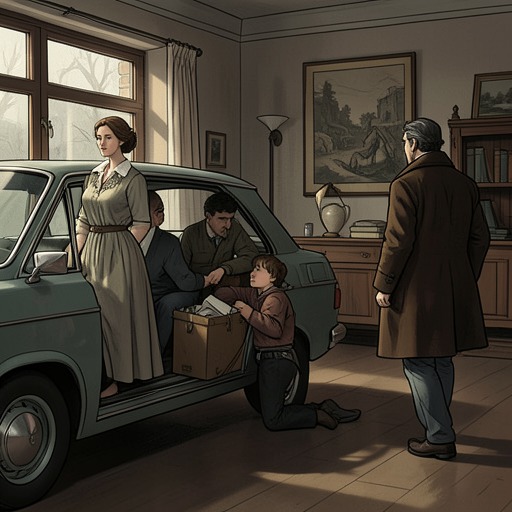
The apparent lack of a visible perpetrator does not persuade Tommy that the events are supernatural. When the detectives are preparing to leave, Monica brings down a large cardboard box tied with string, containing papers she has collected for them. As she says she doubts the papers will explain the mysterious happenings, a crash sounds overhead. Tommy runs upstairs and finds the jug and basin in a front room broken on the floor, with nobody in the room.
Tommy’s response is telling: he refers to the ghost’s tricks with a grin, then returns downstairs thoughtfully. The contrast between the joke and his private attention marks a shift from taking the haunting at face value to reading the scene as a staged performance. The empty room proves only that the culprit is absent when the damage is discovered; it does not prove that nobody caused it.
Tommy’s Explanation
After the Beresfords leave, Tommy tells Tuppence that Crockett is involved. He reads her being out of breath as a sign that she has run down the back stairs after smashing the jug and basin. His explanation accounts for the empty room and the timing of the crash without requiring an invisible force.
Tommy also proposes a broader method: Crockett may sometimes have secretly admitted her nephew, who could create the poltergeist-like disturbance while she appeared to remain innocently with the family. This remains Tommy’s investigative explanation rather than a supernatural account. The possibility of two participants helps explain how incidents could seem to occur beyond the reach of the person apparently present with the household.
The buyer’s interest supplies a further clue. Before leaving, Tommy says that Dr. O'Neill will make another offer before the day is out. After dinner, Monica receives a note from him raising his previous offer by £150. The increase follows the Beresfords’ visit and accords with Tommy’s suspicion that the manifestations and the purchase proposal are connected. The evidence establishes the suspicious pattern and Tommy’s proposed mechanism; it does not, in these scenes, provide a final account of every disturbance.
Narrative Significance
The haunting is constructed through a repeated gap between violent effect and absent cause: crockery breaks, furniture moves, and crashes sound overhead, while the rooms are empty when searched. That gap invites a supernatural interpretation, but the investigation gradually redirects attention to access, timing, and people capable of exploiting the household’s fear. The broken jug and basin are especially important because the object’s damage becomes a clue rather than merely another uncanny spectacle.
The episode’s reversal is material as well as interpretive. Monica hopes that the supposed investigator’s offer will rescue the household; Tommy instead sees the repeated disturbances as potentially serving the interests of people connected to the proposed purchase. The house’s reputation has become an instrument in a contest over its sale, while the ordinary costs of frightened guests and failed investment fall on Monica. In this way, the Red House haunting makes the appearance of the supernatural inseparable from the practical vulnerabilities that allow a deception to work.