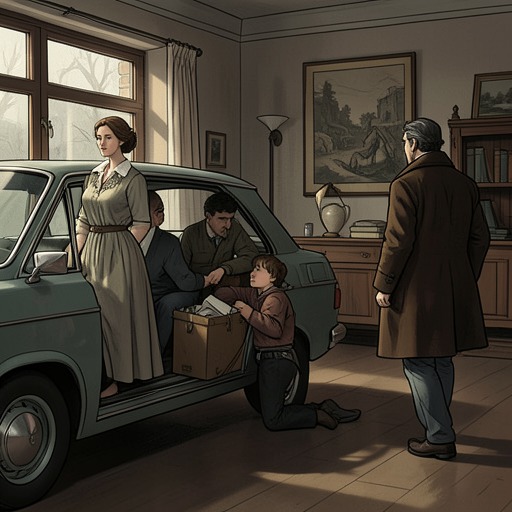
Red House treasure cache
Partners in CrimeThe Red House treasure cache is the fortune that the former owner of the Red House secretly buried in her garden, concealed in tins beneath the ordinary explanation of preserving new potatoes. Its recovery turns scattered domestic clues into a precise trail: a bank withdrawal, a charade, a biblical citation, an old recipe and a gardener’s recollection. For Tommy Beresford and Tuppence Beresford, the search answers why the old woman’s estate seemed so small; for Monica Deane, it restores the wealth that could alter her future.
The missing fortune
The cache’s existence emerges when Tommy talks with a country banker about whether much gold has recently been paid in. He invents a story about an aunt who, at the outbreak of the war, went to the Army and Navy Stores and came home with sixteen hams. The banker responds with a more consequential instance: one of his clients had withdrawn every penny of her money, taking it in gold where possible, and insisted on keeping her securities, including bearer bonds, in her own custody. She had once owned the Red House. Tommy infers that she had hidden the money there, explaining why Monica and Tuppence had been astonished by the small value of her estate. The banker’s casual reference converts an apparent financial discrepancy into the central question of where the missing assets were concealed.
The likely stakes are sharpened by Monica’s circumstances. She explains that selling the Red House would not provide enough for her and Gerald to live on: he is a talented engineer but desperately poor, and capital might secure his partnership in his firm. A wealthier suitor, Mr. Partridge, could end their financial troubles, but marrying him would not be emotionally equivalent. The hidden fortune is therefore more than a puzzle prize. Its recovery could give Monica the material freedom to choose the man she loves without treating marriage as a solution to poverty.
Clues in paper and verse
Tommy suspects that Crockett knows there is treasure in the house and might search for it with her nephew once they had the property to themselves. He and Tuppence need to find it first. At the Red House, they pose as prospective purchasers, allowing them to inspect the house and grounds without revealing Tommy’s conclusion. Monica tells them that her aunt’s belongings had already been sorted: some clothes went to Crockett, while the rest were distributed among poor families. A search through the dead woman’s papers produces little—among the items are a bill, newspaper cuttings about pearls and a man with four wives, and a recipe for jugged hare—but Tommy has set aside a half-sheet of notepaper because it seems unusual.
The paper contains a charade, beneath which is written “St. Luke XI. 9.” The verse prompts Tuppence to see that the reference is itself a clue: the biblical text sits oddly under a children’s-style riddle. She solves the charade through its parts. The first is “pot,” something placed on glowing coal; the second is the letter A, the first; and the third is “cold toes.” Together they spell “potatoes.” At first, the answer seems useless to a search for treasure. Tommy then remembers that the box also contained a recipe for new potatoes, and the riddle becomes a pointer to the recipe rather than a direct description of the hiding place.
The recipe supplies the method: put new potatoes into tins and bury them in the garden, where they will remain as if freshly dug even in winter. Tuppence recognizes that the instructions may explain the missing money’s concealment. Tommy had already asked the gardener whether he had buried anything, and the man denied doing so; the recipe suggests that the question had been too general, since buried potato tins could be part of an established household practice rather than an unusual act of hiding valuables.
The gardener’s memory and the search
On Christmas Eve, Tommy and Tuppence locate the old gardener’s cottage and approach the subject indirectly, talking about whether new potatoes could be kept for Christmas dinner. The gardener confirms that people in the area buried them in tins and recalls that the former owner of the Red House regularly buried three tins each summer, sometimes forgetting to have them dug up. Asked where she put them, he identifies the ground by the wall near the fir tree. His memory gives the recipe’s commonplace instructions a precise location and a personal history.
That night, Tommy and Tuppence enter the grounds with a spade. Tommy digs where the gardener indicated and strikes metal. The first large biscuit tin is sealed with adhesive plaster; Tuppence opens it with Tommy’s knife, only to find potatoes. They empty it, discover no valuables, and continue digging. The failed first find makes the hiding place more than a single buried container: the potato tins are real and consistent with the old woman’s habit, but they do not all contain the fortune. The pair persist until they find another tin, then arrange to open the recovered loot at the inn.
Contents and consequences
The cache contains several kinds of wealth, not one conveniently interchangeable hoard. A heavy chamois-leather bag holds gold sovereigns; Tommy counts two hundred pounds. A separate oilskin-wrapped package contains closely folded banknotes amounting to exactly twenty thousand pounds. Tuppence also unwraps a small parcel of exceptionally well-matched pearls. Tommy estimates that the pearls are worth at least another five thousand pounds, and links them to the old woman’s retained newspaper cutting describing pearls as a sound investment. He concludes that she had realized her securities and converted them into notes and jewels before hiding the proceeds.
The recovered money and jewels make sense of the old woman’s financial precautions and her unexpectedly modest estate, while the three forms of wealth—coin, paper money and pearls—show the conversion of assets into portable objects that could be concealed. The cache also changes the practical terms of Monica’s predicament. With the fortune found, she need not choose a secure marriage to Mr. Partridge simply because Gerald lacks the capital to advance his engineering career. Tuppence imagines Monica marrying the man she loves and living happily, a personal ending made possible by a secret that had waited in the garden beneath tins associated with an everyday crop.