Rescue of Tuppence and capture of No. 16
Partners in CrimeThe rescue of Tuppence and capture of No. 16 is the climax of the pursuit at the Blitz Hotel: Tommy discovers that the apparent victim, Mrs. Van Snyder, is No. 16 in disguise, and that Tuppence has been hidden and drugged beneath the bed’s bolster. The staged escape nearly succeeds by turning the rescuers’ attention toward a false trail, but Tommy’s final inspection overturns the scene. Tuppence is alive, and No. 16 is taken into custody.
Background and the false escape
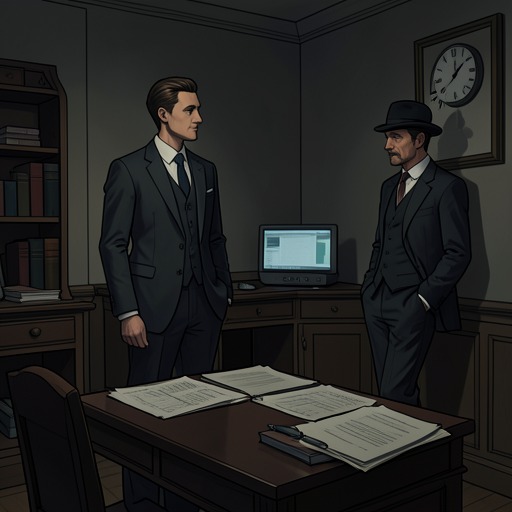
No. 16’s plan depends on misdirection as much as disguise. Tommy initially finds a bundle under the sofa containing Tuppence’s long black coat, walking dress, and hat, together with a long fair beard. He concludes that the enemy has taken Tuppence and escaped, while the supposed hospital nurse and boy who had stayed at the hotel for several days were accomplices. Their familiar presence was part of the preparation: when the plot began, they could serve as a credible trail for the pursuers to follow.
Tommy reconstructs how the deception may have been carried out. No. 16 had apparently realized at lunch that he was trapped, used the adjoining room and its temporary vacancy, and silenced both Tuppence and the woman next door. Tuppence was drugged, dressed in boy’s clothes, and removed while No. 16 altered his own appearance. Tommy recognizes that the clothes were ready in advance, but the apparent escape leaves one problem unresolved: he cannot understand how Tuppence could have cooperated. Mr. Carter finds the answer in a small fragment of hypodermic needle on the carpet. She had not willingly gone with the supposed nurse and boy; she had been drugged.
The bedroom confrontation
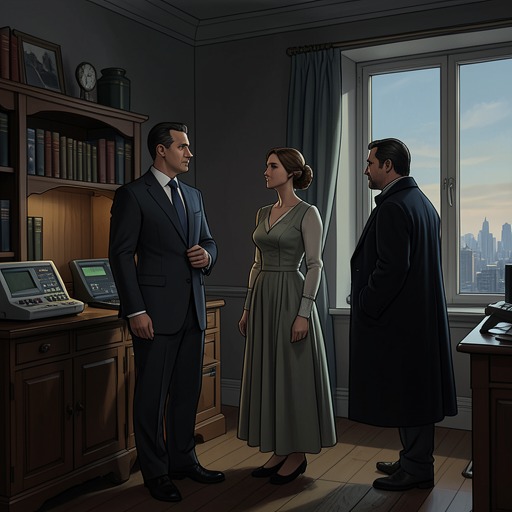
Tommy does not accept the apparent trail as a complete explanation. He returns to the Blitz with Evans and Albert and goes straight to room 318, where Mrs. Van Snyder is lying on the bed. He asks her to get off it. Her astonishment and protest do not settle the question: Tommy has noticed that the hurried account of events cannot fit the time available.
His reconstruction turns on the physical sequence. In five minutes, it would be impossible to drug Tuppence, dress her in boy’s clothes, gag and bind another woman, and change one’s own appearance. The hospital nurse and the boy, Tommy concludes, were intended as decoys; Mrs. Van Snyder was meant to be left behind as a seemingly helpless victim. The story presented in the room had supplied a neat explanation for the escape, but its timing gave it away.
Tommy and Evans pull Mrs. Van Snyder from the bed. Tommy tears away the coverings and the bolster, revealing Tuppence lying horizontally across the top of the bed. Her eyes are closed and her face is waxen. For an instant Tommy fears she may be dead, but the slight rise and fall of her breast shows that she is alive, though drugged. The rescue changes the apparent outcome from abduction and escape to concealment and survival.
Unmasking and capture
The final clue is not a confession but a removable disguise. Tommy seizes the elaborately dressed hair of the supposed Mrs. Van Snyder, and it comes away in his hand. The woman is No. 16. The reveal exposes the central trick of the scene: the apparent victim who helped authenticate the false account was the criminal who had arranged it.
About half an hour later, Tuppence opens her eyes with a doctor and Tommy bending over her. Asked whether they have No. 16, Tommy says that he has once again crushed him like an eggshell, but credits the actual custody to Carter: Carter has the prisoner. The capture closes the immediate pursuit, while Tuppence’s recovery confirms that the apparent escape had not cost her life.
Detective play and the ending
The confrontation also resolves a running comic pattern in the Beresfords’ work. Earlier, Tommy treated detective fiction as a practical education: he proposed studying the leading fictional masters, trying different styles, and comparing results, and bought a camera to photograph footprints and enlarge negatives. At another threat, he and Tuppence assigned themselves the roles of the brothers Okewood, with Tommy insisting on being Desmond and Tuppence preferring the more capable Francis. The cases repeatedly let such borrowed roles collide with actual criminal methods.
When No. 16’s danger becomes immediate, Tommy again performs a famous detective, declaring that the enemy is a returned No. 4 elevated to No. 16 and invoking Hercule Poirot. The pose is theatrical, but the successful bedroom search depends on concrete reasoning: a hypodermic fragment explains Tuppence’s passivity, the impossible five-minute timetable exposes the staged account, and the hairpiece confirms the disguised criminal’s identity. The episode therefore makes the couple’s detective-fiction play more than a joke, without treating imitation alone as a solution. Tommy’s flourish announces the final coup; attention to evidence and sequence makes it possible. When Tuppence asks for the full story, Tommy gives her a spirited account with certain omissions, ending the affair in a note of affectionate comic reticence.