Secret Service
Partners in CrimeThe Secret Service is the government organization behind the Beresfords’ covert detective-agency operation. By placing them in a public-facing office, it turns an apparently ordinary business into a listening post for coded correspondence and a trap for a foreign agent. Its work depends not on official force alone but on disguise, controlled information, surveillance, and the ability to read small discrepancies before an adversary can exploit them.
Mandate and Recruitment
The Secret Service first enters the story as the “Department” whose work Tommy Beresford already performs, though he describes it as office work rather than the perilous adventures he and Tuppence once experienced. Tuppence’s discontent is partly that this employment does not give her a role: Tommy might be sent abroad, but she would be left behind. Mr. Carter’s proposal that a particular piece of departmental work might suit both of them therefore answers the couple’s wish for action while extending the Service’s reach through their partnership.
The assignment arises because Theodore Blunt has been indiscreet and Scotland Yard has intervened. Blunt is being detained at His Majesty’s expense, yet refuses to provide all the information the authorities want. Rather than expose the operation by replacing him with an overt official presence, Carter proposes that Tommy take six months’ leave on grounds of ill health and run a detective agency under Blunt’s name. The arrangement gives the Service a plausible commercial front and uses the Beresfords’ ability to play roles in public without making their official connection visible.
The Detective Agency as Cover
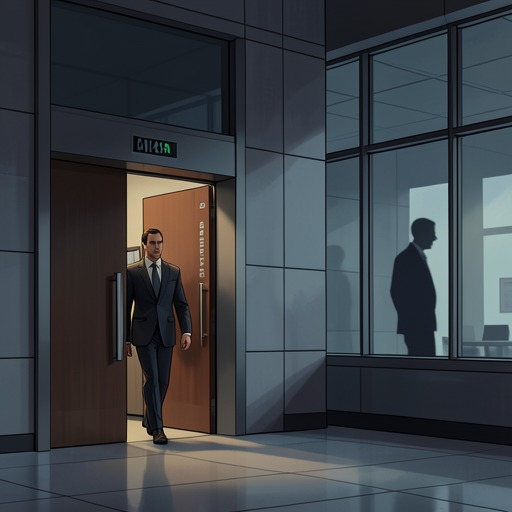
The International Detective Agency’s offices are on the second floor of a dilapidated Bloomsbury building. Their arrangement makes the new identity tangible: the outer office leads to rooms marked “Clerks” and “Private,” while the private room has a large businesslike desk, labeled but empty files, leather-seated chairs, and a telephone beside the supposed Mr. Blunt. Tommy rehearses telephone effects with Tuppence, and Albert, recast as an office boy, completes the performance with inky hands, a tousled head, and a paper bag of sweets. The setup looks established before it has clients, making the appearance of an operating business part of the disguise.
Tuppence has a separate adjoining room with a typewriter and a gas ring for tea. The difference between the two rooms establishes a division of work within the cover: Tommy occupies the chief’s authoritative office, while Tuppence performs the practical and clerical duties that keep the enterprise functioning. But she is no passive secretary. Carter’s plan is explicitly offered to both of them, and her observations and initiative repeatedly become operational assets. The agency’s everyday appearance is a tool, not the limit of her contribution.
The cover also creates an information channel. Carter tells Tommy to watch for blue letters bearing Russian stamps, supposedly sent by a ham merchant seeking a wife who came to Britain as a refugee. He is to copy the letters and send the originals to Carter. If anyone comes to the office and refers to number 16, the Service must be informed at once. The supposed private business thus receives and preserves communications that may carry intelligence, while the Service retains access to the originals and to reports of suspicious visitors.
Coded Communications and Counter-Disguise
The Russian correspondence illustrates how the Service treats ordinary-looking media as potentially layered messages. One letter, written in careful, stilted English, purports to come from Gregor Feodorsky, who urges the agency to spare no expense in finding his wife and claims that a crisis in the pork trade prevents him from leaving Russia. Tommy recognizes that decoding the letter is not their assigned task; their immediate duty is to verify the signal and pass the communication to Carter. Soaking the stamp is meant to disclose the number 16 beneath it, turning a postal detail into a checkable sign within the larger operation.
The threat is a specialist in disguise and linguistic impersonation. The Service warns that a Russian agent has been sent to Britain, though it does not know what name he uses or when he will arrive. He is described as an accomplished linguist able to pass as several nationalities, including English, and as the designer of the number 16 code. The expected test has two parts: a visitor mentions sixteen, to which the Beresfords must reply with a sentence containing the same number; a second password asks whether they have crossed the Channel, answered by the exact statement, “I was in Berlin on the 13th of last month.” The Beresfords are to answer correctly and sustain the fiction, while remembering that the agent can play a double game as well as, or better than, they can.
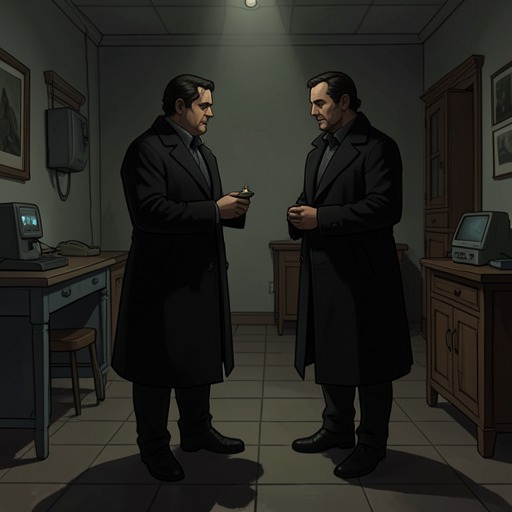
That warning recognizes a basic weakness in the operation: a code can authenticate an apparent contact without establishing that the contact is trustworthy. The Service responds by making the office itself a surveillance point. A dictaphone is installed so a man in the room below can hear conversations and report anything that arises. Carter says the precautions are intended both to secure the wanted man and to safeguard Tommy and Tuppence. The office is therefore more than a stage for the Blunt identity; it is a monitored space in which the Service hopes to hear a threat as soon as it takes shape.
Surveillance, Pursuit, and Failure
The Secret Service also makes use of disguise and controlled access beyond the detective office. In one operation at the Blitz, Carter places two of his men in the restaurant as waiters, stationing others upstairs to watch a suite and additional men outside to follow the people under surveillance. He reassures Tommy that Tuppence will remain in sight and that he will take no risks. Reports reach Carter through men whose ordinary appearances help them blend into the hotel: one arrives as a waiter taking a cocktail order, another as a fashionable, vacant-faced young man. Surveillance is distributed across rooms and roles rather than concentrated in a visible guard.
The arrangement initially appears secure, but it fails at the moment when everyone is watching for the wrong people. Carter and Tommy expect to see a fair-bearded man and a girl leave; the waiter insists that neither came out. Tommy finds a bundle hidden under the sofa: the outer layer is Tuppence’s long black coat, and inside are her walking dress, hat, and a long fair beard. The clothes reveal that the apparent identities in the hotel have been exchanged through costume. The Russian agent has used accomplices who had stayed at the hotel long enough to seem familiar, silenced Tuppence and a woman in the adjoining room, dressed Tuppence as a boy, changed his own appearance, and walked out openly. A fragment of a hypodermic needle on the carpet indicates that Tuppence was drugged, not persuaded to cooperate.
Carter’s calm returns when the escape is discovered, and he immediately directs the search toward the history of the suite: the staff are to establish who occupied it previously and when. His response shows the Service returning to inquiry after its watch has been defeated, looking for preparation and opportunity rather than treating the escape as an inexplicable disappearance. Yet the episode also exposes the limits of the operation. Men stationed in the restaurant, upstairs, and outside cannot prevent a disappearance when an adversary has prepared the room, exploited expectations, and changed the visible evidence through clothing.
Methods and Significance
The Service’s principal method is to make official work resemble something else: a leave from the office conceals an assignment; a detective agency gives the Beresfords a public reason to receive strangers and letters; a coded stamp and passwords distinguish messages and contacts; and hotel personnel become watchers. Its reliance on ordinary objects and roles is consistent throughout. A newspaper advertisement can draw a target into a situation, a postal stamp can conceal a number, a dictaphone can turn an office into a listening post, and a bundle of clothes can explain how an apparently watched person vanished.
The operation also shows that the Service’s resources do not abolish uncertainty. Carter can arrange a network of observers and establish precautions, but success depends on how correctly the watchers interpret what they see. At the Blitz, the disguise succeeds because the observers expect one pair of figures and overlook the possibility that clothing, accomplices, and drugging have rearranged the scene. The Secret Service is thus presented as an organization that works through disciplined concealment and inference, yet must contend with an adversary who understands those methods and can use the observers’ assumptions against them.