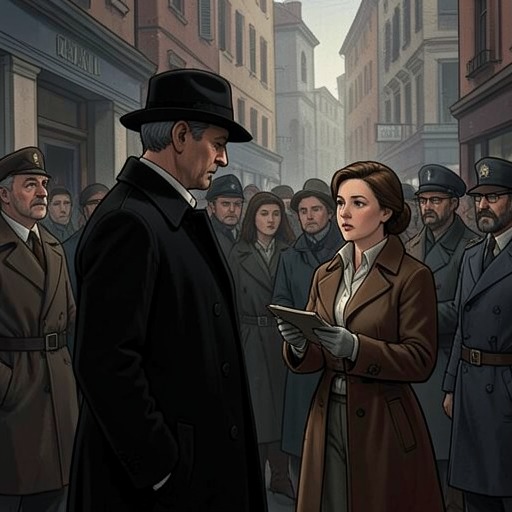
Sir Arthur Merivale
Partners in CrimeSir Arthur Merivale enters the investigation as Lady Merivale’s bereaved husband and an emphatic defender of Captain Bingo Hale. That defence gives his grief an apparently loyal shape, but Tuppence’s reconstruction turns the apparent case against Hale into a frame-up: Sir Arthur, not the man he protects, is the murderer.
Introduction and Apparent Position
Inspector Marriot introduces Sir Arthur to Tuppence after Lady Merivale has been identified. The tall, thin man has haggard eyes and thinning hair; the account presents him at once as a husband confronted with a shocking loss. Marriot wants him to hear directly from Tuppence what the dead woman said before she died, because Sir Arthur has been difficult to convince.
His response is absolute: he says he cannot and will not believe that Bingo Hale ever harmed Vere. The certainty initially reads as devotion to a friend, and it helps obscure his own place in the crime. Sir Arthur is not a detached observer of the evidence: he is the person whose household and knowledge of Hale become central to the explanation.
The Evidence Against Hale
Marriot lays out a circumstantial case centred on the newspaper-costume advertisement. He interprets it as Hale’s way of attracting Lady Merivale’s attention: the pair had arranged to meet at the Ace of Spades, and Sir Arthur’s late decision to go made a warning necessary. The cryptic phrase “Necessary to finesse the King” is explained as that warning. Sir Arthur ordered his own costume at the last minute, while Hale’s was supposedly homemade.
The crucial physical detail is a fragment of newspaper found clasped in Lady Merivale’s hand. Marriot says his men will take Hale’s costume from Sir Arthur’s house and compare its tear with the fragment. If the edges match, the apparent chain of evidence will point directly to Hale. Sir Arthur rejects that conclusion, insisting that the expected proof will not be found; his confidence is not vindication of Hale, but part of the deception Tuppence exposes.
Tuppence’s Reconstruction
Tuppence explains how the apparent clue could have been manufactured. In her account, a newspaper costume could be worn over an executioner’s outfit, allowing the killer to disguise what he wore beneath it. A note had first been slipped into Hale’s hand, telling him not to speak to a particular woman; Lady Merivale knew nothing of the note and went to the appointed meeting expecting the person she had arranged to see.
Tuppence’s reconstruction places the murder at the meeting in the Ace of Spades. Lady Merivale believes she is encountering her lover, while the killer uses that mistaken recognition to conceal his identity. She tears a small piece from the costume, leaving the fragment that seems to incriminate Hale. Tuppence argues that Sir Arthur then reproduced the tear in Hale’s costume, burned his own costume, and prepared to appear as Hale’s loyal friend. The supposed match between costume and fragment would thus be not a discovery of Hale’s guilt, but a deliberately constructed false trail.
Relationships and Significance
Sir Arthur’s defence of Hale is the hinge of the disguise. By presenting himself as a husband who cannot accept an accusation against a close associate, he appears to stand outside the evidence even as the investigation turns on what was found in his house. The contrast between his declared faith in Hale and Tuppence’s account of a calculated frame-up gives the scene its reversal: loyalty is the performance that makes suspicion harder to see.
The evidence supplied here establishes Tuppence’s explanation of Sir Arthur’s method, rather than recording a confession or the final test of the costume. His decisive narrative role is nevertheless clear: he converts the victim’s attempt to leave a clue into an instrument against an innocent man, while the very details meant to settle the case expose the possibility of deliberate tampering.