The Adventure of the Sinister Stranger
Partners in CrimeThe Adventure of the Sinister Stranger is the case in which the Beresfords’ newly established International Detective Agency is infiltrated by a criminal posing as a Scotland Yard inspector. A suspicious client, an invented official identity, and a Russian-stamped envelope draw Tommy into captivity; the apparent villains’ triumph over the letter gives Inspector Marriot and armed colleagues the opening to arrest them. The case turns the agency’s makeshift office and its owners’ playful imitation of detective fiction into instruments of a real counter-deception.
The Agency and Its Chosen Roles
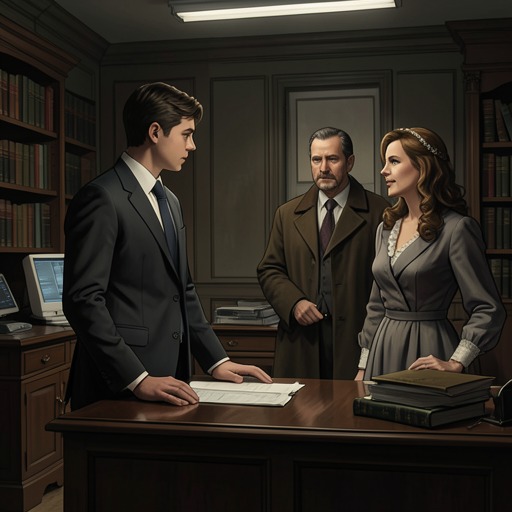
The case unfolds against the carefully staged setting of the International Detective Agency. Its private office has a large businesslike desk, artistically labelled files that are all empty, leather-seated chairs, and a telephone beside Tommy, who is trying to look as though he has run a detective agency all his life. In the adjoining room Tuppence works at a typewriter, with less impressive furniture and a gas ring for making tea. The office is furnished to suggest professional authority before it has any clients; the performance is part of the business from the start.
Tommy treats that performance as something to refine through study. He has bought detective stories by celebrated writers, intending to try different investigative styles and compare what they yield. Tuppence points out that he lacks the medical, legal, and scientific expertise needed to reproduce some famous detectives, and Tommy answers that he has acquired a camera for photographing and enlarging footprints. The books are not merely props: their imagined methods give the couple a shared vocabulary for assigning roles and interpreting danger, though the affair will show that imitation alone does not guarantee safety.
That habit becomes explicit after the suspicious visitor leaves. Tuppence suspects that the limping client is a criminal and that the gang has discovered Tommy is not the real Mr. Blunt. Tommy responds by choosing the roles of the Okewood brothers, declaring himself Desmond. Tuppence would rather be Francis, whom she considers the more intelligent brother and the one who arrives in time to rescue Desmond from trouble. Their joking disagreement becomes an unexpectedly accurate outline of the case: Tommy is captured, and Tuppence’s actions help bring about his release.
The Client and the Counterfeit Inspector
The visitor introduces himself as Dr. Charles Bower, a Hampstead practitioner troubled by several strange occurrences. Tommy receives him in the private office, while Tuppence takes notes as Miss Robinson. After Bower leaves, Tommy remarks on the difficulty of dealing with him, and Tuppence identifies his limp as a clue: she calls him a clubfoot. She also says that his attention to a letter has persuaded her he belongs to the gang and that the gang intends to harm them. Her suspicion is based not on the client’s elaborate story alone but on the small details of his manner and the impression he has made in the office.
The supposed Inspector Dymchurch then arrives under a reassuring explanation: Inspector Marriot is away in South Wales and has asked him to watch the Beresfords and their premises. Dymchurch claims Scotland Yard knows the agency is not what it seems, but that the matter is outside its department; he also anticipates that Bower has arranged to meet Tommy at a particular place that evening. The explanation converts official scrutiny into apparent protection. By borrowing Marriot’s name and invoking an existing relationship with the Yard, the impostor makes his presence seem a safeguard rather than a threat.
The performance collapses when Tommy is seized from behind. A sweet, sickly pad is pressed over his mouth and nose; chloroform briefly incapacitates him, and his captors gag and bind him. When he comes round, he sees Dymchurch openly directing the operation. The man explains that he had suspected the new Mr. Blunt might be a spy, so he sent his associate Carl Bauer to play a suspicious client with an improbable tale, then appeared himself under Marriot’s name to win confidence. What had seemed a succession of odd encounters was a deliberately arranged test and ambush.
The transformation is also physical and vocal. As Dymchurch, the criminal had looked like a typical Englishman; now he appears unmistakably a well-educated foreigner, speaking English perfectly without an accent. The disguise has not relied on a single false name but on the full performance of an official identity: appearance, manner, assumed professional authority, and a borrowed connection to Marriot. Once the performance is discarded, Tommy can see how thoroughly those signals had shaped his trust.
The Letter and Tuppence’s Countermove
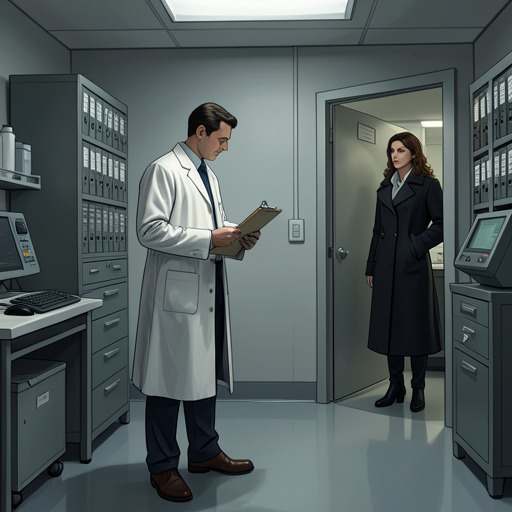
The gang’s immediate objective is a blue envelope bearing a Russian stamp. Tuppence enters carrying a letter, asking the supposed Inspector Dymchurch where Francis is. Vassily attacks her from behind and covers her mouth while Dymchurch tears the handbag from her grasp and searches it frantically. He finds the blue envelope and raises it in triumph. At that instant, Inspector Marriot and two armed men enter through the other door and order the criminals to raise their hands.
Tuppence explains that she had contacted Marriot after reading Tommy’s note. She admits that Dymchurch’s use of the number sixteen should have alerted her sooner, but says Tommy’s message settled the matter. She arranged for Albert to meet Marriot with a duplicate office key, then came to the scene carrying an empty blue envelope. The real letter had already been forwarded according to instructions after she parted from Tommy that afternoon. The gang therefore obtains the object it expects to be decisive, but the envelope in its possession is only a decoy; the seizure that seems to secure its success instead coincides with its exposure.
After Tommy is freed, he takes Tuppence’s hands and praises her as brother Francis, completing the role-play they had selected after Bower’s visit. He turns the same literary joke against Dymchurch, telling him he ought to read the classics. The line marks the reversal neatly: the criminals had tried to exploit the Beresfords’ constructed identities, but the couple’s practiced attention to roles and clues has helped them coordinate a counterstroke.
Disguise, Detection, and the Case’s Wider Pattern
Across the wider narrative, the affair belongs to a recurring contrast between identity as appearance and identity as something tested through circumstance. The agency itself depends on performance: Tommy plays Mr. Blunt, Tuppence takes the name Miss Robinson, and Albert acts the part of an office boy, complete with a paper bag of sweets, inky hands, and tousled hair. Dymchurch’s fraud is a darker and more dangerous version of the same mechanism. A convincing role can secure trust, but small inconsistencies—the client’s limp, his attention to the letter, the unexplained significance of sixteen—can expose the difference between the part and the person.
The couple’s engagement with detective-fiction conventions gives the case both comedy and practical shape. Tommy’s wish to try different styles, his camera for footprint evidence, and his enthusiasm for the Okewood brothers make detection a form of play, while Tuppence’s sharper judgments repeatedly challenge his preferred role. Their exchange does not simply celebrate literary knowledge: their borrowed models are useful insofar as they encourage observation, collaboration, and flexible interpretation. The decisive work is not performed by a fictional master’s technique, but by Tuppence acting on Tommy’s note, involving Marriot, securing the duplicate key, and substituting an empty envelope for the genuine letter.
The story’s other episodes likewise turn on how easily appearances and identities can be manipulated. At a country house, the Beresfords hear the moan of a woman in pain from an upstairs room; elsewhere, a discussion of a golfer’s possible disguise explains how a skirt, sweater, hat, and detachable side curls could make a man pass as a woman at a distance, then change back quickly. In a later investigation, Tommy reconstructs a scheme in which an attacker is meant to gain his confidence and a diplomatic bag becomes a vehicle for smuggling drugs. These episodes extend the logic of the affair: clues are often embedded in the conduct of a performance, and the investigator must ask not only who someone claims to be but what the disguise is intended to make possible.
Resolution and Significance
The immediate outcome is the exposure of Dymchurch’s false identity and the capture of his associates when they reach for the decoy envelope. Tommy’s danger is real—he is gagged and bound, and Tuppence is seized during the criminals’ search—but the trap fails because the couple’s warning reaches Marriot and the police are positioned to enter at the moment of apparent victory. The resolution depends on coordinated actions across the office: Tommy’s note, Tuppence’s decision, Albert’s delivery of the duplicate key, and Marriot’s armed intervention.
The affair establishes a pattern for the Beresfords’ work: make a professional-looking stage, watch the details that disrupt it, and do not mistake an authoritative performance for proof of authority. Dymchurch succeeds for a time because he understands the value of borrowed names and official appearances; he fails when Tuppence distinguishes the real letter from its empty substitute and arranges for the genuine message to travel by another route. The episode’s final joke about reading the classics therefore carries a serious point beneath its lightness: literary roles may furnish the Beresfords with a way to think, but survival depends on their ability to revise the script when reality refuses to follow it.