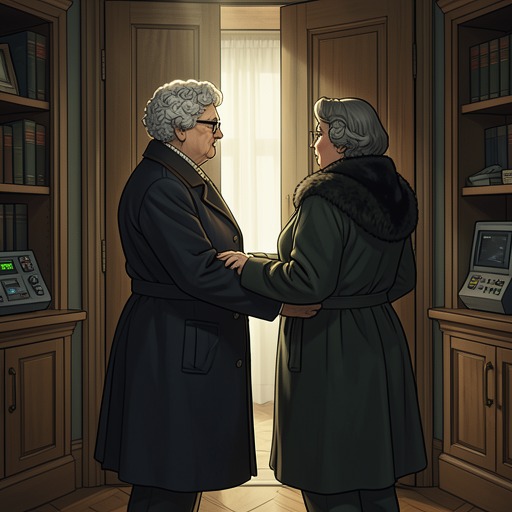
The Crackler counterfeit-note investigation
Partners in CrimeThe Crackler counterfeit-note investigation brings Tommy Beresford and Tuppence Beresford into a search for a large-scale source of forged Treasury notes. Inspector Marriot places his confidence in the pair, whose private detective-agency performance and playful borrowing from detective fiction sit alongside a more concrete method: learning to recognize the notes and tracing where they are being circulated. The supplied scenes establish the scale and direction of the inquiry, but they do not securely establish its final arrest: the later identification of Hank Ryder as “the Crackler” occurs in a scene whose described trap concerns a different operation.
Commission and the scale of the forgery
Inspector Marriot approaches the Beresfords with a case that cannot be reduced to spotting an occasional bad note. He says forged notes are circulating in the hundreds and shows Tommy a one-pound note that appears genuine. After five minutes of instruction, Tommy and Tuppence become reasonably expert at recognizing the counterfeits. Marriot does not ask them merely to keep their eyes open; he entrusts them with getting to the bottom of the matter.
The suspected distribution is concentrated in the West End, while the notes are also being passed across the Channel. Marriot believes someone high in the social scale is distributing them. That account makes the investigation a problem of tracing money through social access and circulation, not simply identifying a flaw in the notes. The one-pound example gives the broad claim a tangible form: the forged currency is meant to pass as ordinary value in everyday exchange.
Suspicions and the trail of notes
Marriot singles out Major Laidlaw as a person of interest, while carefully distinguishing suspicion from proof. Laidlaw is known in connection with racing, and people familiar with him regard some of his transactions as shady, but Marriot says there is nothing directly against him. Little is known about his past or origins; his attractive French wife is frequently seen with admirers, and the couple appear to spend freely. For Marriot, that apparent expenditure sharpens the question of where their money comes from, but the evidence leaves Laidlaw a lead rather than a demonstrated culprit.
Tuppence later returns with ten one-pound notes, asking Tommy to assess them. He confirms her diagnosis that they are counterfeit. The scene marks a practical advance from the initial lesson: she has located a batch of suspect notes and can bring the evidence to Tommy for confirmation. The ten notes give the inquiry a specific quantity to examine, though the supplied account does not state where Tuppence obtained them or how they connect to Major Laidlaw.
A detective agency that performs detection
The case belongs to the Beresfords’ broader experiment in running the International Detective Agency. Its offices are staged to project authority: the private room has an imposing desk, neatly labelled but empty files, solid chairs and a telephone for rehearsed effects, while Tuppence works in the adjoining room with a typewriter and a gas ring for tea. The arrangement makes detective work partly an act of presentation. Clients are still lacking at the agency’s beginning, but Marriot’s commission supplies serious work behind the carefully constructed appearance.
Tommy supplements that performance with deliberate study. He arranges detective novels by acknowledged masters and proposes trying their different styles and comparing results, because he considers himself and Tuppence amateurs who could benefit from acquiring technique. His interest in a scientific detective’s methods meets a practical limitation: Tuppence points out that he has neither medical nor legal experience and is weak in science. Tommy answers that he has bought a camera and intends to photograph and enlarge footprints. The counterfeit-note inquiry thus sits within a larger pattern in which fictional models inspire the pair, but investigation still depends on what they can actually observe and verify.
Their role-playing can also turn peril into comic play. When Tuppence suspects that a man has recognized Tommy as a false Mr. Blunt and that the pair are in danger, Tommy opens his book cupboard and declares that they will become the brothers Okewood, assigning himself Desmond. Tuppence chooses Francis, whom she considers the more intelligent brother and the one who arrives in time to rescue Desmond. This exchange does not solve the forgery, but it shows how the couple use detective-story identities to frame their work—and how Tuppence’s choice gently reverses the assumption that Tommy must be the capable lead.
Evidence and an unresolved identification
The evidence catalog also preserves a later arrest scene that must be distinguished from the counterfeit-note commission. There, several men close in on Tommy after he enters a building; Inspector Marriot then leads an assault on the house and arrives through a back door. Tommy explains that Albert had been ordered to follow on a motorcycle and that he had poured valerian on the ground, drawing neighborhood cats to mark the right house for Albert and the police. He tells the arrested Mr. Ryder that he has got “the Crackler,” but this scene does not describe counterfeit notes or connect Ryder to the West End circulation Marriot outlined in the earlier investigation.
That distinction matters to the case’s documented limits. The initial briefing supplies a scale, a distribution pattern and a prominent suspect, while Tuppence’s ten notes provide a concrete batch of counterfeits. The later Ryder scene supplies a capture and an alias, but not the missing evidentiary link between that arrest and the forged-note network. The surviving account therefore supports the investigation’s commission, methods and leads more firmly than a claim that Major Laidlaw or Hank Ryder is conclusively identified as the counterfeiting organizer.