Tommy Beresford
Partners in CrimeTommy Beresford is a former amateur detective who becomes the public face of the International Detective Agency and, with Tuppence Beresford, makes investigation a partnership of playacting and practical reasoning. His defining method is to borrow the poses and procedures of celebrated fictional detectives, then test them against material evidence; the comedy of those imitations coexists with genuine ingenuity, especially when a case turns on chronology, disguise, or a detail overlooked by others.
Identity and the Agency
At the opening, Tommy is Mrs. Thomas Beresford’s husband, sharing a flat and an unsettled domestic routine with Tuppence. Her wish that something would happen meets his reproving look, establishing an affectionate contrast: she voices the hunger for adventure, while he initially seems more reserved. Their domestic restlessness becomes the point of departure for renewed detective work.
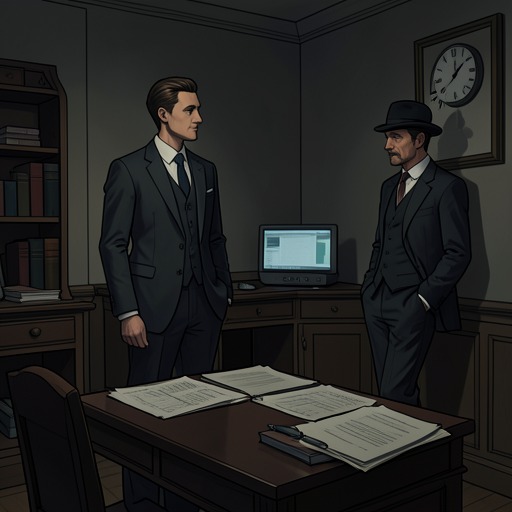
Mr. Carter offers the couple a way back into active service through the International Detective Agency. The agency has been failing, and a friend of Carter’s has acquired it cheaply; Carter proposes reopening it on a six-month trial, with a manager needed. Its former manager, Theodore Blunt, has been detained after Scotland Yard intervened over his indiscretion. Tommy takes Blunt’s place as the agency’s public representative, introducing himself to a prospective client as Mr. Blunt. The borrowed identity is more than a business convenience: it gives the couple a platform from which to advertise their services and, at times, to operate under cover.
The agency’s public pose is grander than its origins. Tommy describes himself as having handled duchesses, millionaires, and charwomen, and offers to help Scotland Yard with a forged-note investigation partly because he dislikes seeing the Yard at fault and partly because the Daily Mail might soon take notice. The bravado makes the detective business sound like a performance, but the cases repeatedly require him to move beyond display into disciplined inquiry.
Learning the Detective’s Part
Tommy treats detective fiction as a practical curriculum. After falling while arranging books on a high shelf, he explains that he has assembled works by leading writers in the genre to study their methods and compare results. He recognizes that he and Tuppence are amateurs and hopes that learning the techniques might improve their work. He even buys a camera so that he can photograph footprints and enlarge the negatives, turning the borrowed authority of fictional science into an actual investigative tool.
The experiment is knowingly imperfect. Tuppence points out that Tommy lacks the medical and legal knowledge needed to imitate Thorndyke and doubts that science is his strength. Rather than abandon the game, he invites her to use her “little grey cells,” adopting the vocabulary of the great detective as a shared cue for reasoning. The phrase recurs as a comic refrain, but it also marks a serious habit: the pair pause, compare clues, and try to make an explanation fit the facts.
When Tommy suspects that a gang has recognized that he is not the real Blunt, he chooses another literary model. He announces that they will become the brothers Okewood and assigns himself Desmond. Tuppence prefers to be Francis, whom she considers the more intelligent brother, because Francis tends to arrive in time to save Desmond from trouble. Their casting is affectionate, but it also makes explicit a persistent imbalance in Tommy’s chosen roles: he likes to play the bold, endangered hero, while Tuppence is alert to the practical intelligence that can rescue him.
The same habit appears when Tuppence lays out a complete fireman’s kit. Tommy initially guesses that he has joined a fire brigade, and she urges him to think again, invoking Watson and the bull in the arena. He begins to infer a hidden purpose and asks what she intends to wear: his old clothes, an American hat, and horn-rimmed spectacles. The scene shows their role-playing as a collaborative method. Tuppence often stages the problem; Tommy tries to read the props and infer the plan.
Reading Evidence, Not Just the Story
Tommy’s work in the Merivale case demonstrates both the appeal and the risk of a neat theory. He connects an advertisement to Captain Bingo Hale, reasoning that it was meant to catch Lady Merivale’s eye because the two had arranged to meet. Since Sir Arthur Merivale decided to attend only the day before, Tommy interprets “Necessary to finesse the King” as a warning. He argues that Hale’s newspaper costume was homemade and that a fragment found in the dead woman’s hand may have been torn from it; he orders the costume taken from Sir Arthur’s house so it can be compared with the fragment.
The case supplies a concrete test. Hale denies speaking to Lady Merivale at the show and claims an unidentified person gave him a note warning him not to approach her because Arthur suspected them. He cannot produce the note, and Tommy and Tuppence know from seeing him that he was with her at the Ace of Spades. Tuppence then compares two photographs: a fragment marked “DAILY LE-” and the front sheet of the Daily Leader, whose small round tear matches it exactly. The apparent fit sharpens the suspicion around the newspaper costume, but the evidential chain remains an argument to be tested against the garment, not a verdict established by the fragment alone.
Tommy’s skepticism also restrains Tuppence when she wonders whether Mr. Hollaby senior had a financial motive for killing his business partner, Captain Sessle. Tommy answers with circumstances that complicate the suspicion: Hollaby parted from Sessle on the golf links in the presence of Barnard and Lecky, spent the evening at the Dormy House, and the hat pin seems to point toward a woman. He does not treat a possible motive as proof when the observed movements and physical clue pull in another direction.
The Captain Sessle investigation remains unresolved in the account of Doris Evans’s case. Doris says she struggled to get free of him and ran across the golf links; a revolver found in the furze bushes had not been fired. She denies striking with a hat pin, though the narrative allows that it might have happened in self-defence. She has been sent for trial, but the identity and connection of the tall woman in brown remain unexplained. Tommy’s exchange with Tuppence about the wife and the hat pin belongs to that unfinished inquiry: his orderly explanation of the known circumstances does not supply an answer the evidence has not yielded.
Collaboration and Casework
Tommy’s partnerships extend beyond Tuppence to Scotland Yard. In the forged-note case, Inspector Marriot recognizes that the Hollabys had already attracted suspicion over the Porcupine figures, although the police lacked evidence and found them too shrewd to pursue. Marriot credits Tommy and Tuppence with an ingenious idea involving a blue coat and promises that Blunt’s Brilliant Detectives will receive credit. The exchange gives Tommy’s adopted professional identity a public consequence: the agency’s theatrical name is not only a disguise but a reputation that can be acknowledged by the Yard.
In another case, Tommy turns a seemingly ornamental clue into a way of locating Hank Ryder. He explains that Albert was instructed to follow by motor cycle if Tommy and Ryder went out together. While Tommy conspicuously marked a chalk cross on a door to hold Ryder’s attention, he also poured valerian onto the ground. Cats, attracted to it, gathered outside the right house, allowing Albert and the police to identify the location. The joke that Ryder knows “all the best fairy tales” sits beside a carefully arranged operation: a decoy gesture, a concealed scent, an assistant in pursuit, and police ready to act.
Tommy’s reasoning is especially explicit when he exposes a diplomatic-luggage swap. He reverses the apparent question of why someone would want the Ambassador’s bag for an hour: perhaps the other bag needed to be in the Ambassador’s possession during that interval. Because diplomatic luggage is not subjected to Customs examination, he concludes that the exchange points to smuggling, and the restriction on bulky goods leads him to suspect drugs. A staged disturbance in his office had been intended to distract him or remove him from the investigation, but he noticed that the supposed accomplice’s reaction when Albert performed a lasso act did not fit her assigned role. He pretends to believe her story and lets her lead him to the beauty shop, while leaving instructions behind and delaying his arrival so that help can be assembled. Inspector Grace and another officer are waiting there, and the man they seize is wanted by the police.
No. 16 and the Rescue of Tuppence
Tommy’s most urgent test comes when Tuppence is abducted as part of No. 16’s operation. At first, his role-playing takes an extravagant form: he identifies the enemy as a supposedly resurrected criminal, “4 squared,” now No. 16, and casts himself as Hercule Poirot opposite Tuppence as Poirot’s associate. The performance is knowingly absurd, complete with talk of little grey cells, yet it gives the pair a shared language for approaching a real threat.
After the nurse and the boy have driven away from the Blitz Hotel, Mr. Carter promises that every resource of the department will be mobilized to find Tuppence. Tommy leaves the hotel in shock and walks without knowing where to search. In the Green Park, Albert finds him and urges him to think. Tommy restores his method by arranging the movements in sequence: the quarry entered the lift at ten minutes past two; five minutes later they questioned the lift man and went to the third floor; at about nineteen minutes past two they entered Mrs. Van Snyder’s suite. The absence of a trunk becomes the detail that breaks the impasse.
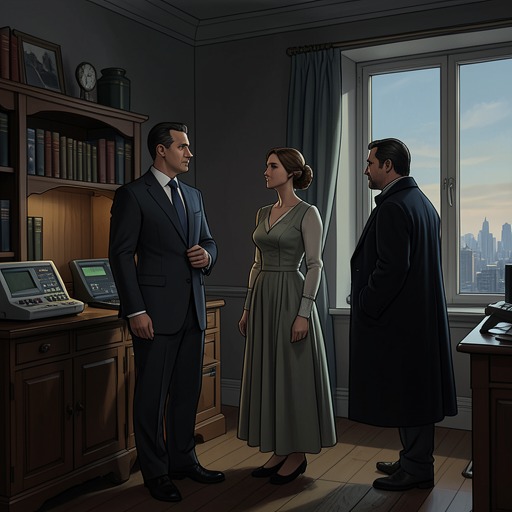
Tommy’s sudden idea sends him racing back with Albert. At the suite, Mrs. Van Snyder calls him mad, but he identifies the hiding place as beneath the bolster, laid horizontally across the bed. He also recognizes the wardrobe trunk prepared to carry a body away. His reconstruction is that the apparent nurse-and-invalid-boy escape was a decoy: Tuppence had been drugged and placed under the bolster, while an accomplice posed as a bound and gagged woman and Mrs. Van Snyder presented herself as a victim. The supposed sequence could not have been completed in the five minutes available. Tommy’s conclusion turns on physical time and arrangement, not on the theatrical persona he has adopted.
The rescue brings the method and the marriage into the same frame. Even while trying to reason through the abduction, Tommy tells Albert that Tuppence is worth a dozen men like them. His admiration is not merely affectionate decoration: throughout their work, she supplies costumes, tests his assumptions, compares clues, and helps turn his performances into investigations. When the crisis becomes personal, the joking detective routine gives way to an urgent search, then returns as the means by which he orders the facts and reaches her.
Character and Narrative Role
Tommy is drawn through a productive contradiction. He enjoys grand identities and detective-fiction quotations, but he is not simply a fool playing at detection: the valerian, the photographic comparison, the reversed question about the diplomatic bags, and the timed reconstruction in Mrs. Van Snyder’s suite all show him using practical clues to reach consequential conclusions. Conversely, the clues do not always produce a completed solution. The Merivale costume requires confirmation, and the identity of the woman connected with Captain Sessle remains a mystery. The narrative lets performance sharpen attention while refusing to make confidence equivalent to proof.
His changing detective masks also make the couple’s cases a comedy of genre expectations. Tommy chooses the endangered Desmond, the imperious Poirot, or the conspicuously capable agency manager; Tuppence often sees the gap between the role and its demands, and sometimes points toward the useful next step. Yet the play is not a barrier to serious work. It gives them a flexible way to disguise themselves, encourage observation, and keep reasoning together under pressure. In the final rescue, the borrowed language of fictional detection yields to the simplest test of all: whether the proposed events could physically have happened in the time allowed.