Tommy and Tuppence’s detective role-playing
Partners in CrimeTommy and Tuppence’s detective role-playing is the Beresfords’ recurring practice of borrowing the identities, methods, and props of celebrated fictional detectives as they investigate real cases. Its significance lies in the tension between theatrical imitation and practical amateur insight: the performances can be playful or overconfident, yet the couple’s exchanges also help them interpret evidence and make use of their distinct knowledge of people.
A detective agency as a stage
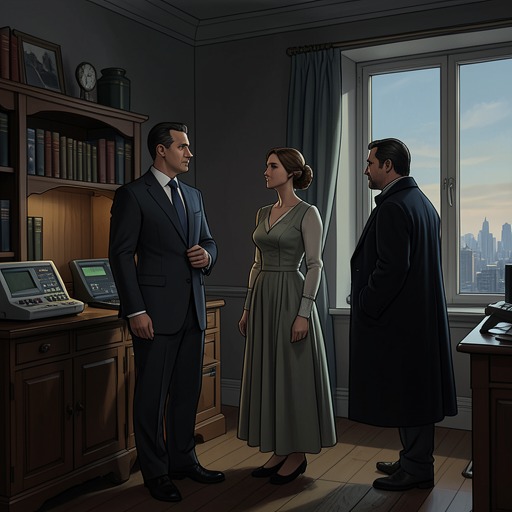
The performance begins alongside the couple’s new professional identity. In the International Detective Agency offices, Tommy sits behind an imposing desk among artistically labeled but empty files, while Tuppence works in the adjoining room with a typewriter and a gas ring for making tea. The office is carefully arranged to suggest an established business even though it has no clients. Tommy’s role as the agency’s chief is itself a performance, supported by rehearsed telephone effects and Albert’s instructions; the couple’s later impersonations of fictional investigators grow naturally out of this theatrical workplace.
Tommy makes that impulse explicit when he begins studying detective stories by leading writers. He sees the books as models whose styles can be tried and compared, partly to compensate for the couple’s amateur status. He has bought a camera and proposes photographing and enlarging footprints, imagining that technique can be acquired through practice. Tuppence, however, points out the limits of one model he invokes: he lacks the medical, legal, and scientific knowledge associated with Thorndyke. Their play is therefore not simply an assumption that fictional methods will work. From the outset, it includes an argument about what imitation can and cannot supply.
Taking on familiar roles
The books become a shared vocabulary for assigning parts. When Tuppence suspects that their adversaries have discovered Tommy is not the original Mr. Blunt, Tommy responds by selecting the brothers Okewood as their new roles: he claims the part of Desmond, while Tuppence chooses Francis, whom she considers the more intelligent brother and the one who arrives in time to rescue the situation. The joke turns a literary pairing into a light-hearted negotiation over competence and responsibility. Their chosen characters are not merely disguises; they let the couple frame their own relationship as a familiar detective adventure.
At another point, Tommy adopts the manner of Sherlock Holmes, calling Tuppence Watson and insisting that she observe rather than merely see. He uses the pose to examine an encounter in a café, while Tuppence punctures the performance by identifying him as the Old Man in the Corner and asking after his piece of string. Tommy produces a twisted length of string and ties knots in it, completing the borrowed detective’s characteristic prop. The moment makes imitation visible and reciprocal: Tommy tries on one investigator’s habits, and Tuppence recognizes and answers with another investigator’s signature device.
Their repertoire also includes the Great Hanaud and Hercule Poirot. On seeing a prospective visitor, Tommy imagines himself as Hanaud, praising the detective’s ability to shift among sharply contrasting social roles. Tuppence questions whether Tommy can manage those changes of personality, and he reasserts his authority as captain of the ship. Later, in a deliberately heightened exchange, Tommy declares himself Poirot, recasting the formidable criminal they believe they face as No. 16 and invoking the earlier No. 4. Tuppence supplies the corresponding Hastings role; Tommy refuses the possibility of changing the established arrangement in which Hastings remains the foolish friend. These enactments turn recognition of detective-fiction conventions into a running game between partners.
Performance and practical reasoning
The role-playing does more than decorate the investigations. During one discussion, Tuppence asks to take charge, describing herself as the bull who has spent more than twenty minutes in the arena. Tommy accepts the reversal and names her captain of the ship. Their metaphors make investigative authority something they can pass between them, rather than a fixed prerogative of Tommy’s assumed role as chief. The exchange marks the value of Tuppence’s reading of a case and Tommy’s willingness to let her lead.
Their method is grounded in what they call the amateur point of view. Tommy recalls that Marriot valued its intimacy: the Beresfords know something about people like Captain Sessle and his wife, including what they are likely to do and what they are unlikely to do. Each partner contributes particular knowledge. The observation connects their playful detective personas to a more personal form of inference, based not only on abstract technique but on familiarity with people and social behavior.
The couple also borrow investigative procedures as well as character identities. After a client leaves, Tuppence invokes Inspector French and his method of checking alibis: an account may initially appear sound, but careful examination can expose its flaw. Tommy later claims that showing photographs to a restaurant waiter was exactly like Inspector French, although Tuppence notes that their work has required more half-crowns and ten-shilling notes than the fictional method seems to demand. Their exchange combines genuine procedural imitation with comic awareness of the difference between literary economy and the practical costs of an inquiry.
The joke and its limits
The performances repeatedly put fictional expectation beside the demands of actual investigation. A borrowed role offers an immediate template, but Tuppence is ready to challenge its fit: she questions Tommy’s resemblance to Hanaud and his ability to manage the detective’s changes of personality, and she corrects his interpretation of what she will order in the café even as he presents his observation as Holmesian. The comedy depends on the gap between the grandeur of the assumed persona and the ordinary partnership in which each can see the other’s mistakes.
That gap also keeps the play from being merely escapist. The couple’s first impulse to study the masters acknowledges that they are amateurs; the question is whether a model can teach them something useful without disguising what they do not know. Their borrowed scripts supply hypotheses and habits—photographing footprints, checking alibis, attending to small clues—but the investigations still call for judgment tailored to the people and circumstances before them. The result is a continuing exchange between literary convention and lived experience: detective fiction gives the Beresfords roles to perform, while their partnership tests those roles against the untidy work of solving cases.