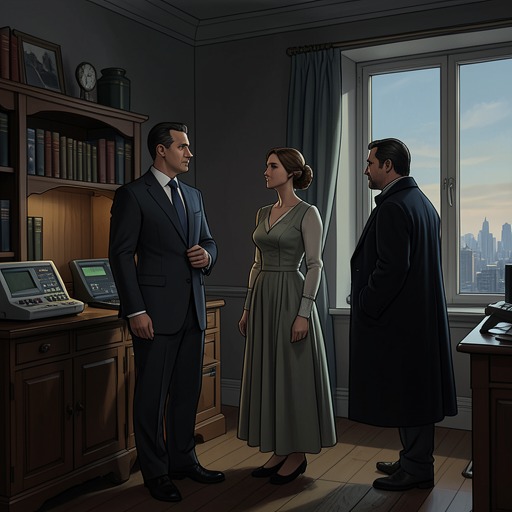
Tuppence Beresford
Partners in CrimeTuppence Beresford is an amateur detective whose appetite for action becomes a disciplined, inventive way of working beside her husband, Tommy Beresford. Across the cases in the book, she moves readily between performance and analysis: she adopts assumed identities, reads people and physical clues, and brings experience that Tommy does not have. Her investigations are also a continuing game of detective-fiction role-playing, but the game has real stakes, and its final turn is domestic: she announces that she and Tommy are expecting a child.
Identity and Introduction
Introduced as Mrs. Thomas Beresford, Tuppence is restless in the couple’s flat, looking out at the small block opposite, sighing and yawning before wishing that something would happen. The domestic stillness establishes a contrast that runs through her story: she wants incident, and the work of detection repeatedly supplies it. When Mr. Carter visits, she greets him warmly, while his question about how life is going brings the couple’s ordinary circumstances into the same conversation as their new professional prospects.
Tuppence’s professional manner is itself a performance. When she enters as Miss Robinson to speak with Lawrence St. Vincent about a missing young woman, she is neat and demure, and she adopts a soft, sympathetic voice. Her apparent concern is deliberately qualified by false cheerfulness: St. Vincent is so worried that her manner depresses him, yet it helps establish the attentive persona through which she can hear his account. She quickly gives him room to express his devotion to the missing woman and asks him for her name and the details of the disappearance.
The Detective Game and Its Methods
The Beresfords approach detection partly through the conventions of the books they read. Tommy proposes studying the leading detective-story writers, trying different styles and comparing results; Tuppence immediately tests that ambition against his limitations, noting his lack of medical and legal experience and weak scientific knowledge. Their exchange makes the couple’s amateur status a source of both comedy and method: they know they lack professional training, but they are alert to the limits of borrowed formulas and to what their own experience can contribute.
Their role-playing is not confined to reading. When Tommy decides that their opponents have recognized that he is not the real Mr. Blunt, he casts them as the brothers Okewood, choosing to be Desmond. Tuppence counters that she would rather be Francis, whom she regards as the more intelligent brother and the one who arrives in time to save Desmond from trouble. At the end of another dangerous episode, Tommy calls her brother Francis as he takes both her hands, crediting the role-play with a practical result: she has helped bring about his release.
Tuppence also uses the language of detective fiction to prod Tommy into looking again. Confronted with a fireman’s kit, she tells him to use his little grey cells and invokes Watson and a bull in the arena. The costume is not self-explanatory; her teasing turns it into a prompt to infer a purpose. The joke captures a central rhythm of their partnership: she does not simply hand Tommy an answer, but challenges him to recognize what the evidence and disguise imply.
Observation, Experience, and Partnership
During the investigation of the murder of Captain Sessle, Tuppence’s attention to people helps resist an overly simple reading of a clue. Doris Evans’s account is that she struggled to escape Captain Sessle and ran across the golf links; a revolver found near the body had not been fired. The case remains unresolved in the account presented to the Beresfords, with suspicion focused on a tall woman in brown whose identity and connection to the crime are unknown. Tommy reasons that a hat pin points toward a woman as the killer. Tuppence challenges that assumption rather than treating the object as decisive, and Tommy acknowledges that talking the problem through with her can make its elements straighten out.
She explains their advantage as an amateur one: intimacy with the kinds of people involved, knowledge of what they are likely to do and what they are not, and distinct forms of personal expertise. Tommy recognizes her familiarity with women’s likely possessions and with the feelings and actions of wives. This is not a claim that instinct alone solves the case. It is a statement of how their everyday knowledge can test an inference that might otherwise be mistaken for proof.
Tuppence’s most explicit contribution of specialist knowledge comes in the investigation involving Lois Hargreaves and Dennis Radclyffe. She tells Miss Logan that she worked in a hospital during the War and knows about serum therapeutics. She applies that knowledge to ricin: small hypodermic doses can produce immunity and antiricin, while the later poisoning could be made to look like a fatal exposure. Tuppence accuses Miss Logan of using her knowledge of the poison, acquired through helping her father’s work, to arrange the deaths in an order that would affect inheritance. The explanation links scientific knowledge to motive and timing, while showing that Tuppence’s wartime experience is more than a biographical detail: it gives her a basis for recognizing what another character has manipulated.
In the investigation of the newspaper costume at the Ace of Spades, Tuppence and Tommy also connect a fragment to a full sheet of the Daily Leader. Captain Hale’s account is that he never spoke to Lady Merivale at the performance and received a note warning him that Arthur suspected; he cannot produce the note. The Beresfords know he was with Lady Merivale there, and the photographs show that the torn fragment marked DAILY LE fits a small tear in the newspaper’s front sheet. Tuppence identifies the marks along the edge as stitches, linking the fragment to a costume sewn from multiple sheets. The physical match sharpens the case, although the difference between a matching clue and a complete explanation remains important: the fragment supports an inference about the costume, while the surrounding accounts still have to be assessed.
Disguise, Danger, and Resolution
Tuppence’s disguises make her an active participant in the cases, not merely a commentator beside Tommy. In the diplomatic-bag investigation, she calls Scotland Yard after reading Tommy’s note; Inspector Grace and another officer meet her outside the beauty shop. When the operation is exposed, she is revealed as the apparently ordinary customer who has been holding Cicely March, while the officers restrain the prisoner. Tommy’s explanation turns on reversing the apparent question: rather than asking why someone wanted the ambassador’s bag for an hour, he asks why the other bag needed to be in the ambassador’s possession. Because diplomatic luggage is not subject to a Customs examination, he infers that the exchange conceals smuggling, likely of drugs. Tuppence’s call and disguise help convert that reasoning into an arrest.
The book’s extended No. 16 episode makes the dangers of performance especially clear. Tommy adopts the persona of Hercule Poirot and identifies the supposed criminal as No. 16, a figure connected in his account to the earlier No. 4. Tuppence is later drugged and hidden horizontally across the bed, beneath the bolster, while the attackers attempt to make Mrs. Van Snyder seem like a bound victim and direct the investigators toward a false trail involving a nurse and a boy. Tommy rejects the account as physically impossible to arrange within five minutes, exposes the decoy, and finds Tuppence alive but unconscious. The moment briefly makes the danger personal for him, even as he insists afterward that he remained calm. Tuppence calls him a liar when he denies having been half frantic, and his haggard appearance contradicts his claim.
Change and Ending
For much of the book, Tuppence’s curiosity is expressed as a wish for something to happen; the cases turn that wish into action, risk and responsibility. Her skill develops through a combination of theatrical adaptability, close attention to evidence, candid argument with Tommy and knowledge acquired outside detective work. She is willing to inhabit the role required by an investigation, but she also questions the deductions those roles encourage, especially when a conspicuous object seems to point too neatly toward a conclusion.
The final exchange shifts the scale of the story from cases to family. When Tommy asks what she means, Tuppence announces, loudly and triumphantly, that she is speaking of their baby. Her news does not cancel the partnership that has defined the book; it changes the horizon beyond its investigations. The woman who began by wishing for an event ends by naming a new one, and the last word belongs to a future she and Tommy will meet together.