
Arne-Sayles’s Theory of Other Worlds
PiranesiThis flow traces Arne-Sayles’s ideas from claims about ancient perception to the creation of a route into the House and the consequences of those ideas for others.
increasing Bearing strength in each event
 decreasing
Bearing strength in each eventdecreasingThe Lost Dialogue

A World That Answers
Ancient perception
Arne-Sayles argues that earlier people experienced nature as responsive and meaningful, rather than as mute material. Rivers, stars, and other powers were participants in human life.
Disenchantment as loss
He interprets modernity as a rupture in that relationship. The idea gives his later search its emotional force: he wants not merely to study old beliefs but to recover what he thinks has departed.
The Seer’s Head
Seeking a Physical Link
The proposed ritual
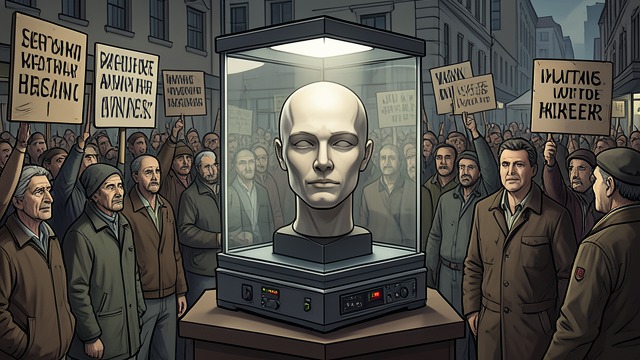
Arne-Sayles claims that ancient powers might be recovered through a physical connection to someone who possessed them. He seeks access to Marepool III, a preserved head he identifies as a king and seer.
Public confrontation
The museum refuses his request, and supporters stage “Free the Head” demonstrations. The dispute shows his willingness to turn speculative theory into public pressure and action.
A Door Between Worlds
The Half-Seen Door
A model of passage
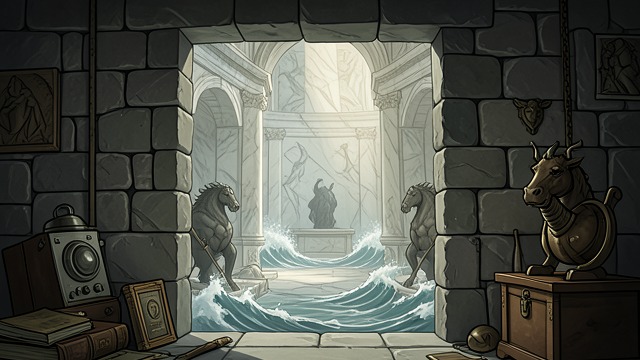
Arne-Sayles describes lost powers as energy that has flowed elsewhere, leaving a passage behind. He uses the image of water wearing a cave through stone to explain how another world might become reachable.
A personal method
He says that returning to a childhood state of perception lets him see the door. His theory combines intellectual argument with a method that depends on memory and altered awareness.
A Labyrinth Described
The World Beyond the Door
A physical arrival
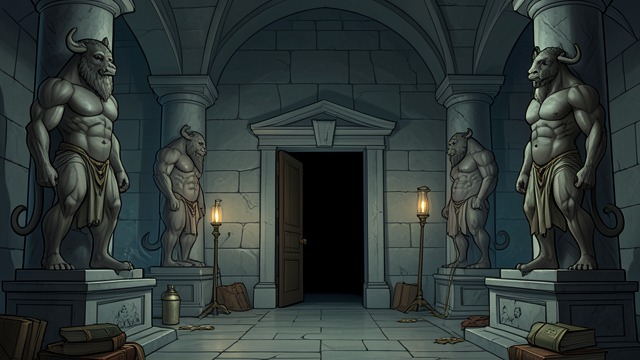
Arne-Sayles describes a vast marble chamber with minotaur statues and the sound of the sea. The account closely resembles the House Piranesi inhabits.
A disputed legacy
The theory may explain how people reach the House, but it does not make Arne-Sayles benevolent. His knowledge coexists with manipulation, coercion, and a willingness to leave others trapped.
A Theory Used Against Its Maker
The Route Remains Open
Raphael’s discovery
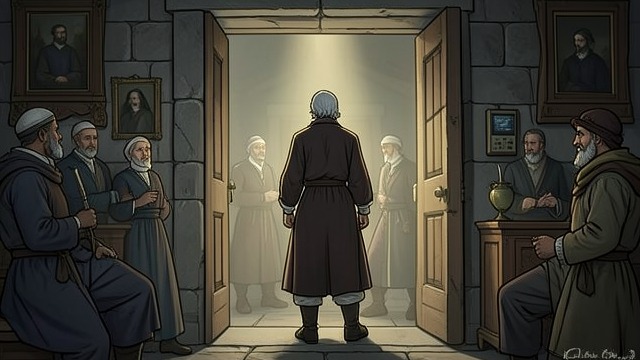
Sarah Raphael uses Arne-Sayles’s instructions to reach the House and find Matthew. The same theory that enabled disappearance also makes rescue possible.
Knowledge without absolution
Matthew can later travel between worlds and bring James Ritter back to the labyrinth. Arne-Sayles’s theory proves consequential, but its practical truth does not excuse the harm caused in its name.
In Arne-Sayles’s early published work, beginning in 1969
During the 1976 campaign around Manchester Museum
In the account published in 1979
When Arne-Sayles recounts his first entry into the House
After Piranesi returns to the outside world
