
The Mythic Garden and Repeating Patterns
PossessionThe garden, tree, water, snake, and golden fruit recur across poems and lives, making the novel’s central images both shared patterns and unstable meanings.
increasing Bearing strength in each event
 decreasing
Bearing strength in each eventdecreasingAsh’s Golden Apples
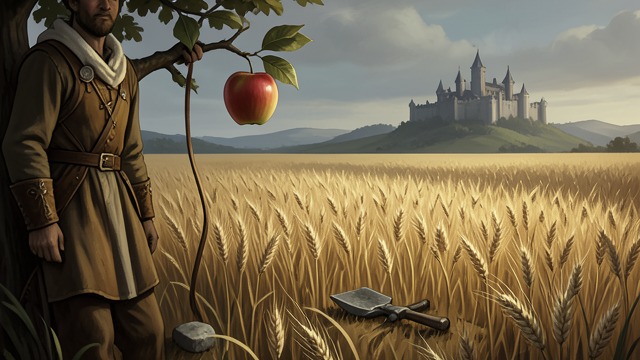
Grain, Gold, and History
Vico’s Interpretation
Ash’s notes link golden apples to grain and the early origins of commerce and community. Myth becomes a way to imagine how material life acquires symbolic form.
A Pattern Begins
The garden and fruit later recur in poems and relationships. Their repeated appearance invites connection without guaranteeing that every occurrence has the same meaning.
The Garden of Proserpina
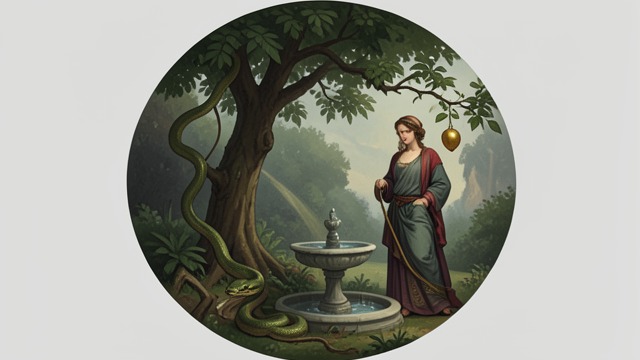
A Poem Reopens
The Shared Images
Roland sees garden, tree, woman, water, serpent, and gold as a connected poetic system. The poem does not reduce them to a single sexual or theological code.
A New Reader
Reading becomes an encounter with language’s patterns rather than a hunt for a hidden biographical key. Roland finds that a poem can be historically resonant and independently alive.
LaMotte’s Melusina Landscape
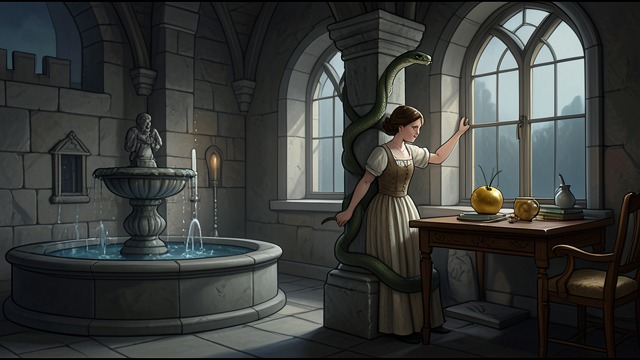
The Fountain and the Keep
A Female World
LaMotte’s poem links water, castle building, domestic labor, and the serpent’s body. Its images resist the simple opposition between a safe home and a monstrous outside.
Changing Interpretations
Maud’s scholarship reads the poem through female autonomy, while the recovered letters connect it to Ash and Yorkshire. Neither context exhausts the poem’s imaginative world.
The Researchers Repeat the Pattern
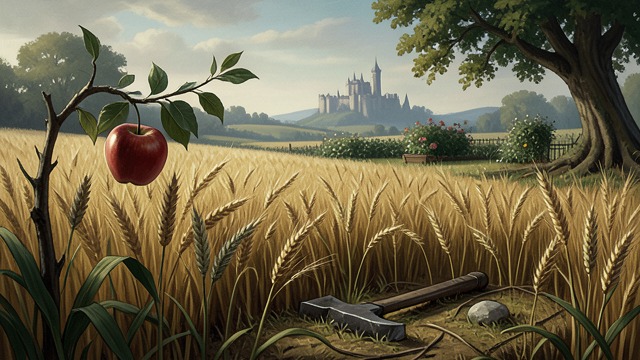
Two Landscapes, One Vocabulary
Echoes
Maud and Roland notice correspondences between Ash’s natural-history letters and LaMotte’s descriptions of water, stone, and light. Their shared attention makes landscape function as evidence of a past encounter.
The Danger of Overreading
The researchers know that metaphor can become a net that catches everything. Their task is to recognize real echoes without mistaking repetition for certainty.
The Recovered Garden
A Pattern Without Ownership
Recognition
The final poem returns to the garden and its creatures, showing that images move across writers, readers, and generations. No one character owns the pattern outright.
The Novel’s Open Meaning
The mythic garden is at once a place, a literary construction, and a structure of human desire. Its persistence suggests continuity, while its changing forms resist final interpretation.
In the Vico notes found at the novel’s opening
During Roland’s later reading in Putney
During the reading of The Fairy Melusine
During the Yorkshire trip
In the final chapter of the contemporary plot
