
The Limits of Feminist Interpretation
PossessionThe novel stages feminist recovery as necessary while questioning any reading that converts every poem, body, and landscape into a single ideological code.
increasing Bearing strength in each event
 decreasing
Bearing strength in each eventdecreasingA Forgotten Woman Poet

Recovering LaMotte
Historical Neglect
Christabel LaMotte is dismissed by older accounts as a minor, obscure poet. Feminist critics recover her work and show how Victorian conventions restricted women’s subjects and authority.
The Value of Recovery
The new scholarship restores a neglected writer to the literary record. Yet the act of recovery must still attend to the actual complexity of her poems and life.
Melusina as Feminist Figure
Power and Monstrosity
A New Reading
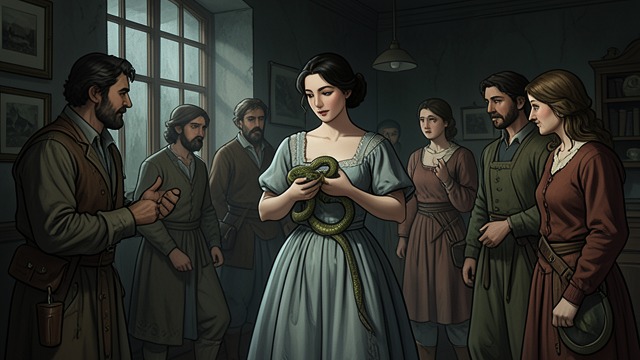
Leonora and Maud interpret Melusina as a figure for female power, sexuality, and the fear of women who exceed prescribed roles. The poem’s serpent form becomes a challenge to patriarchal judgment.
Multiple Meanings
LaMotte’s own writing also gives the fairy domestic and maternal dimensions. The novel resists turning a complex figure into a single emblem of liberation.
Roland’s Objection to Reduction

Metaphor as a Cage
Critical Saturation
Roland objects when every glove, landscape, and organism is reduced to human sexuality. He fears that theory can make the external world disappear inside a single interpretive system.
A Productive Dispute
Maud does not simply dismiss him; she argues that historical truths about sexuality cannot be wished away. Their debate asks criticism to acknowledge both real social structures and the particularity of objects.
Women’s Archives and Access

Institutions of Recovery
A Home for Women’s Work
Maud wants LaMotte’s manuscripts kept in the Women’s Studies Resource Centre, where they can support future scholarship. Leonora wants broad access and recognizes the risks of institutional underfunding.
Equality and Practical Need
The discussion shows that feminist recovery depends on material resources as well as interpretation. A small archive can embody autonomy but may struggle to preserve fragile documents.
A More Complicated LaMotte

Beyond the Category
New Evidence
LaMotte’s love for Ash, her concealed motherhood, and her artistic independence challenge accounts that identify her only as a lesbian-feminist symbol or a secluded spinster.
Recovery Without Simplification
The new information does not invalidate feminist readings, but it makes them more historically specific. The novel argues for a critical practice that can revise its categories without erasing what they first made visible.
Before Maud’s research begins
During the contemporary critical debates
At Filey Brigg
During the dispute over LaMotte’s papers
After the final letter is read
