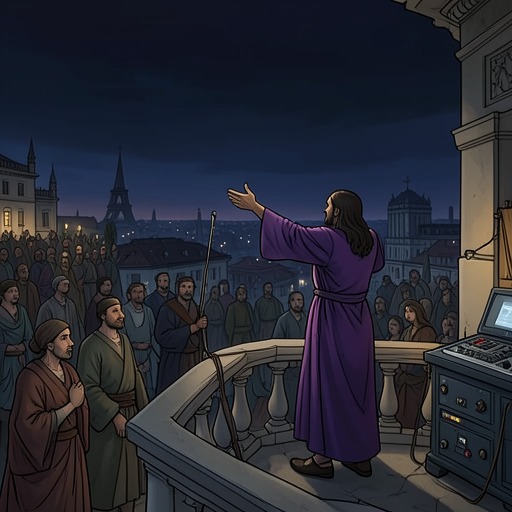
Augustian courtiers
Quo VadisThe Augustian courtiers are the elite and dependent retinue clustered around Nero, a courtly world whose members appear as spectators, beneficiaries, rivals, and potential victims of imperial power. They accompany Nero through feasts and journeys, gather at moments of illness and political uncertainty, and fill the audience at the persecution of Christians. Their significance lies in this double position: they help stage the emperor’s authority, yet their shifting loyalties and reactions reveal how precarious that authority has become.
Identity and Courtly Composition
The group is not presented as a formal body with a fixed membership or defined duties. It is a moving court composed of people whose status and access vary: senators and knights, freedmen, slaves, women, and children all appear in Nero’s retinue. On his journey toward Antium, the court is described as so extensive that it seemed to include everything richest, most brilliant, and most notable in Rome. Nero’s traveling society could exceed the number of soldiers in a legion, a measure of the scale at which imperial privilege moved through the city and countryside.
The court’s social breadth does not erase its hierarchy. At the palace, visitors gather among the slaves to ask after the imperial infant, while senators and knights also use the occasion to make their concern visible in the presence of Nero’s household. The scene shows that access itself is political: the courtiers’ proximity to the palace, and their display of anxiety before its servants, help mark their standing within the imperial world.
Feasts, Display, and Imperial Travel
At Nero’s feast, the court participates in a spectacle of abundance. Slaves circulate with successive courses; wine is brought from large vessels packed with snow and decorated with ivy; and roses fall from the ceiling as the guests drink freely. The feast is more than private consumption. Its carefully staged excess places the courtiers inside a performance of imperial wealth, in which service, decoration, and the assembled audience make Nero’s power visible.
Tigellinus later organizes an even more ambitious banquet at the Pond of Agrippa, intending to compensate Nero for the postponed journey to Achaea and to outdo every previous host. Praetorians ring the groves to keep the crowds from disturbing the emperor and his guests. Preparations extend from Naples and Beneventum, with rare animals, birds, fish, plants, vessels, and cloth brought from distant regions; the revenues of whole provinces are spent on the project. The courtiers’ presence at such an event joins their privilege to the political machinery that protects and finances imperial display.
Travel turns the court into a public procession. As Nero’s party sets out for Antium, Poppaea passes in a litter carried by eight Africans, followed by servants and wagons of personal effects. Petronius travels in a litter with his enslaved attendant, while Tigellinus rides in a chariot drawn by decorated ponies. The procession continues for hours, and the full retinue seems to migrate from Rome. The spectacle projects magnificence, but its enormous size also makes court life dependent on constant movement, display, and the labor of those who serve it.
Favor, Rivalry, and Political Insecurity
Within the court, apparent favor is unstable and closely watched. After Petronius withdraws into the depth of a chamber, senators and knights immediately gather around him, assuming that he must now be Nero’s leading favorite. Tigellinus, silent, records their behavior. The moment exposes court allegiance as a calculation: the courtiers interpret a single incident as a change in access, while a rival minister observes who has aligned himself with the man expected to rise.
Petronius’s influence rests in part on his ability to judge and discuss poetry, music, and artistic excellence with Nero. His habitual detachment and wit make him appear indifferent to the court, and he can criticize the emperor to his face before turning the exchange to his advantage. The courtiers believe that Nero cannot easily dispense with such a companion. Yet the same proximity that gives Petronius influence also makes his position vulnerable as Nero’s character and interests change.
The court’s fear sharpens when Nero’s conflict with the Senate grows dangerous. Tigellinus considers summoning legions from Asia Minor, while Vatinius loses his habitual humor and Vitelius his appetite. The Augustians are themselves alarmed because any morning might bring their destruction. Tigellinus opposes a proposal that Petronius might otherwise have made, not because he can devise a better solution, but because he resents the possibility that Petronius will once again rescue the court and regain singular influence. Personal rivalry therefore affects decisions made under collective threat.
Petronius’s survival offers only a temporary image of security. After leaving Nero, he returns to his house on the Carinae, which has escaped the fire because a garden surrounds three sides of it and the small Caecilian Forum lies in front. Other Augustians who have lost homes, wealth, and works of art call him fortunate; his reputation as Fortune’s favorite seems confirmed by Nero’s recent friendship. But the contrast between his intact house and the losses of the other courtiers is contingent, not a guarantee of safety. Later, while Petronius is at Cumae with other Augustians following Nero, he receives a letter that makes clear that his long contest with Tigellinus is nearing its end. Nero increasingly regards Petronius’s silence as blame and his praise as mockery, while his wealth and art have become objects of desire to both emperor and minister.
Spectators and Public Judgment
The Augustians are repeatedly defined by where they stand as viewers. Nero’s entry into Rome after the fire is guarded by sixteen thousand Praetorians, who hold the agitated population at a distance. The crowd curses, hisses, and shouts; some among the poor applaud in hope of a more generous distribution of wheat, olives, clothing, and money. Tigellinus orders horns and trumpets sounded, and Nero ascends the Appian aqueduct, followed by Augustians and singers carrying musical instruments. The procession is thus framed by competing audiences: a court arranged around the emperor, an angry population held back by soldiers, and the poor whose material hopes shape their response.
From the aqueduct, Nero watches the burning city as a scene suited to the tragedy he is composing. The court and singers accompany his performance, while the Roman people below mutter and protest. The distance between the elevated imperial party and the population beneath it gives the episode its political force: Rome’s catastrophe becomes an occasion for Nero’s self-presentation, and the courtiers’ presence helps furnish the setting for that performance.
At the executions of Christians, attendance becomes an explicit display of loyalty. The amphitheatre fills by dusk, and the Augustians arrive together with Tigellinus at their head, not only to see the spectacle but also to demonstrate devotion to Nero and their judgment of Chilo, whose actions have become a subject of public attention. The court’s collective appearance makes the audience part of the event’s political staging.
Yet spectatorship does not produce a uniform response. During the arena spectacles, members of the audience encounter Christians presented in staged scenes drawn from myth and Roman history. The courtiers are among those who watch, but the spectacle also places individual acts of endurance before the assembled public. Vestinius warns that the Christians’ divinity cannot be treated lightly, and says he would offer a hecatomb to it if Nero permitted. His statement registers a challenge to the religious and political assumptions of the court from within its own audience.
When Nero looks toward the Augustians for signs of whether the condemned should die, Petronius raises his hand in a nearly defiant gesture for mercy. Vestinius does the same, followed by Scevinus, Nerva, Tullius Senecio, Ostorius Scapula, and other distinguished figures, including Thrasea, who is honored by the people. The amphitheatre has already gone wild, but these raised hands show that the court is not simply a passive instrument of Nero’s will. At a decisive moment, visible dissent within the imperial audience becomes part of the public judgment on the spectacle.
Narrative Significance
The Augustian courtiers bind together the novel’s scenes of luxury, political calculation, and mass violence. At banquets they help make imperial abundance into theatre; on the road they enlarge Nero’s procession into a moving image of rule; during crisis they watch rivals rise and fall; and in the amphitheatre their gestures register whether the emperor’s command still governs the judgment of those closest to him. Their shifting reactions also expose the insecurity beneath their privilege. They can crowd around a newly favored man, fear destruction when Nero confronts the Senate, and risk signaling mercy when the emperor solicits a verdict of death.
Their function is therefore not only to surround Nero but to make his power legible through an audience. The court’s presence can magnify his performance, as when Nero appears above the burning city, but its members can also withhold the response he expects. In the final arena episode, the movement from collective attendance to individual signs of mercy gives the courtiers a role in the conflict between imperial spectacle and moral judgment: the emperor’s public audience becomes, briefly, a visible measure of the limits of his authority.