Campania
Quo VadisCampania is the southern Italian setting around Rome that gives the Great Fire a regional scale: its roads carry Vinicius toward the capital, its countryside fills with people drawn by the disaster, and its neighboring towns and port supply the city’s emergency relief. The region also belongs to the novel’s contrast between imperial abundance and the vulnerability of ordinary people when urban order and food distribution fail.
Setting and Imperial Travel
The route to Antium, on the Campanian coast, is presented as a stage for Nero’s immense traveling household. Before Poppaea’s arrival, herdsmen from Campania drive five hundred she-asses toward the gates so that she can bathe in their milk. The crowds watch the procession, then clear and decorate the road with flowers and pine needles, expecting the floral covering to extend all the way to Antium. The preparations turn an imperial journey into a public spectacle, while the people’s labor and private gardens furnish its display.
Nero’s expeditions require far more than a temporary retinue: servants carry domestic furniture, statues, and mosaics, while Praetorian guards and Augustians travel with their own household slaves. Against this extravagant movement, Campania’s roads also carry the practical traffic of people seeking safety, news, and provisions.
The Fire and the Roads into Rome
When news of the fire reaches him at Nero’s villa, Vinicius leaves for Rome at night, riding through the countryside toward the capital. His journey passes through relay stations and towns, including Aricia, where crowds have gathered with torches and the news that Rome is burning is already circulating. He learns from mounted Praetorians that the disaster is not a distant rumor but an advancing emergency, and presses on toward the city.
The approaches to Rome are crowded with people fleeing in the opposite direction. Roads, fields, gardens, cemeteries, and temples have become temporary camps; the route is obstructed by those escaping as well as by disorder and violence. Vinicius cannot enter through the Appian Gate because of the congestion and intense heat, and the missing bridge across the Tiber forces him to consider a longer route around the flames toward the Via Portuensis and the Trans-Tiber district. Campania’s road network thus becomes part of the disaster itself: it brings the news and the would-be rescuer toward Rome, but cannot guarantee access to the city.
Regional Disaster and Breakdown of Order
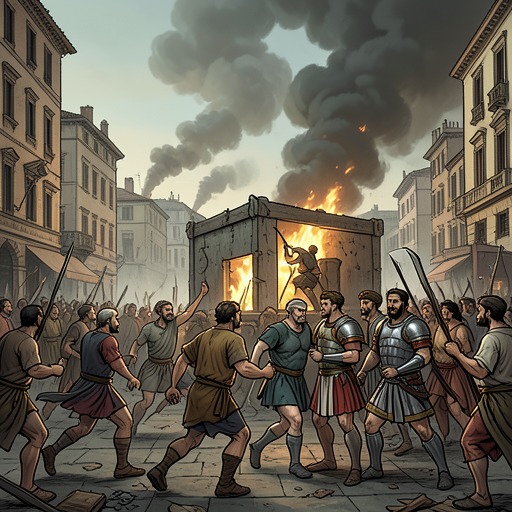
The fire spreads through Rome’s densely built districts, where timber structures, shops, warehouses, and stored food provide abundant fuel. The narration depicts new fires breaking out far from the main conflagration and notes that wind carries burning fragments beyond the immediate blaze. People gather on aqueducts and outside the city, while others arrive from small towns and the Campanian countryside, some seeking safety and some hoping to plunder. The capital’s catastrophe therefore draws the surrounding region into its orbit even as it sends residents outward.
The flight and influx of people intensify the collapse of public order. Displaced residents lose homes and possessions; crowds compete for shelter, and violence and robbery spread amid rumors about the cause of the fire. The novel distinguishes these popular suspicions from established fact: many people accuse Nero of ordering the burning, but the rumor is presented as a belief circulating among the crowd, not as proof of responsibility.
Relief, Supply, and Aftermath
Once Tigellinus arrives from Antium, the authorities order houses demolished on the Esquiline to create open spaces where the advancing fire may die out. This effort aims to preserve what remains of the city rather than save the districts already burning. Meanwhile, the destruction of Rome’s immense food stores leaves hundreds of thousands outside the walls without adequate supplies; hunger begins to grip them within two days.
Orders for provisions are sent to Ostia, and flour and baked bread are brought from there and from towns and villages nearby. Yet arrival does not mean effective distribution: at the Emporium, a crowd breaks into the storehouse and seizes the supplies, producing further disorder before soldiers take control. The episode makes Campania’s surrounding settlements and routes essential to relief, while showing how the loss of storage, authority, and orderly distribution turns food itself into a flashpoint.
Departure Through Campania
After the persecution and deaths of fellow believers, Peter leaves Rome with Nazarius, walking along the Appian Way toward Campania at dawn. The movement away from the capital reverses Vinicius’s earlier rush toward it: the same regional road that carried news, refugees, and emergency traffic now serves as Peter’s route out. Campania consequently links the novel’s scenes of imperial travel, urban catastrophe, relief, and religious departure without becoming merely a distant backdrop.