Christian Martyrdom and Eternal Life
Quo VadisChristian Martyrdom and Eternal Life is the novel’s account of how the Christians understand and endure persecution: death inflicted by Rome becomes testimony to Christ, while the promise of resurrection turns apparent defeat into hope of eternal life. The idea moves from private conviction to a shared discipline, voiced by Peter, embodied by the condemned, and set against the emperor’s claim to divine authority. Its force lies not only in what believers say about death but also in how their conduct changes the meaning of the spectacle for witnesses.
Belief and Its Conflict with Imperial Power
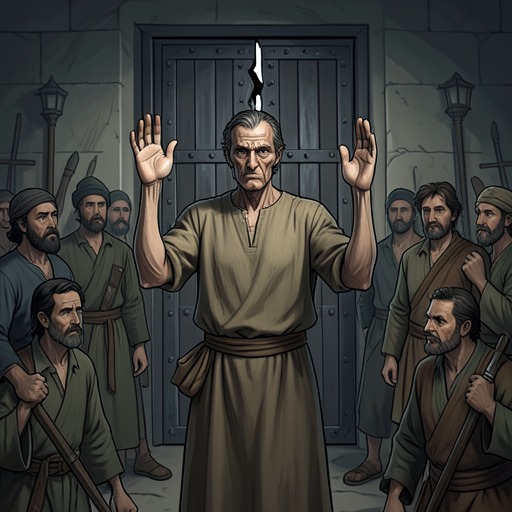
The conflict begins with rival claims to ultimate authority. When Nero asks whether the Jewish priests refuse to call him a god, their representative answers that they would rather die than violate their law. Nero then observes that Chilo’s faith does not prevent him from calling the emperor a god; Chilo replies that his faith is in Nero and that he hates the Christians. The exchange makes public religious language a test of allegiance: the emperor seeks divine recognition, while the Christians’ confession points to a power Rome cannot command.
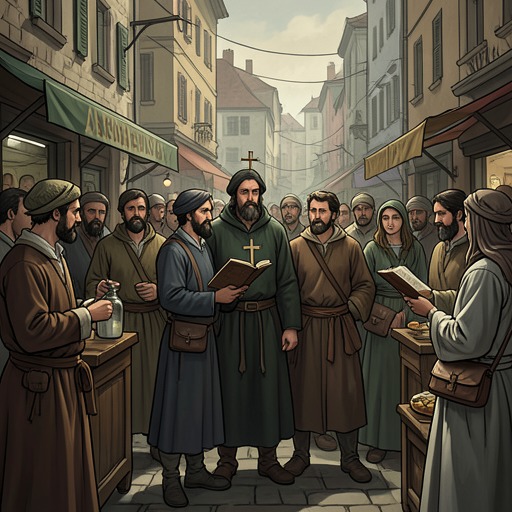
Earlier, Vinicius approaches the Christians’ gathering with the assumptions of an outsider. He wonders why they meet cautiously to hear their highest priest instead of worshipping openly in the temples used by the Jews in the Trans-Tiber district. Chilo explains that Christians conceal themselves from both Jewish enemies and a hostile populace that accuses them of crimes. The contrast helps establish the conditions under which martyrdom becomes possible: the community’s public witness arises from a life already shaped by suspicion and concealment.
Vinicius’s conversion shows that this faith is not merely a refusal of imperial claims but an affirmative commitment to love. Asking Peter for baptism, he says that although he once believed in the Roman gods, he did not love them; he now loves the one God and would gladly give his life for him. Peter answers by directing him to love other people as brothers, the means by which he may serve God. Vinicius’s declaration that he would confess God even if the city and the whole world perished places spiritual allegiance above the survival of Rome, while Peter’s response binds that allegiance to a practical ethic of love.
Peter’s Address to a Fearful Community
As persecution intensifies, the believers’ confidence falters. Vinicius sees their distress and fears that Peter might admit that Nero is stronger than Christ. The fear is more than concern for physical survival: if the apostle were to deny the faith’s truth, Vinicius imagines that the last support for his own life and hope would collapse. Peter answers this crisis by speaking from the memory of Christ’s death and resurrection.
Peter recalls that he saw Christ crucified and died, and remembers asking why God had permitted it. He then recalls Christ’s resurrection on the third day and the strengthening of the disciples’ faith. This sequence gives the community a pattern for interpreting its own suffering: the apparent triumph of violence is not the end of the story, and grief need not mean abandonment. Peter insists that Christ did not promise believers a life free of death, but called them to follow him. He addresses those facing the loss of children, parents, and other loved ones, promising them reunion and life with God beyond the present anguish.
His message reverses the meanings attached to the believers’ circumstances. Instead of treating torture and death as proof that Rome has prevailed, Peter describes them as a passage from tears to joy, from bondage to rule, and from earthly fear to eternal life. He tells the Christians that the Lord is above Rome and dwells within them; although their bodies may be overcome, they will be victorious. Their suffering is thus presented as testimony against the city’s oppression and pride, not as evidence that imperial force has the final word.
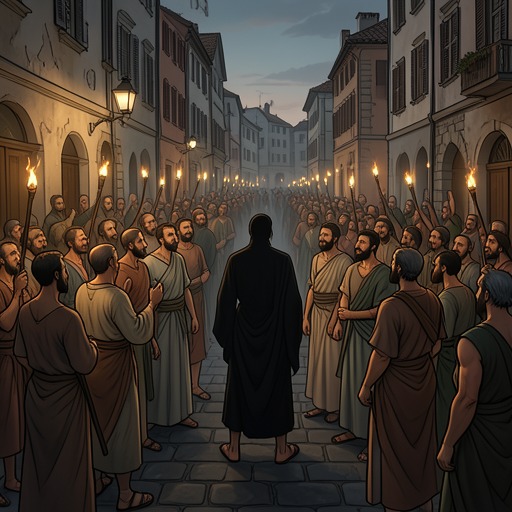
Peter’s authority is at once communal and pastoral. After his address, he raises his hand to bless the believers as they go to torture and death. They gather around him and ask him to guard himself, recognizing his responsibility as their spiritual leader. He places his hands on their heads and blesses them one by one, a gesture that gives the collective teaching an intimate form: those facing execution are sent onward as individuals known and cared for by their shepherd.
Witness in the Arena
At the arena, the teaching becomes public action. When the condemned enter, they kneel together rather than plead with the crowd. Spectators mistake their posture for a request for mercy and respond with hostility. The Christians then sing “Christus regnat!” Their hymn makes their allegiance audible in the very place organized to display Nero’s power, and the audience begins to recognize that they are not asking to be spared or behaving as the spectators had assumed.
The spectators’ response marks a change in the meaning of the scene. Their attention shifts from contempt for the kneeling Christians to a question: who is the Christ whom the condemned proclaim as ruler? The hymn does not stop the violence, but it interrupts the audience’s easy interpretation of the victims as defeated or culpable. Their composure becomes a form of witness, and the arena’s intended message of imperial mastery is unsettled by the visible conviction of those about to die.
Peter watches from a high row, unseen by most of the crowd, and blesses the Christians as they perish. He remembers his charge to feed Christ’s sheep and entrusts the dying believers to the Lord, asking that their suffering be answered by happiness greater than their torments. His concealed presence links the arena to his earlier blessing in the vineyard: the same pastoral act continues even when the Christians have been carried from their gathering to public execution.
The suffering is not presented as effortless or emotionally simple. Peter’s heart is rent as he watches; his prayer acknowledges the pain of what is happening even as he entrusts the victims to God. The condemned, too, are depicted through more than one response. Crispus, assigned to the cross after the lions have not killed him, welcomes the approach of death and interprets it through Christ’s own death. Yet his stern speech warns the other victims that suffering alone does not erase the distinction between the just and the wicked. The novel therefore presents martyrdom as an act of faith and witness, not as a claim that every victim’s life or judgment is identical.
The Witnesses and the Meaning of Death
The novel repeatedly sets Christian endurance beside Roman entertainment. In the arena, Nero watches through an emerald while Christians are killed; Peter, from the upper seats, sees individuals and blesses them. This contrast separates spectacle from witness. The emperor’s position turns death into an exhibition, while Peter’s attention restores a spiritual relationship between the dying and the community that mourns them.
Chilo’s final appearance gives that witness an especially visible transformation. Formerly a betrayer, he is brought into the arena after torture and nailed to a low cross. The crowd sees a frail, silent man where it expected a familiar figure to mock or condemn. His face now appears calm, and the spectators fall quiet; some of Nero’s companions whisper in fear at the way the condemned die. The episode does not make his suffering a triumph in any worldly sense, but it alters the audience’s response and gives his death the form of a final appeal for mercy.
Across these scenes, the narrative presents martyrdom as both an individual passage and a collective testimony. The Christians’ hymns, Peter’s blessings, Vinicius’s confession, and the altered attention of spectators connect private faith to public consequence. Rome retains the power to imprison and kill, but the Christians’ understanding of resurrection prevents that power from defining the meaning of their deaths. Eternal life is therefore not an escape from the historical violence represented in the novel; it is the belief that enables believers to face that violence without conceding that Nero rules the world.