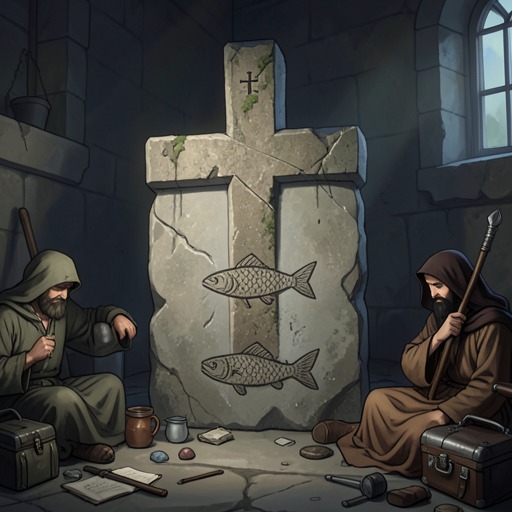
Christian fish symbol (ΙΧΘΥΣ)
Quo VadisThe Christian fish symbol (ΙΧΘΥΣ) begins as a small, seemingly incidental mark: Vinicius remembers that Lygia once drew a fish in the sand. Chilo supplies its Christian meaning by explaining that the Greek initials for “Jesus Christ, Son of God, Saviour” form the word for fish. That explanation makes the image a sign of shared belief and a practical clue to a dispersed, vulnerable community; in the wider story, its meaning stands in quiet contrast to the state’s demand that Nero be treated as a god.
The Fish as a Christian Sign
When Chilo asks whether Vinicius has seen any token or gesture associated with Pomponia or Lygia, Vinicius recalls the fish Lygia traced on the sand. The detail is brief and easy to overlook. Chilo’s questions give it a second life: what had seemed an isolated act becomes a sign by which believers may recognize one another.
Chilo explains the symbol through the initial letters of the Greek words for “Jesus Christ, Son of God, Saviour.” Put together, they form the Greek word for fish. Petronius identifies the resulting word with astonishment, and Chilo declares that this is why fish has become the Christians’ watchword. The scene turns an image into a verbal key: its force lies not in the outline alone, but in the confession concealed within its name.
Recognition and the Search for Lygia
The symbol matters to the plot because it gives Chilo a way to interpret the scattered traces left by Christians. He has searched across the city, moving through shops, streets, and gathering places, and says he has drawn a fish in many places to watch how people respond. His method treats the mark as a test of recognition: the image can disclose a connection without requiring an open declaration of faith.
Vinicius’s recollection links this larger search to Lygia personally. Chilo’s explanation does not itself reveal her hiding place, but it strengthens the inference that she belongs to the Christian community and suggests how that community might be approached. The symbol therefore serves at once as a sign of affiliation and as a clue pursued by someone seeking access to believers for his own purposes.
Secrecy and the Christian Community
The Christians’ gatherings are described as cautious and mysterious. Chilo observes that they assemble away from the ordinary public religious spaces, while Vinicius wonders why they meet secretly when Jewish temples stand openly in the Trans-Tiber district. The account connects their hidden meetings to hostility from Jews and the wider populace, who accuse them of crimes and hate them. In this setting, a compact sign has practical value: it can signal belonging without the public visibility of a formal assembly.
The fish is not presented as a magical object or as proof that every drawing has a fixed meaning. Its importance arises from the explanation shared among the characters and from its use as a recognizable token. The gap between an ordinary sketch and its religious interpretation also shapes the scene’s suspense: Vinicius has seen the mark, but only Chilo’s decoding makes its significance legible to Petronius and to him.
Contrast with Imperial Worship
The symbol’s religious meaning acquires political force beside Nero’s demand that others call him a god. When Nero questions the Jewish priests about refusing that title, they answer that their law forbids it, even recalling that envoys preferred death to violating the law. Chilo, by contrast, professes belief in Nero and claims to hate Christians, presenting himself as a compliant subject. These exchanges expose the conflict between religious allegiance and the ruler’s claim to divine honor.
The fish sign offers a different kind of authority: it points away from the emperor and toward the Christian confession encoded in its initials. The text does not show the symbol being used in a direct confrontation with Nero, but its meaning belongs to the same underlying conflict. It identifies a community whose shared belief cannot simply be absorbed into imperial ceremony, and whose discreet mark can carry that allegiance through a city where open association is dangerous.