Great Fire of Rome
Quo VadisThe Great Fire of Rome is the catastrophe that transforms the novel’s conflict from a struggle over individual lives into a crisis engulfing the capital. The fire destroys streets and stores, displaces hundreds of thousands, and unsettles the authority of Roman law; the government’s decision to blame Christians deepens the disaster into a test of imperial legitimacy. Though the flames are eventually checked in places, the accusation against the Christians does not hold public belief in place: suspicion of Nero spreads, and the suffering of the condemned begins to alter how Rome sees them.
Background and the Fire’s Spread
The fire reaches the story amid the movement between Rome and Antium. When news arrives at Cæsar’s villa, Vinicius leaves at once and rides toward the city. At Aricia, he asks a detachment of mounted guards which part of Rome is burning. His route then brings him up against the scale of the emergency: the Appian Way is crowded with people and vehicles fleeing the city, while heat and the obstruction of routes across the Tiber make it difficult to reach the districts beyond the river. The disaster is not only a distant spectacle; it closes roads and forces those trying to enter Rome to reckon with the same crowding and danger that drive others out.
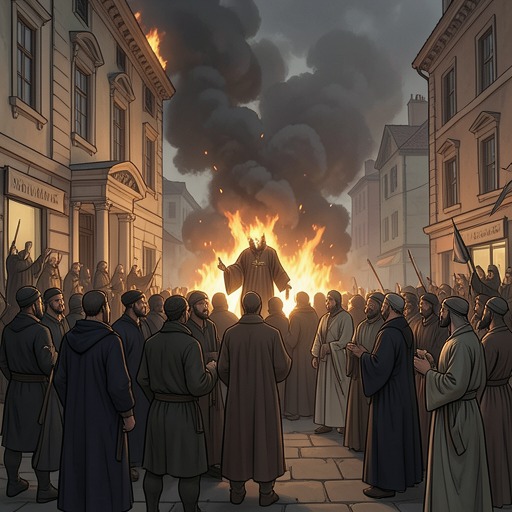
As the fire spreads, it consumes areas of dense housing and storage. The flames run from the heights into valleys packed with houses of five and six stories, shops, booths, temporary wooden amphitheatres, and storehouses containing wood, food, and clothing. The abundance of combustible material helps the fire overtake whole streets with extraordinary speed. The wind carries burning fragments beyond the main conflagration, while people watching from outside the city and from the aqueducts see new fires break out in separate places. Within the narrative, these repeated, remote outbreaks are presented as grounds for believing that human hands are spreading the fire; they are part of the evidence shaping the characters’ suspicion, not an independently demonstrated account of its origin.
Flight, Displacement, and Public Disorder
The roads leading toward Rome become places of refuge as well as escape. Houses, fields, gardens, cemeteries, and temples along the Appian Way are taken over by people seeking shelter. In the temple of Mars near the Porta Appia, the crowd breaks down the doors to get inside; in cemeteries, people seize the larger monuments and fight over them. The usual distinctions of status and family obligation lose their force amid the emergency. The city’s crisis is therefore also a crisis of access: crowds, blocked passages, and the fire itself make movement through and around Rome perilous.
As inhabitants flee, others converge on the burning city. People from nearby towns, peasants, and shepherds arrive in the hope of plunder. Escaped enslaved people join the disorder, and the account depicts violence and robbery spreading while the ordinary population seeks safety. The guards protect some of the more peaceable crowds and fight to contain attacks, but their presence cannot restore normal public order. Reports of the fire circulate alongside rumors about its cause. Some attribute it to divine action; the most widespread allegation is that Nero ordered Rome burned so that he could build a new city. The accusation is reported as popular belief, and its political consequence is immediate: anger at the emperor becomes a possible rallying point for revolt.
Destruction and Relief Measures
The fire continues after the Circus Maximus has fallen and streets in the earliest-burning districts have collapsed. On Tigellinus’s orders, houses on the Esquiline are demolished to create open spaces in which the fire may die out. The measure can protect what remains, but cannot save what is already burning. It also reveals how the emergency response becomes a contest between containing the flames and preserving the city: demolition is a defensive intervention made necessary by the speed and reach of the disaster.
The loss of the city’s stores brings hunger to the displaced population. By the second day, people outside the walls are already short of food, and the destruction of authority has delayed the arrival of replacement supplies. Orders eventually send provisions from Ostia; flour and as much bread as possible are also gathered from nearby towns and villages. Yet relief does not arrive into a calm city. When the first delivery reaches the Emporium at night, the crowd breaks into the granary and seizes the supplies. People fight for loaves, and soldiers later take the building and disperse the crowd. The episode makes the material consequences of the fire inseparable from the problem of governing: food distribution is essential, but scarcity and disorder turn relief itself into another flashpoint.
The Fire and the Accusation Against Christians
The disaster’s aftermath is shaped by the effort to identify a culprit. As cries against Christians spread through Rome, Nero’s persecution turns suspicion into official action. Petronius hears the public demand to send Christians to the lions, while the arrest of people accused of setting the fire gives the rumor a new and dangerous force. The crowds repeat the accusation widely, but their anger does not settle the question of responsibility; in the narrative, the belief that Nero ordered the fire continues alongside the persecution he authorizes.
The accusation becomes especially unstable when Chilo publicly identifies Nero as the incendiary and swears that innocent people are perishing. The crowd’s response changes amid the confusion: voices accuse the emperor, repeat that Christians’ bodies are innocent, and question why so much blood and suffering has been inflicted if the Christians did not burn Rome. The episode marks a shift in public feeling, not a formal finding of guilt. The fire has given the regime a scapegoat, but the punishment of the accused also makes the charge against them harder for many spectators to accept.
Aftermath and Political Significance
The persecution continues even as public belief turns against the official account. Nero and Tigellinus issue further orders against Christians, while the government also distributes wheat, wine, and olives and publishes rules intended to ease rebuilding and reduce the risk of future fires. Nero attends Senate sessions and presents himself as concerned for the people and the city, but the measures bring no reprieve for the condemned. The gap between material relief and continued punishment underlines the limits of the regime’s response: administrative action may address hunger and reconstruction without resolving the crisis of trust.
The fire’s consequences reach beyond the ruined streets. In a later letter to Petronius, Vinicius describes the wave of madness and malice spreading from the Palatine and connects Nero’s rule to the extraction of wealth for his planned Golden House. The letter makes the disaster part of a wider portrait of imperial abuse, while contrasting Roman violence with the Christians’ hope that death is a passage rather than an end. Later, when news arrives that Galba and Spain have joined the uprising, Nero’s rule is nearing its collapse. His ensuing rage includes an order to burn Rome a second time, a threat that connects his response to political rebellion with the earlier catastrophe. The fire thus remains a turning point after its flames have passed: it exposes the fragility of urban life, intensifies popular opposition, and supplies the setting for the persecution that becomes a public indictment of imperial power.