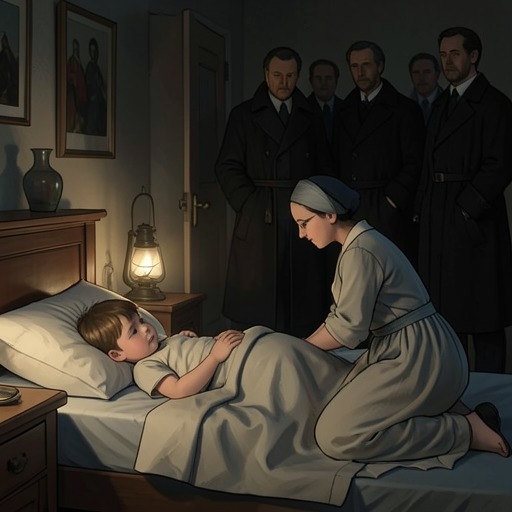
Infant Augusta
Quo VadisThe infant Augusta is the daughter of Nero and Poppaea Sabina, whose birth is celebrated as a dynastic and political triumph. Her brief life and sudden death alter the risks surrounding Lygia and sharpen the novel’s contrast between imperial spectacle and the precarious lives caught within its reach.
Birth and Imperial Importance
The child’s birth at Antium had been marked by extraordinary ceremony. The Senate had solemnly entrusted Poppaea Sabina’s pregnancy to the gods, a votive offering was made at the place of delivery, splendid games were held, and a temple was erected to the two Fortunes. Nero greeted the birth with extravagant delight; the infant was dear to Poppaea Sabina both as her daughter and as a presence that strengthened her political position and influence.
The court’s attention to the child makes her more than a private family concern. The narrative observes that the fate of the empire might depend on her health and life, reflecting the importance attached to dynastic continuity and to Poppaea Sabina’s standing. Yet when Vinicius hears that the infant is ill, his own search for Lygia occupies him more urgently: he asks to see Acte rather than respond to the news.
Illness and Threat to Lygia
The infant falls ill suddenly after an encounter in the palace gardens. Acte tells Vinicius that Lygia had been there with her and Poppaea Sabina, and that the child began to cry as she was carried past them. Lilith, the woman carrying the infant, insists that Lygia bewitched her. Acte warns that if the child does not recover, Poppaea Sabina may accuse Lygia of witchcraft and use the charge to exact vengeance.
The accusation transforms the infant’s illness into an immediate political danger for Lygia. Acte urges Vinicius not to speak of her to Nero until the child’s condition is known. The warning also explains why Vinicius, despite his eagerness to find Lygia, is reluctant to seek Nero’s help while the imperial household is alarmed by the illness.
Death and Courtly Response
Sacrifices, prayers, offerings, medical treatment, and attempts at enchantment fail to save the child. She dies after a week of illness. The court and Rome go into mourning; Nero withdraws to his apartments and refuses food for two days, while senators and members of the Augustians gather to offer sympathy. In an extraordinary session, the Senate declares the dead infant divine and resolves to build a temple and appoint a priest for her. Further sacrifices are made, statues are cast from precious metals, and her funeral becomes a vast public ceremony.
The people observe Nero’s conspicuous grief as both mourning and spectacle. Petronius, watching the court’s response, suspects that Nero is also concerned with the impression his grief makes on others. He fears that the death will intensify the danger to Lygia: Poppaea Sabina attributes it to enchantment, and physicians, priests, sorcerers, and the people reinforce that explanation. The narrative thus connects the child’s death not only to family loss but also to the spread of an accusation that can serve the imperial household’s need to assign blame.
Consequences and Narrative Significance
Petronius is relieved that Lygia has fled, since her absence reduces the danger to her and to Aulus Plautius and Pomponia Graecina. He goes to a reception for senators and Augustians after the mourning cypress is removed, intending to discover how far Nero has accepted the rumors and to forestall the consequences of his belief. Nero publicly accuses Petronius of having brought the supposed evil spirit into the palace through his advice, turning grief into a charge and making Petronius himself vulnerable.
The infant’s death therefore creates a chain of consequences beyond the palace: it places Lygia under suspicion, gives Nero a pretext for accusation, and draws Petronius into a dangerous effort to contain the court’s response. Her earlier importance as the focus of dynastic celebration is reversed; the same imperial household that surrounded her birth with ritual now uses her death to sustain a search for someone to blame.