Judgment Day
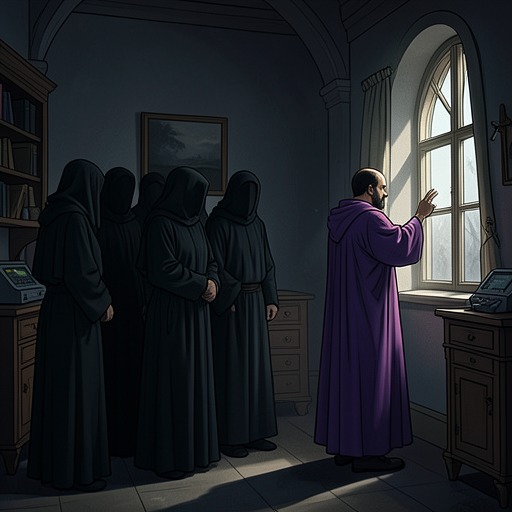
Quo VadisJudgment Day is the imminent divine reckoning that Roman Christians believe the Great Fire has announced. In the fire’s shadow, this expectation first intensifies communal terror, then becomes a test of spiritual leadership: Crispus preaches destruction, while Peter directs the assembly from fear toward trust in divine mercy.
The Fire as a Sign
As Rome burns, believers gather in a quarry and await an extraordinary event. When the sound of collapsing buildings reaches them, many take it as confirmation that the end is near. Their expectation draws on the belief that Christ will return and that the world’s destruction will accompany his coming; the catastrophe seems to make that long-held anticipation immediate.
Crispus gives the flames a definite religious meaning. He proclaims that the Lord has sent them against Babylon, a city of crime, and announces that the hour of judgment has arrived. In his vision, Christ returns not as the Lamb who offered himself for human sin but as a judge who condemns sinners and unbelievers. The imagined signs include stars falling, the sun darkening, the earth opening, and the dead rising. His certainty turns the fire into a forecast of universal judgment rather than only a civic disaster.
Fear Within the Assembly
The destruction outside presses directly upon the gathered Christians. Each fresh crash from the burning city seems to confirm Crispus’s warning, and the listeners respond with cries for mercy, confession, and fear for what may come. Some cover their faces; others seek comfort in friends. The danger is not simply that Rome is being destroyed, but that the community reads its own surroundings through an expectation of imminent divine reckoning.
That expectation also creates a severe moral demand. Crispus urges the assembly to renounce earthly riches and attachments, warning that love of family or worldly pleasure may be judged against devotion to God. The fire therefore threatens both the material world beyond the quarry and the believers’ emotional ties within it. The scene makes apocalyptic belief a lived crisis, not an abstract doctrine: the Christians must decide how to understand suffering and what, amid it, they are to hold dear.
Peter’s Reassurance
Peter’s arrival changes the meaning of the moment. After the terror of Crispus’s denunciation, he addresses the assembly calmly and questions the certainty that anyone can know what will happen before the appointed hour. He acknowledges that the Lord has punished Babylon with fire but emphasizes that those purified by baptism and redeemed by Christ’s blood may die with Christ’s name on their lips. His response does not deny danger or promise that believers will escape death; it places their fate within mercy rather than condemnation.
The contrast between the two speakers is decisive. Crispus presents Christ as an approaching judge and the fire as evidence that the world is ending; Peter recalls the merciful Christ known through the Apostle’s teaching and steadies the listeners’ faith. The assembly’s pleas for Peter to remain with them show that reassurance restores a sense of spiritual protection. Vinicius, searching for Lygia amid the fire and the crowds, also turns to Peter for help, linking the community’s collective fear to his personal desperation.
Meaning and Consequence
Judgment Day in this episode is both a future expectation and an interpretation imposed upon present catastrophe. The fire makes the end seem close, but the scene does not confirm that the final judgment has arrived. Instead, it distinguishes between fear that treats destruction as proof of abandonment and faith that can endure uncertainty through trust in God’s mercy.
The episode also gives the expectation a communal consequence: catastrophe unsettles belief, and Peter’s response gathers the frightened Christians around a more sustaining account of their faith. Their hope rests not on safety from the burning city but on Christ and the possibility of mercy even in death. Judgment Day thus sharpens the novel’s contrast between Rome’s visible collapse and the believers’ conviction that worldly destruction does not have the final word.