Linxu
Quo VadisLinus is a Christian who lives in a small house in Rome’s Trans-Tiber district, near Miriam. Although he remains mostly offstage in the cited episodes, his home and movements connect Lygia’s hiding place to Vinicius’s search, the Christian community’s response to the Great Fire, and the shelter offered at Ostrianum. His role is defined less by public action than by the refuge his household provides and the trust others place in his care.
Identity and Home
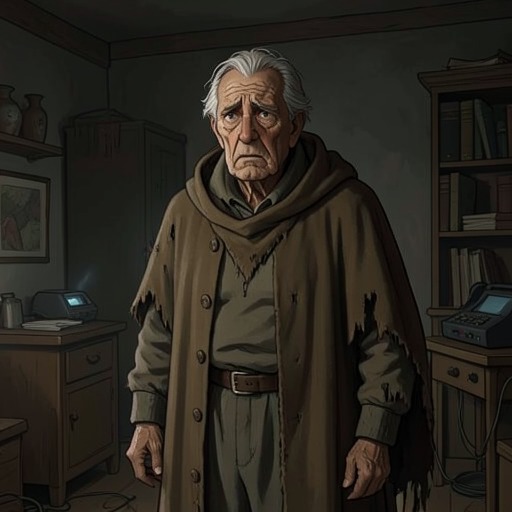
Linus lives in the Trans-Tiber, where, as Vinicius learns, many Christians make their homes. His own small house stands apart behind a wall covered with ivy. That secluded setting gives the house a practical role in the story: it is a refuge for Lygia and Ursus, but also a location whose discovery could expose them to the pursuit of a powerful Roman.
Linus’s home becomes known to Vinicius through Chilo, who leads him there. Vinicius tells Peter and Paul that he has returned from the house and knows Lygia’s hiding place, but insists that he has chosen not to surround it with his many slaves and seize her. The house therefore marks a turning point in Vinicius’s conduct: he has the means and claims the right to take Lygia, yet the Christian example he has encountered makes him refrain and seek her guardians’ consent instead.
Linus and Lygia’s Refuge
The wider background to Lygia’s vulnerability reaches back to the decision that brought her into Roman custody. Nero’s messenger tells Aulus Plautius that Lygia is the daughter of the king of the Lygians, given to Rome as a hostage under Claudius, and that Nero now orders her transferred from Aulus’s household into imperial guardianship. Aulus explains to Lygia that although he and Pomponia have raised and loved her as their daughter, she is not their biological child and Caesar claims authority over her.
Later, Lygia is hidden at Linus’s house. Vinicius understands that Linus, rather than merely sheltering her himself, has become part of the chain of protection surrounding her. He tells Peter and Paul that he regards them as taking the place of her father and mother and asks that she be given to him as his wife. His appeal to them, rather than an assault on the house, registers how the Christian community’s influence has altered his approach to Lygia.
The Great Fire and the Move to Ostrianum
When Rome burns, Linus is not at his house. Vinicius reaches the devastated city after receiving news of the fire, but the flames, crowds, and blocked routes prevent him from going directly to the Trans-Tiber. The fire spreads rapidly through densely built districts, where tall houses, shops, wooden structures, and stored food and other combustible goods feed the conflagration. At the Appian Gate, intense heat and the destruction of an available crossing make the route across the city impossible; Vinicius realizes he must turn back and approach the Trans-Tiber by way of the Via Portuensis.
After the fire, Vinicius asks where Linus is. Chilo reports that Linus went out through the Nomentan Gate to Ostrianum two days earlier. The news changes the direction of the search: Lygia and Ursus are likely to have left the house with him, and may have escaped the fire by staying beyond the walls. A Christian weaver named Macrinus confirms that Linus has gone to Ostrianum with Clement, the chief priest, where Peter is to baptize a company of believers. Macrinus also explains that Linus had entrusted his house to Gaius before leaving, a detail that supports Vinicius’s conclusion that Linus’s household did not remain in the threatened district.
Significance in the Plot
Linus’s movements link private refuge to communal religious life. The ivy-walled house gives Lygia and Ursus a place to hide, while Linus’s journey to Ostrianum carries the people under his care toward a gathering led by Peter. His departure also leaves a practical trace: the house has been entrusted to Gaius, allowing Vinicius to infer that Lygia is no longer there rather than simply lost in the burning city.
The danger of the fire sharpens the importance of that network of shelter. With the Circus Maximus destroyed, streets collapsing, supplies burned, and crowds driven into severe want, the authorities struggle to preserve order and feed the displaced population. Linus’s move beyond the walls places him among Christians seeking safety and worship amid that upheaval. When Vinicius finally reaches Peter at Ostrianum, he asks him to save him and restore Lygia to him; Peter lays a hand on his head and tells him to trust and come along. Linus is not shown directing this encounter, but his earlier journey has helped bring Vinicius to the community in which that appeal can be made.