Lions
Quo VadisThe Lions are captive animals repeatedly held in Rome’s vivaria and arenas, where imperial spectacle converts their confinement into public entertainment and a threat of execution. Their presence threads together the novel’s images of Roman power: they appear as a display in Nero’s procession, as ominous voices in the night, as possible casualties and agents of disorder during the Great Fire, and finally as part of the machinery of persecution. Their narrative force lies in the contrast between the freedom their roars seem to call for and the uses to which Rome puts them.
Captivity and Imperial Display
During Nero’s grand procession, lions and tigers are led in chains of steel by Arab and Indian handlers. Garlands are wound around the chains, making restraint look decorative, while the animals’ apparent tameness allows the procession to display them as luxurious equipment for Nero’s imagined imitation of Dionysus. At moments they raise their heads and look over the crowd, a reminder that the pageant’s carefully arranged beauty depends on captive, dangerous animals.
The animals also belong to the city’s infrastructure of public entertainment. Vinicius explains that the games are near and the vivaria are crowded, while the narrative notes that thousands of lions are sometimes kept in Rome’s various arenas. At night, animals may approach the grating and press their heads against it, roaring. Their confinement is therefore not incidental to the spectacle: it is an ongoing urban condition that makes the arena’s promised violence possible.
Roaring as Omen
One night, while Vinicius and Lygia sit together planning their future, the silence is broken by roars from the vivaria. The first sound is answered by others from different parts of the city until the lions’ calls fill the night. For Lygia, the sound unsettles the calm vision of the future she had shared with Vinicius. He embraces her and tries to reassure her by pointing to the approaching games and the crowded animal enclosures.
The memory later acquires a darker significance for Vinicius. He tells Petronius that the lions’ roar that night has remained in his mind as a threat and an announcement of misfortune, although he knows that such sounds are common in Rome and has been warned by Paul not to believe in omens. The recollection conveys both his fear for Lygia and his struggle to interpret fear through his developing Christian understanding. Petronius dismisses omens and jokes that the sounds may have come from German bisons, but allows that, if Christ has risen, He may protect them from death.
The Great Fire and the Breach of Confinement
When Rome burns, animal confinement becomes vulnerable alongside the city’s buildings and institutions. Vinicius hears lions again while searching for Lygia in a threatened house. The sound recalls the earlier night and briefly seems to him like a prophecy of danger. Inside, he finds a cross in the household shrine and takes the burning taper beneath it to search the rooms, but Lygia, Linus, and Ursus have already fled.
The fire also drives animals from their enclosures. Reports that Nero has released wild beasts circulate among the frightened population; the account distinguishes rumor from what has actually occurred, explaining that elephants in some places broke out at the sight of the approaching flames and rushed away in panic. The surrounding crisis is marked by flight, overcrowding, theft, and the failure of ordinary restraints. The Lions thus belong to a wider catastrophe in which the boundaries separating controlled spectacle from uncontrolled danger, and captive life from escape, begin to fail.
Arena Violence and Human Spectacle
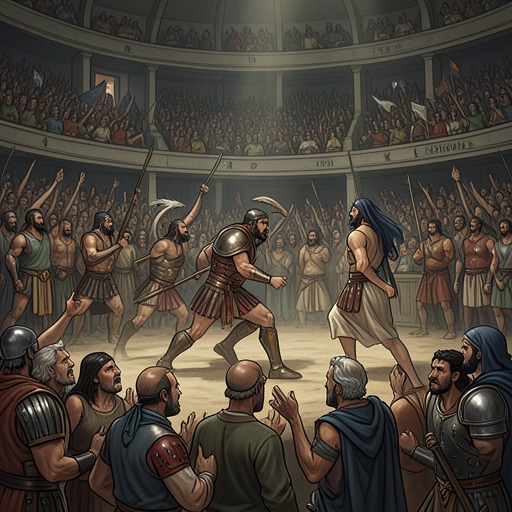
The arena makes explicit the connection between animals and the public use of violence. During an execution of Christians disguised in animal skins, the condemned kneel and sing “Christus regnat!” before repeating “Pro Christo!” as the dogs hesitate and the audience presses for the spectacle to proceed. The scene places animal behavior, human performance, and the crowd’s demand for violence within the same arena system. The animals are not simply symbols: they are trained, confined creatures made instruments of an execution whose religious meaning the spectators do not control.
Later, as Ursus kneels in the arena expecting to die, an enormous German aurochs enters carrying Lygia. Vinicius recognizes her and cries her name. The episode turns the arena’s animal spectacle into the crisis of his personal story: the danger he had once associated with the Lions’ roars is now present in a direct, visible form, and Lygia’s fate is bound to a captive beast released before the crowd.
Narrative Significance
Across these scenes, the Lions mark the distance between Rome’s polished displays and the coercion beneath them. Garlands can make steel chains appear festive, and the arena can present persecution as entertainment, but neither transformation erases the captive animal or the human victim. The nocturnal roars carry that contradiction beyond the arena: they sound through the city as signs of animals held for the games, while characters hear in them fear, foreboding, and the fragility of their hopes.
The novel does not give the animals an independent account of their captivity, but repeatedly makes their constrained presence matter to the human plot. Their confinement supplies Rome’s spectacles; their escape becomes one element in the fire’s disorder; and the arena’s use of animals exposes how a society that claims to distinguish civilization from savagery makes violence into a public institution. The Lions therefore connect imperial display, urban catastrophe, and martyrdom without reducing their recurring appearances to a single omen or metaphor.