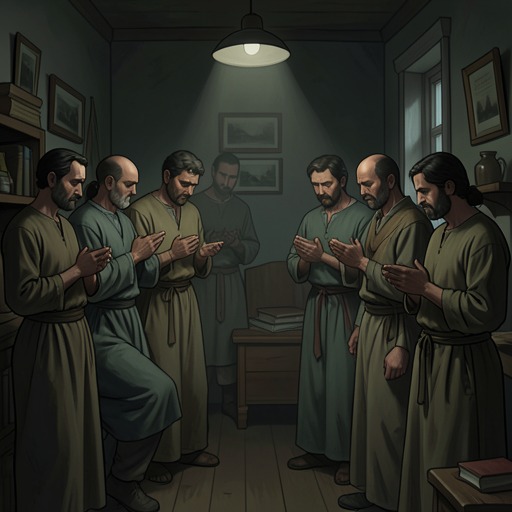
Ostrianum cemetery
Quo VadisOstrianum cemetery is an old Christian burial ground outside Rome, between the Via Salaria and Via Nomentana. It is where Peter teaches and baptizes a large nighttime gathering, where Vinicius first encounters the Christian community’s worship and finds Lygia among its members, and where the story’s image of collective faith acquires force against the later devastation of Rome.
Setting and Christian Gathering
Chilo directs Vinicius toward Ostrianum after learning that Christians will assemble there to hear a great apostle. He explains that the cemetery lies beyond the city gates and that the believers will gather at night. The meeting is possible because the community remains cautious: although no edicts yet prohibit its religion, Christians face public hostility and therefore conceal their worship. The cemetery’s location beyond the walls gives the assembly a degree of separation from the city, while its burial function makes it a place of remembrance as well as religious instruction.
The approach is a narrow depression enclosed by ditches, with an aqueduct crossing it at one point. At the end stands a wall thickly covered in ivy. Two quarrymen guard the entrance and check visitors’ signs before allowing them through. Inside, a wall encloses a spacious area containing separate monuments, the entrance to an underground crypt with graves, and a fountain before the entrance. Because the hypogeum cannot hold the expected crowd, the ceremony takes place outdoors. Lanterns and torches mark the gathering, while the believers, many hooded against exposure or the cold, assemble in the cemetery grounds.
Peter’s Teaching and Vinicius’s Encounter
Peter emerges from the hypogeum and stands on a stone beside the fire. The crowd recognizes him as the foremost disciple of Christ: some kneel, others reach toward him, and the gathering falls silent as he blesses them with the sign of the cross. The scene presents authority without the elaborate insignia associated with the priests of other religions Vinicius has encountered. What commands attention is the congregation’s response and the directness of its devotion.
Vinicius arrives preoccupied with finding Lygia, yet the service unsettles his familiar understanding of religion. He observes that the Christians address God not merely through a prescribed ritual or in hope of personal advantage, but with the love of children for a parent. Their worship stands in contrast to the practices he associates with Rome and Greece, where he has seen people honor gods from fear or to secure assistance. For him, the cemetery becomes the setting of a first significant encounter with a faith organized around love rather than exchange.
The gathering also supplies Vinicius with a concrete lead in his search. Chilo has already learned that Ursus works near the Emporium and that Lygia is likely to attend the assembly. As midnight approaches, Chilo points out Ursus in the crowd, with a young woman beside him; Vinicius turns and sees Lygia. His search thus brings him into the very community whose worship has begun to challenge his assumptions. Finding her does not erase the difference between his aims and the Christians’ way of life, but it places that difference directly before him.
The Cemetery in the Story’s Wider Arc
Ostrianum’s importance is not limited to Vinicius’s discovery. It represents a hidden, organized religious life within a hostile city: believers travel beyond the gates, gather under guarded conditions, and listen together to an apostle. The cemetery’s graves and underground chamber situate this communal worship among the dead, while the open-air assembly makes the congregation visible to Vinicius as a living community. This contrast gives the place a distinctive narrative function: it is both a site of burial and a setting for the transmission of belief.
The novel later places the Christian community’s teaching and endurance against Rome’s physical and political crisis. During the Great Fire, flames spread through densely built streets and the authorities order houses demolished on the Esquiline in an attempt to halt the advance. The disaster drives people from their homes, disrupts food supplies, and intensifies disorder. Vinicius struggles to reach Rome and cross toward the Trans-Tiber district, while the city’s inhabitants and newcomers crowd its roads and surrounding spaces. Against this upheaval, the earlier gathering at Ostrianum offers a remembered image of a community held together by shared worship and belief.
The cemetery also serves as a point in Vinicius’s spiritual trajectory. At Ostrianum he sees a form of devotion unlike the religious customs he knows and identifies Lygia within the Christian fellowship. Later, he asks Peter for baptism and declares his love for Christ; Peter answers by directing him to love other people as brothers. The contrast between those moments gives the cemetery retrospective significance: the encounter there begins to connect Vinicius’s personal search for Lygia with a broader change in how he understands faith, obligation, and love.
Narrative Significance
Ostrianum brings private pursuit into contact with public belief. Vinicius enters seeking one woman, but the scale of the gathering and Peter’s presence expose him to a community whose convictions cannot be reduced to his desire to recover her. The cemetery’s geography reinforces that encounter: it lies outside Rome’s gates, yet the people gathered there represent a social and spiritual order that will matter increasingly within the imperial city.
Its burial setting also gives the scene a quiet structural resonance without making the cemetery merely a symbol of death. The underground graves are part of the physical place; above them, the assembled Christians listen, pray, and recognize one another as a community. Later scenes of persecution and martyrdom sharpen the contrast between their vulnerability and the confidence of their faith. Ostrianum is therefore both a specific location in the plot and an early setting in which the novel makes Christian worship, communal solidarity, and Vinicius’s changing perspective visible.