Peter
Quo VadisPeter is an aged apostle and the foremost disciple of Christ, presented as both a witness to the resurrection and a shepherd to the Christian community. His influence depends not on rank, wealth, or priestly insignia, but on testimony and care: he teaches Christians how to live, receives Vinicius as a guest despite their unequal histories, blesses the young man's love for Lygia, and steadies the faithful when Rome burns. Through Peter, authority becomes a form of service that can reach both an individual seeking a new life and a frightened community facing disaster.
Identity and Presence
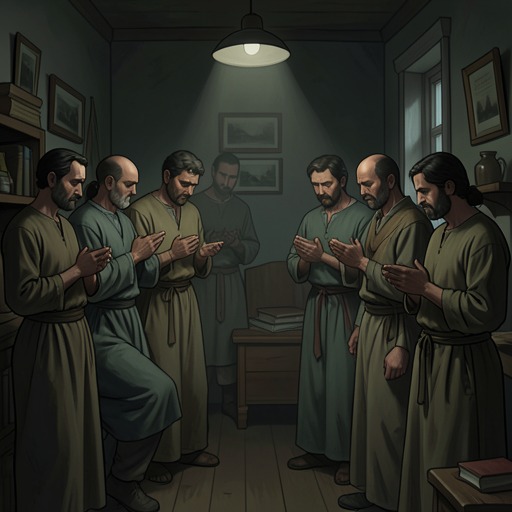
At a Christian gathering, Peter emerges from a hypogeum and takes his place on a stone near the fire. The crowd recognizes him at once; some kneel, and others reach toward him. He blesses them with the sign of the cross. Vinicius, who has entered with attendants while searching for Lygia, follows the assembly's gesture so as not to betray himself. The young Roman's first view of the apostle is therefore part of a communal act: Peter's presence gathers the congregation into stillness and shared attention.
Peter's simplicity makes a strong impression on Vinicius. He wears none of the formal insignia associated with Roman, Greek, Egyptian, or eastern priests. Rather than appearing as an officiant set apart by costly dress or ritual symbols, he seems to Vinicius a witness: an old man who has traveled to tell what he saw, touched, and believes. The apparent plainness does not lessen his authority. Vinicius senses that Peter's conviction gives him a power to persuade that ceremonial display cannot supply, and becomes eager to hear the teaching followed by Lygia and Pomponia Graecina.
Teaching and Testimony
Peter speaks like a father instructing children in how to live. His counsel joins private conduct to responsibilities within society: Christians are to reject excess and luxury, value poverty, purity, and truth, bear wrongs and persecution patiently, obey those placed over them, avoid treason, deceit, and calumny, and set an example both for one another and for pagans. His teaching is practical as well as devotional, describing a disciplined manner of life rather than a collection of abstract claims.
He also speaks as someone whose faith is grounded in remembered events. In recounting Christ's death and the discovery of the empty sepulchre, Peter describes how he and John, after returning from the Cross, remained in the supper-chamber for two days and nights in grief, doubt, and alarm. On the third morning, Mary of Magdala rushed in to say that the Lord had been taken away. John reached the sepulchre first; Peter entered after him and found the burial clothing on the stone, but no body. The account does not begin in triumph: the disciples initially fear that the priests have removed Christ, return home in greater grief, and struggle to understand why their hopes appear to have failed. Peter's authority as an apostle is bound to this recollection of fear and loss, as well as to his later witness.
Welcome and Blessing of Vinicius
Peter's pastoral welcome becomes personal when Vinicius approaches the Christians as a friend. The tribune acknowledges that he knows where Lygia is, at a house near their dwelling, and that Caesar has granted him a claim to her. He also admits that he could use the nearly five hundred slaves at his houses in the city to surround her hiding place, but says he has chosen not to seize her and will not do so. Peter receives this disclosure without rejecting him: he answers that the community greets him as a friend and invites him to sit and share their meal. He then tells Vinicius that the Lord's blessing will be upon him and that his heart will be purified.
Peter recognizes that Vinicius is suffering and responds to the change already visible in his decision. Speaking of love, he blesses both the tribune's soul and his love for Lygia, invoking the Redeemer. Vinicius springs toward him and presses the old apostle's hand to his lips in gratitude. Peter understands the gesture as evidence that his teaching has reached a new person: the image of sowing and of a fishing net gathering a soul makes Vinicius's welcome part of a wider mission, not merely a private reconciliation.
Peter's blessing leads to practical help. The Christians consider the significance of a Roman tribune and member of an ancient Roman family turning toward their faith. Peter, responsible for a large community, cannot accompany Vinicius to Antium; Paul of Tarsus agrees to go with him instead. Before leaving, Vinicius asks Peter to let him see Lygia or take him to her, explaining that he wants to ask whether she could accept him as a husband if he becomes a Christian and whether she will answer his past wrongs with goodness. Peter readily grants the request. He reassures Vinicius that he need not fear Caesar and sends Miriam to fetch Lygia without revealing who is waiting, so that the meeting will bring her pleasure.
Pastoral Authority in Crisis
During the Great Fire of Rome, Peter's role expands from teacher and guide to a source of composure for a community under immediate threat. After a roar shakes the quarry where Christians have gathered, people fall to the earth in terror. Peter has entered the cave shortly before; his calm greeting changes the scene. The people rise and draw close to him, as if seeking shelter under a shepherd's protection. He asks why they are troubled and urges them to remember that no one can know what will happen before the appointed hour. He speaks of judgment and of mercy for those purified by baptism, and tells the Christians that they will die with Christ's name on their lips.
The reassurance is especially consequential because Crispus has just spoken words that intensified the assembly's fear. Peter's response replaces that terror with a sense of God's love and mercy. Christians gather at his knees and call themselves his sheep, asking him not to desert them in disaster. Vinicius approaches, takes the edge of Peter's mantle, and begs him to save him: he has searched for Lygia in the smoke and the crowds without finding her, but believes Peter can restore her to him. Peter places a hand on his head, tells him to have trust, and invites him to come along. His response joins communal consolation to the tribune's urgent personal plea, carrying their relationship into the continuing search for Lygia.
Narrative Role and Significance
Peter connects several distinct forms of authority in the novel. His account of the empty sepulchre makes him a first-hand witness; his instructions at the gathering give the community rules for conduct; his hospitality gives an outsider a way to approach it; and his reassurance in the quarry helps the Christians withstand fear. In each setting, his authority is enacted through speech and presence rather than material power. He does not force Vinicius to change or dismiss the Christians' danger; he welcomes the tribune's decision not to seize Lygia, blesses his love, and offers guidance and companionship.
The contrast between Peter and Roman prestige is particularly clear through Vinicius's response. The apostle has no ceremonial emblems, yet his remembered testimony and personal concern command a respect that cannot be explained by status. As the Great Fire disorganizes the city and leaves the Christians fearing for their lives, Peter's pastoral voice offers a different basis for order: shared faith, mutual care, and confidence in mercy. His significance lies in making these principles concrete, whether by inviting a visitor to supper, arranging a reunion, or leading frightened believers forward.