Pisonian Conspiracy Group
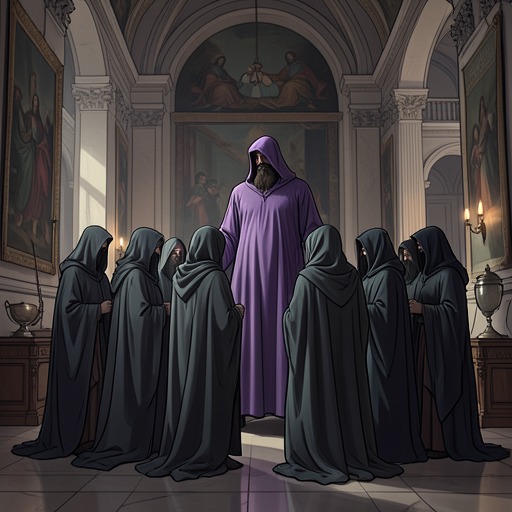
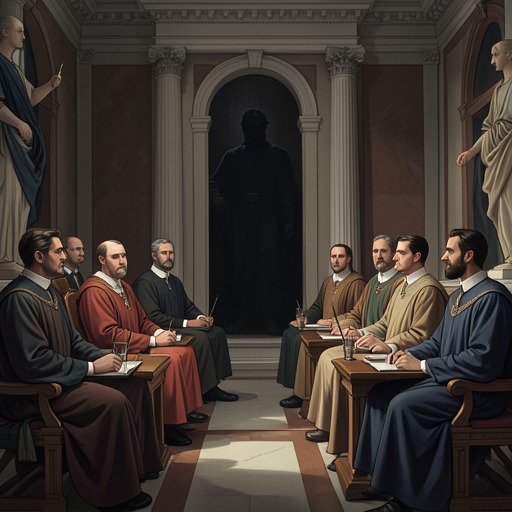
Quo VadisThe Pisonian Conspiracy Group emerges in the novel as the political expression of mounting disaffection under Nero: an alliance around Piso that draws strength from dissatisfaction among courtiers, senators, and members of the Praetorian Guard. The text presents it less as a narrated sequence of conspiratorial acts than as a dangerous possibility discussed in private, then as a conspiracy whose exposure precipitates a sweeping purge. Its significance lies in that reversal: opposition to Nero becomes the pretext for a terror that reaches far beyond the alleged plotters and makes fear a condition of life in Rome.
Political Conditions and Early Signals
By the time Flavius Scevinus speaks with Petronius, he describes a court and city in which discontent has become difficult to conceal. He says that even Nero’s Augustians are dissatisfied, while Fenius Rufus, the second prefect of the Praetorian Guard, has been forced to endure Tigellinus’s orders. Scevinus also points to resentment among Seneca’s relatives over Nero’s treatment of Seneca and Lucan. His report links courtly grievance to a more consequential shift: much of the Praetorian Guard, he says, has been won over by Rufus, and disaffection is growing in the camp as well as among the people.
Scevinus frames that military unrest through the precedent of Caligula’s death. He does not openly advocate a similar act, but recalls that Cassius Chaerea freed the world from a ruler regarded as a monster. Petronius recognizes the implication and challenges the guarded manner in which Scevinus invokes it. The exchange shows the political danger of the moment: even conversation about Nero’s vulnerability is charged with the possibility of violence, and a speaker can test an ally’s response without stating his own position outright.
Piso and the Network Around Him
Scevinus then turns from general complaint to Piso, praising his family, character, attachment to his wife, calmness, intellect, and ability to win people over. He presents Piso as the successor many people already see in Nero’s childless household and claims that they would support him wholeheartedly. The conspiracy thus appears not simply as a private faction but as an alternative center of allegiance, assembled around the prospect of succession.
The names Scevinus supplies sketch the breadth of this claimed support. Fenius Rufus is said to love Piso; Seneca’s relatives are devoted to him; and Plautius Lateranus, Tullius Senecio, Natalis, Subrius Flavius, Sulpicius Asper, Afranius Quinetianus, and Vestinius are described as ready to risk themselves for him. Petronius doubts that Vestinius will contribute much, and Scevinus answers that Vestinius is fearful but practically minded, and opposed to the persecution of Christians. The conversation distinguishes a network of differing temperaments and interests rather than presenting every prospective adherent as equally committed or courageous.
Petronius and the Limits of Allegiance
Petronius’s place in this political atmosphere is deliberately uncertain. Scevinus speaks to him as someone whose concern for the persecution of Christians might align with a desire to end Nero’s abuses. Petronius, however, does not declare himself a conspirator; his replies expose the implications of Scevinus’s hints without confirming participation. The scene makes political knowledge itself a risk: Petronius becomes cautious because his friend speaks so openly, and the conversation moves between frank criticism and dangerous insinuation.
That caution contrasts with Petronius’s earlier willingness to confront Nero in public. When Nero seeks to blame the Christians for the burning of Rome, Petronius urges him to acknowledge responsibility rather than punish people he knows to be innocent. He argues that Nero’s fear of appearing culpable will damage his reputation in future ages. This earlier intervention establishes Petronius as a critic of imperial conduct, but not as an organizer of the conspiracy; his opposition is expressed through counsel and rhetoric, while Scevinus’s later conversation introduces the possibility of organized political change.
Defeat and the Purge
The narrative later identifies the Pisonian conspiracy as having appeared before the Apostles’ final hour, placing its emergence amid an already worsening crisis. Its defeat triggers what the narrator calls a merciless reaping among Rome’s leading figures. Piso is executed, followed by Seneca, Lucan, Fenius Rufus, Plautius Lateranus, Flavius Scevinus, Afranius Quinetianus, and others. The list carries the conspiracy’s consequences beyond its central figure: men connected to the opposition network, as well as prominent figures swept into the aftermath, are removed in a succession of deaths.
Nero’s response extends from the accused to their families, friends, and even acquaintances. Soldiers fill the city, and centurions carry death sentences to houses deemed suspect. The condemned submit through flattering letters and surrender portions of their property in attempts to preserve something for their children. The narrative’s emphasis is not on the conspiracy’s methods, which remain largely unreported in this evidence, but on how its defeat gives Nero a rationale and an occasion to widen the circle of punishment.
Historical and Narrative Significance
The conspiracy’s most consequential effect in the story is the political climate it leaves behind. Rome lives in expectation of the next arrest; grief must be disguised, and even mourning is constrained while public spaces are decorated with ivy and flowers. Nero’s Senate continues to honor him, appointing priests and magnifying his voice, while its members privately tremble. The contrast between public praise and private fear reveals a regime in which allegiance is performed under pressure and opposition becomes increasingly difficult to distinguish from mere suspicion.
The Pisonian Conspiracy Group therefore functions as both an attempted alternative to Nero and the occasion for the state’s violent consolidation. Scevinus’s account suggests that resentment spans the court, the military, and the wider populace, yet the later purge does not produce a narrated transfer of power: it produces executions, confiscations, and a city more thoroughly dominated by terror. The episode sharpens the novel’s portrait of Nero’s Rome, where the possibility of resistance is real, but its exposure allows imperial power to turn political dissent into a justification for attacking an ever-expanding circle of people.