Roman Christian Community
Quo VadisThe Roman Christian Community is portrayed as a far-reaching but discreet network whose practices of worship, mutual aid, and resistance to imperial religious demands become increasingly consequential as Rome moves from private suspicion to public persecution. Its members are not a single, fully informed body: believers may not know one another, meet in different places, or possess the same information. Yet shared signs and acts of care make the community recognizable, while the reactions of Roman crowds show that its meaning cannot be confined to the accusations made against it.
Identity and Recognition
The community first comes into view through outsiders trying to classify Lygia. Nero asks whether she is the hostage loved by Vinicius, and Petronius confirms it; the question of her people and her religion soon becomes part of the court’s scrutiny. Petronius explains that Lygia was raised by Pomponia in the religion Pomponia herself follows. He reports that Lygia has never been seen making offerings to the Roman gods and that she was accused of being a Christian, although a household tribunal cleared her. The suspicions are joined to familiar slanders: Christians are said to worship an ass’s head, hate humanity, and permit crimes. Petronius counters the slur about hatred by pointing to Pomponia’s virtue and to her treatment of slaves; Vinicius likewise observes that slaves are treated better in the household of Aulus Plautius than elsewhere.
This early account establishes a gap between the community’s actual conduct and what Rome says about it. The Christians’ association with a foreign god and refusal to participate in familiar civic worship make them difficult for outsiders to place. Chilo exploits that uncertainty, reasoning that the people who helped Lygia escape must share her religion and that learning their identity will lead him to her. His assumptions turn religious affiliation into a trail for pursuit, even as the acts of assistance he observes make the community’s practical character harder to reconcile with hostile rumors.
Worship, Secrecy, and Mutual Aid
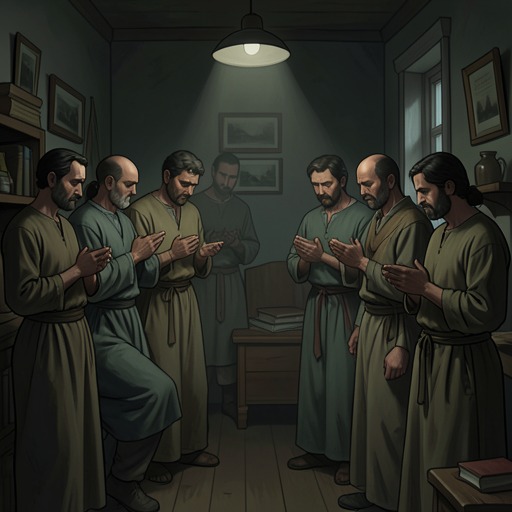
In Vinicius’s report to Petronius, Chilo describes the breadth and discretion of the movement. He says Christians are numerous in Rome and that their meetings take place at night in varied settings: outside the city, in empty houses, and in sand-pits. They worship Christ, sing hymns, and share feasts. Because the believers are spread across many gatherings, ordinary members do not necessarily know everyone in the community; Chilo hopes that access to presbyters, or elders, will reveal information unavailable to him through casual inquiries. Their caution and reserve are presented as a response to danger, not as proof of the crimes attributed to them.
The community’s care is made concrete in the incident Vinicius witnesses after following Chilo. At a place where workers are unloading stones from a barge, Chilo gives a purse to Euricius, an old slave whose master has kept the son in slavery despite taking the money intended to redeem him. The son is present. Chilo blesses them and others, making the sign of a cross as those gathered kneel. Vinicius sees the exchange but does not interrupt it, even though he considers offering money in return for information about Lygia. The episode links Christian identity to relief offered to an exploited family and shows how a search for a fugitive brings Vinicius into contact with the community’s acts of solidarity.
The fish sign supplies another, deliberately indirect means of recognition. Chilo says he has visited shops, streets, gathering places, and cemeteries, tracing the sign and watching how people respond. His search leads him to an old slave at a fountain, whose account of a broken promise over his son’s freedom helps Chilo move closer to the Christians. The method reveals both the community’s dispersal and the risks of being identified: a shared sign can connect strangers, but an outsider can also use it to penetrate their circles.
Ostrianum and the Limits of Knowledge
A gathering at Ostrianum demonstrates that the community’s meetings are organized without being universally knowable. A laborer tells Chilo that believers will assemble there at night because a great apostle of Christ has come to teach them. He does not know Glaucus personally, explaining that there are thousands of Christians in Rome and that all are not acquainted with one another. Ostrianum is identified as their cemetery between the Via Salaria and the Via Nomentana. The meeting is therefore both a religious occasion and a gathering at a burial place, reached beyond the city gates under conditions that help preserve its privacy.
Vinicius and Chilo arrive among a crowd gathered outside the crypt. Quarrymen at the gate take their signs; monuments stand within the walled space, graves lie below in the hypogeum, and a fountain plays before its entrance. The crypt cannot hold the assembled multitude, so the ceremony takes place outside. Many participants are hooded, and lanterns provide scattered light before torches are kindled near the entrance. Their hymn rises from a low sound into a collective song that Vinicius experiences as a prayer for rescue in darkness. The scene offers a contrast to the rumors of criminal secrecy: the gathering is cautious, but its visible activity is worship, teaching, and communal song.
Vinicius wonders why Christians meet outside rather than worship openly in the temples used by Jews in the Trans-Tiber district. Chilo answers that Christians hide from Jews as well as from a hostile populace that accuses and hates them. He describes Christians as honest even while helping Vinicius search for Lygia, an inconsistency that exposes how little his own prejudices can contain what he sees. The community’s secrecy is thus shown as a condition imposed by vulnerability, while its scale and internal variety prevent any one member from knowing or disclosing everything.
Fire, Scapegoating, and Imperial Power
The Great Fire transforms that vulnerability into a public crisis. As Vinicius reaches Rome, the roads and surrounding places are crowded with people seeking refuge. The narrative depicts the breakdown of ordinary law and social distinctions: escaped slaves and other marginalized people join disorder in the streets, while Praetorians defend portions of the population. Fires continue to break out far from the main blaze, and rumors compete to explain the catastrophe. Some blame the gods; many repeat the accusation that Nero ordered the city burned. The evidence presents these as reports circulating among the people, not as a settled explanation of the fire’s origin.
The scale of the disaster helps make the Christians a target. As the population flees through the gates, people from nearby towns and the countryside arrive, some drawn by the possibility of plunder. The cry that Rome is perishing accompanies the sense that the destruction has loosened the bonds holding the city together. Against this disorder, the shout “To the lions with Christians!” spreads through the crowd after news circulates that suspected incendiaries have been seized. The cry is repeated along streets and through districts among the ruins, converting fear and anger into a demand for collective punishment. The community is recast from a poorly understood religious minority into a public scapegoat.
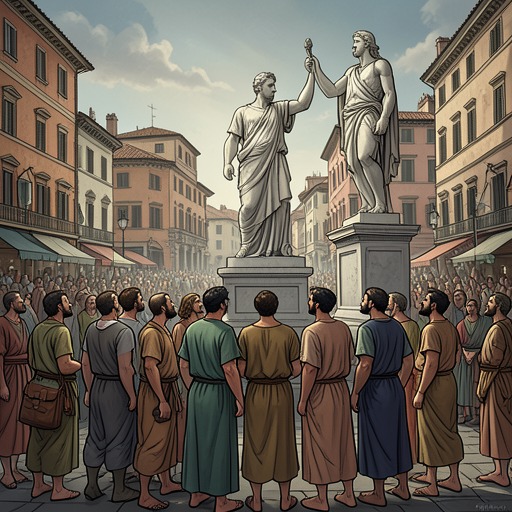
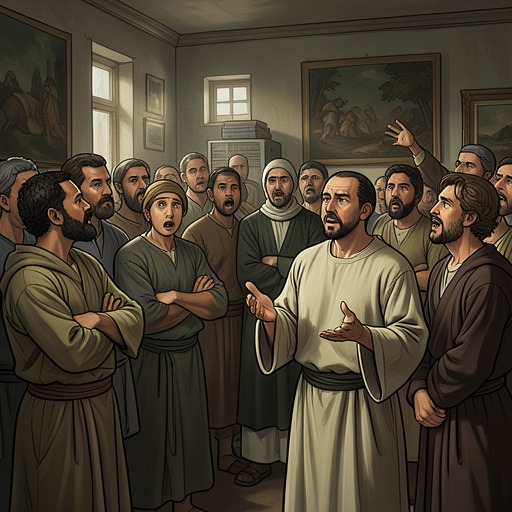
The imperial challenge is expressed directly when Nero questions Jewish priests: he asks whether they refuse to call him god. Their answer invokes religious law and the precedent of envoys who chose death rather than call an emperor divine. Nero then points to Chilo’s willingness to call him a god, and Chilo declares his loyalty to Nero while professing hatred of Christians. These exchanges distinguish personal compliance from religious conviction and show how the emperor tests belief as a form of political allegiance. In the larger conflict, Christians’ separation from Roman religious expectations can be construed as disloyalty, while opportunists such as Chilo use denunciation to win imperial approval.
Public Spectacle and the Crowd’s Reversal
The arena reveals another side of the community’s public exposure. When Ursus rescues Lygia, the amphitheatre erupts in an unprecedented response. The spectators call for mercy, and the crowd’s excitement turns the giant into the foremost figure in Rome. Ursus recognizes that the people are trying to secure both his life and his freedom; with Lygia in his arms, he approaches Nero’s podium and appeals to the emperor. The episode does not erase the danger facing Christians, but it interrupts the logic of spectacle: a scene intended to display imperial power instead produces a collective demand for clemency.
Across these episodes, the Roman Christian Community is defined as much by what it does as by what others claim about it. Its dispersed meetings, shared signs, worship, and aid to the vulnerable offer forms of connection outside Roman civic and household hierarchies. Secrecy protects its members but also feeds suspicion; imperial tests of worship turn religious difference into a political accusation; and mass audiences prove capable of shifting from persecution to pity. The community’s significance lies in this tension between being treated as an invisible, suspect group and becoming, through its practices and the responses it provokes, a force the city cannot simply ignore.