Roman Praetorian Guard
Quo VadisThe Roman Praetorian Guard is the imperial force whose soldiers make Nero’s authority tangible in the story: they carry out commands, watch gates and prisons, escort senior figures through public disorder, and secure the arena. Their institutional power is formidable, but their conduct is not uniform. The narrative repeatedly places guards at the boundary between imperial coercion and individual judgment, where obedience, pity, and public pressure can lead to different outcomes.
Role and Organization
The Guard serves as both a military presence and an instrument of access to the emperor. When Aulus Plautius is ordered to surrender Lygia, the demand is framed as Nero’s command and delivered by Hasta: Lygia is described as a hostage whose guardianship belongs to Caesar and the senate. The order converts her family home into a point of imperial jurisdiction. Aulus explains to Lygia that she was raised as his child, but that the emperor is taking her from the household; the Guard’s role in enforcing such transfers makes the state’s claim concrete.
The soldiers also regulate who may approach the emperor. A chief centurion greets Marcus Vinicius as he comes seeking an audience and warns that the moment is unfavorable and that he is unlikely to see Caesar. This brief encounter presents the Guard not only as a force that acts on bodies, but as a gatekeeping institution controlling proximity to imperial power. At another point, Chilo invokes the emperor’s command while describing the situation, reinforcing how the authority of Caesar can be carried into encounters even when the emperor is absent.
Surveillance, Arrest, and Confinement
The Guard’s power becomes especially visible in the persecution of Christians. Chilo tells Vinicius that the Christians know the gates are watched, but that they can leave the city by other routes; his account makes clear that surveillance is extensive without being total. The distinction matters: the Guard can watch formal exits and pursue suspects, yet the hidden networks and movements of the Christian community frustrate simple control.
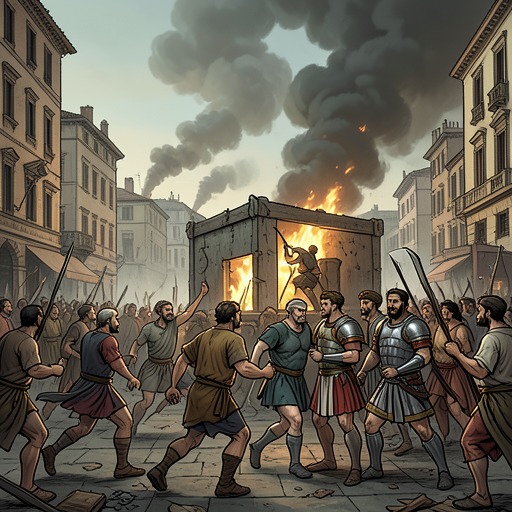
During the persecution, soldiers surround the prison in two ranks, their helmets and spearpoints catching the dawn light. The force around the prison is a visible barrier between those held inside and those who might seek to reach them. The surrounding population also joins the hunt for Christians. Groups camped in the gardens help guards and soldiers seize believers, while the prisoners’ open confession and unresisting acceptance of arrest do not calm the crowd; their patience is misread as defiance. The passage distinguishes the Guard’s official role from the wider violence of the mob, even as their work unfolds amid a public campaign of capture and detention.
Vinicius’s visits to the Mamertine prison show that access depends on recognition and security procedure. Guards who usually know him allow him through without difficulty, but on one visit the line does not open and a centurion approaches him. Later, visitors enter only after the centurion checks their proper tokens by lantern light and the great iron doors open. At another visit, the tokens are scrutinized more carefully than usual, and the centurion Scevinus recognizes Vinicius. The Guard’s procedures are thus both a means of confinement and a narrow, conditional channel through which visitors may reach prisoners.
Individual Judgment and Mercy
The story gives the Guard internal distinctions through officers who choose not to treat duty as blind obedience. Scevinus is described as devoted to Caesar, yet when he recognizes Vinicius at the prison he draws him aside rather than raising the alarm. His action suggests that personal pity can coexist with loyalty to the emperor; the text does not make him cease to be a soldier, but shows him using his position to avoid an immediate act of enforcement.
A sharper test occurs in the arena. Nero arrives with increased Praetorian protection, and command is held by the tribune Subrius Flavius, previously known for his attachment to the emperor. As the spectators wait for an unusual event, the enhanced guard presence signals that Nero expects danger or resistance. Yet, when the moment comes, Subrius’s stern face is wet with tears and he raises his hand in a sign of mercy. Nero sees him, then looks across the guards and soldiers, encountering frowning expressions and fixed, agitated faces. He gives the signal for mercy. The episode turns the Guard’s collective presence into a visible moral force: the soldiers do not overthrow the emperor, but their response helps shape the decision made before the crowd.
Imperial Power and Its Limits
The Guard’s proximity to Nero links military protection with imperial spectacle. In the amphitheatre, its numbers are increased, and a tribune rather than a centurion commands it. The account emphasizes that this arrangement accompanies Nero’s arrival with Tigellinus, Vatinius, and a notably powerful centurion whom the emperor summons when he wants a defender at his side. Security is part of the staging of imperial authority: the emperor appears surrounded by the force that protects him, while the audience watches both ruler and guards.
That protection does not make the Guard’s members interchangeable or erase the pressure of their own reactions. At the arena, Subrius Flavius’s gesture and the soldiers’ expressions become legible to Nero, whose decision changes accordingly. At the prison, Scevinus’s intervention quietly opens a possibility that strict procedure might have closed. Elsewhere, the force’s ordinary functions—watching gates, surrounding the prison, checking tokens, and controlling access—serve the machinery of repression. The same institution can therefore enforce the emperor’s reach and, through the judgment of particular officers and soldiers, expose limits to that reach.
Narrative Significance
The Roman Praetorian Guard is important less as a separately described organization than as the recurring human face of state power. Its members stand at thresholds: between a household and the emperor’s claim over a hostage, between city streets and hidden routes, between prisoners and visitors, and between Nero’s command and the crowd’s response. These scenes give imperial rule a practical form—guards, ranks, credentials, and restricted doors—rather than leaving it an abstraction.
The Guard’s changing significance rests on the contrast between collective function and individual conduct. Its soldiers help make arrest and confinement possible, and its enhanced presence protects Nero in public. Yet the narrative also gives officers moments of discretion: Scevinus withholds an alarm, while Subrius publicly signals mercy. The result is not a simple portrayal of a benevolent force, but a picture of an institution whose coercive authority remains real even as conscience and human sympathy can interrupt its operation.