Roman Senate
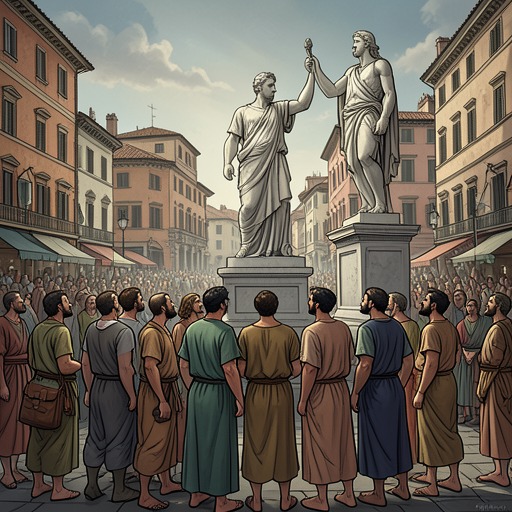
Quo VadisThe Roman Senate appears as a formal center of Roman authority, yet the episodes associated with it show a widening distance between institutional language and effective power. It is named as sharing guardianship over Lygia, and Nero addresses it during a period of public crisis; elsewhere, the Senate’s presence is overshadowed by imperial favoritism, urban catastrophe, and the Emperor’s management of the crowd.
Formal Authority and Lygia’s Custody
When Nero’s centurion Hasta delivers the command to remove Lygia from the household of Aulus Plautius, he presents the transfer as a matter of lawful guardianship: Lygia is the daughter of the king of the Lygians, given to Rome as a pledge, and custody belongs to Caesar and the Senate. The formula places the Senate beside the Emperor as an authorized guardian, but the immediate force behind the order is Nero’s command. Aulus recognizes that he cannot resist it and tells Hasta that Lygia will be delivered.
The consequences of that order are personal and immediate. Aulus explains to Lygia that she has been raised as his and Pomponia’s child, though she is not their daughter by birth, and that Caesar is taking her from their home. The Senate is invoked as part of the official rationale, but the scene depicts no deliberation by senators and gives the family no avenue to appeal. The institution’s stated guardianship therefore accompanies, rather than restrains, an imperial act of removal.
The Senate in Nero’s Political World
Vinicius regards the Senate as compromised by the character of the men who govern. In his judgment, a sound political order might be possible under an honest Caesar and a Senate composed of serious men such as Thrasea; the actual list of prominent figures instead prompts him to condemn the rulers as ruffians and scoundrels. Petronius answers with an ironic comparison, extending the scene’s satire of a governing class whose authority is at odds with its public standing.
The Senate is also a place where imperial decisions are announced. During Nero’s extended return from the coast, Helius, Nero’s freedman, declares the Emperor’s return in the Senate, news welcomed by a populace anticipating games and distributions of grain and olives. The report makes the Senate a channel for public notice, but not the author of the policy that excites the crowd. The Emperor’s movements and provisions set the terms; the Senate receives the announcement.
The contrast between formal government and court power is especially sharp in the rivalry between Petronius and Tigellinus. Petronius possesses refinement and influence, but his wit can provoke Nero’s jealousy, and his independent judgment makes him less useful as an obedient instrument. Tigellinus, by contrast, gains ground through pliancy and extravagance, organizing a vast feast to impress the Emperor. In this political environment, proximity to Nero and the capacity to gratify him carry more practical weight than the Senate’s institutional standing.
The Great Fire and Public Order
The Great Fire reveals the limits of collective authority in the face of material emergency. As the city burns, the destruction of food stores leaves hundreds of thousands outside the walls in want. Tigellinus orders supplies sent from Ostia and surrounding communities, but when the first delivery reaches the Emporium, the crowd seizes it, and soldiers eventually disperse people with weapons. The Senate is not shown coordinating relief: the narrative instead places the response in the hands of imperial officials and armed force.
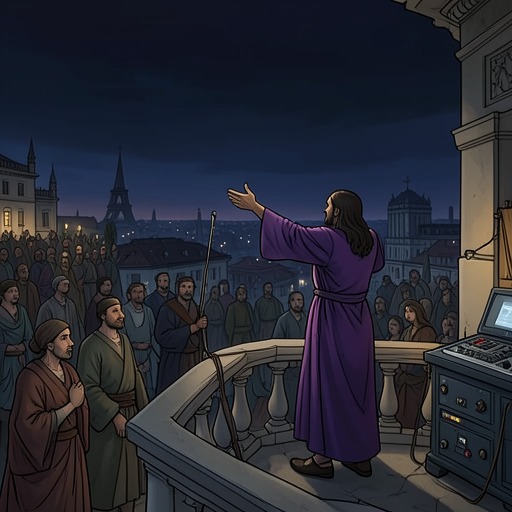
Nero turns the crisis into a public performance of reassurance. Petronius addresses the people with promises that the city will be rebuilt, gardens opened, and wheat, wine, and olives distributed the next day, followed by games and gifts. The crowd takes up the cry of bread and circuses, and Petronius urges it to praise Caesar as provider. The promise answers immediate hunger while binding relief to imperial generosity and entertainment; the Senate does not appear as an intermediary in this exchange.
Afterward, supplies arrive in abundance from Ostia. Wheat is sold cheaply and given to the indigent, while wine, olives, chestnuts, sheep, and cattle reach the city. Yet the supply recovery does not restore ordinary public order. With people living in makeshift camps and authority weakened, robberies, killings, and disappearances continue. The contrast is consequential: feeding the population helps avert famine, but it does not repair the civic institutions or security that have broken down.
Institutional Absence and Narrative Significance
The Roman Senate’s limited presence is itself significant. It appears in the language that legitimizes Lygia’s custody and as the venue for an announcement about Nero’s return, but the evidence does not show it making an independent decision in either episode. During the Great Fire and its aftermath, the principal actions belong to the Emperor, Tigellinus, Petronius, suppliers, soldiers, and the crowd. The Senate thus stands for Rome’s formal political order while the narrative repeatedly locates practical power elsewhere.
This contrast also illuminates the political conditions Vinicius struggles to reconcile with Christian teaching. He imagines that a Senate of principled men could coexist with Roman peace and rule, yet he fears that Christian equality would unsettle the hierarchy on which Roman supremacy rests. Against that debate, the Senate’s appearances remain largely procedural: it can be named as guardian or receive an imperial announcement, but the emergencies and spectacles that shape public life are governed through imperial command, patronage, provisioning, and force.