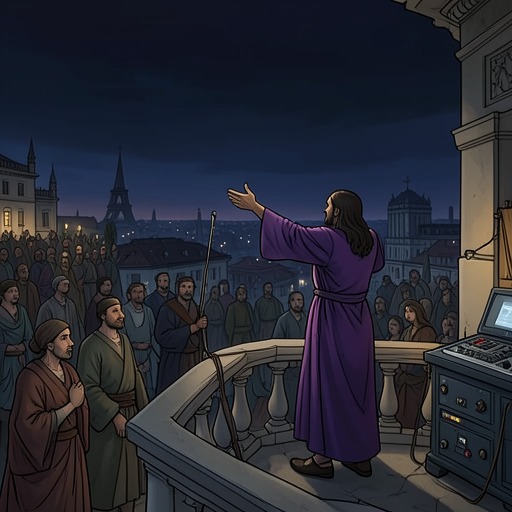
Tigellinus
Quo VadisTigellinus is a court favorite whose ascent depends less on refinement than on service without restraint. As Petronius’s political and personal rival, he converts lavish spectacle into influence, encourages Nero to answer public anger with punishment, and helps direct imperial power against the Christians. His career traces the court’s movement from conspicuous luxury to terror: the man who stages a floating feast becomes an advocate of force and a threat even to those who share his side of the palace struggle.
Identity and Court Position
Tigellinus appears in Petronius’s account of men who have acted as informers or served Nero’s intimates, a company from which Petronius distinguishes himself. Aulus Plautius, Petronius says, respects him in part because he has not been an informer like Tigellinus. The remark places Tigellinus early among the court’s politically dangerous operators, while also establishing Petronius’s own claim to a different kind of influence: he may be no Stoic, but he has sometimes objected to Nero’s conduct where Seneca and Burrus did not.
That contrast becomes explicit in Petronius’s warning to Marcus Vinicius. He calls Tigellinus Nero’s procurer and contrasts the man’s courtly function with Petronius’s own frankness. Petronius says that, were he himself to want Lygia, he would openly tell Vinicius he intended to take her and keep her until tired of her. The imagined threat is a pointed comparison, not an account of Tigellinus taking Lygia: it characterizes the courtly power around Nero as capable of treating another person as an object of imperial appetite.
Rivalry with Petronius
Tigellinus’s rise is measured against Petronius, who surpasses him in polish, intellect, and wit, and can entertain Nero through conversation. Yet that superiority is also a liability. Petronius’s brilliance can outshine the emperor, and he will not serve as an obedient instrument in every matter. Nero resents Petronius’s standing as Arbiter Elegantiarum, a title that seems to compete with the emperor’s own claim to define taste.
Tigellinus recognizes that he cannot match Petronius, Lucan, or other men distinguished by birth, talent, or learning. He chooses instead to excel through pliant service and extravagant display. His influence grows not because Nero prefers him in every respect, but because he is becoming indispensable and does not impose the restraint that Petronius’s judgment can bring. The contest is thus not simply between two courtiers: it is between cultivated authority, which can embarrass the ruler, and usefulness that asks little of him.
The rivalry shapes Petronius’s advice to Vinicius when the latter must return to court. Petronius warns that Tigellinus could use Vinicius’s absence from Nero to his disadvantage. He proposes an excuse and recommends that Vinicius describe Lygia as someone who had been with him until he tired of her, reasoning that Nero would understand the courtly implication. He also warns that Tigellinus can invent something enormous for the emperor. In this atmosphere, access and reputation are vulnerable to deliberate fabrication; Petronius’s wit is a defensive instrument, but Tigellinus’s capacity to manufacture courtly advantage makes him a continuing danger.
Spectacle as Political Power
Tigellinus’s great floating feast is designed to reward Nero after the emperor postpones his journey to Achaea, surpass earlier entertainments, and demonstrate that no one can host Nero on a grander scale. Preparations begin during the court’s travels in Naples and Beneventum. Orders bring animals, birds, rare fish, plants, vessels, and fabrics from distant regions, while the revenues of whole provinces are spent on the project. The scale of the expense displays the material reach of the favorite’s power as much as his desire to impress.
The feast turns the Pond of Agrippa into a stage. A gigantic raft of gilded timbers carries a canopy of Syrian purple on silver columns; its borders are decorated with shells from the Red Sea and Indian Ocean. Palms, lotus groves, roses, concealed fountains, statues, and gold or silver cages of brightly colored birds frame the water. The spectacle gathers Rome’s wealthy, beautiful, and intellectually distinguished guests, while the Praetorians ring the grounds to keep crowds from disturbing Nero and his company. Abundance and controlled access operate together: the feast makes imperial privilege visible, and guards regulate who may approach the performance.
The display also serves Tigellinus’s competition with Petronius. Petronius can command a conversation, but Tigellinus answers the rival’s refinement with a scale of expenditure calculated to overwhelm Nero’s imagination. His strategy succeeds by adapting itself to the emperor’s appetite rather than challenging his authority. The feast therefore presents an early form of the political method that later appears in harsher circumstances: Tigellinus shapes what Nero sees and offers himself as the agent capable of producing it.
His influence does not mean that Nero has ceased to be vulnerable to other court pressures. When Petronius notes that Vinicius’s name remains on the guest list despite the story that he is ill, he concludes that Poppaea Sabina has arranged it because she wants Vinicius. He warns that her desire could expose them both to Nero’s vengeance. In the court Tigellinus helps shape, a guest list can carry political meaning: spectacle is not merely entertainment but a channel through which favor, desire, and danger become legible.
The Fire and the Search for a Scapegoat
During the Great Fire, Tigellinus advocates force against the crowd. He says that he had Praetorians ready and regrets that Nero allowed Petronius to quiet the people instead of letting him silence the shouters. His response treats public disorder as a problem to be suppressed, while Petronius’s intervention shows that the crowd can also be calmed by a promise of material relief. The contrast exposes two instruments of rule—provision and violence—and Tigellinus favors the latter.
When Nero accuses him of having burned Rome, the exchange marks a dangerous turn in their relationship. Those present understand that the emperor is no longer joking. Tigellinus answers by invoking the crowd’s anger and warning that the Praetorians might also revolt. He does not simply deny responsibility; he presents the unrest as a political danger that should govern Nero’s next decision. His counsel redirects the question from blame to control.
Tigellinus then offers Nero a target. He argues that the people want vengeance and that the Christians are already hated and suspected. He portrays their refusal to honor Roman gods, attend public entertainments, or acclaim Nero as evidence that they are enemies of the city and emperor. He also invokes their belief that fire will bring the end of the world, turning their religious expectation into apparent proof of criminal intent. The argument converts refusal of civic and imperial religious observances into a political charge, and gives Nero a group against whom public anger can be directed.
The court’s demand for religious conformity sharpens the danger. Nero asks whether the Christians refuse to call him a god, and later remarks that a Christian’s faith has not prevented him from doing so. In this exchange, the emperor’s divine status functions as a test of loyalty. Tigellinus’s political framing helps make religious difference answerable as treasonous disloyalty, even though the evidence presented is the Christians’ refusal to participate in the emperor’s cult and customary public life.
Persecution and Coercion
Once the persecution is under way, Tigellinus helps organize its scale. An enormous wooden amphitheatre is built among the ruins for the deaths of Christians, and he orders wild animals from across the empire: elephants and tigers from Asia, crocodiles and hippopotamuses from the Nile, lions from the Atlas, wolves and bears from the Pyrenees, and other animals from distant regions. The imperial spectacle that once displayed rare abundance is refashioned as machinery for punishment. The collection of animals makes the reach of the state visible, while the amphitheatre gives the violence a prepared public setting.
Tigellinus also seeks to enlist individual prisoners in the regime’s account of the fire. He offers one accused of treason a lesser punishment—stripes and exile—if he will testify in the amphitheatre that he was drunk and that Christians caused the conflagration. When the man does not comply, the response is an order to torture him. Tigellinus’s method combines inducement with threat: the testimony is to be manufactured, and refusal is met with punishment. The state’s public explanation is thus not merely an accusation but a script it tries to force a prisoner to perform.
At the executions in Nero’s gardens, the spectacle’s intended control over its audience is not complete. As the flames rise around the condemned, some Christians sing in praise of Christ. The gathered people hear them, and the cries of children unsettle even spectators who are drunk. Tigellinus is not identified as directing this particular scene, but it illuminates the public performance his policies help make possible: the condemned are exhibited as objects of imperial power, yet their visible faith and the crowd’s response complicate the intended meaning of the show.
Decline, Threat, and Narrative Significance
Tigellinus’s power is personal and precarious, bound to Nero’s favor and to his ability to act for the emperor. He can offer ten men to accompany Petronius on a mission, presenting himself as a source of immediate force. Later, when Petronius challenges the imprisonment of Lygia, Tigellinus defends the sentence by insisting that Nero’s judgments cannot be changed. His appeal to unalterable imperial authority is especially revealing: he invokes the rule of the emperor when it serves his position, even as he remains an active manager of the ruler’s decisions.
That alliance does not make him safe to others at court. Petronius warns that Tigellinus may resort even to poison, whether from hatred of Petronius and Vinicius or from hatred of Nero himself. The warning shows how the contest has moved beyond rivalry over taste and access into threats against life. Tigellinus’s service to the regime coexists with private enmity, and his power is dangerous precisely because its methods are not confined to public policy.
Petronius’s later reflection in Cumae reveals why the balance has shifted. Nero sinks further into coarse dissipation and behaves increasingly as comedian, buffoon, and charioteer. Petronius’s silence is read as blame, while his praise is taken for mockery; his wealth and works of art attract the desire of both Nero and Tigellinus. He has been spared partly because his knowledge of Greek culture may be useful for the journey to Achaea, but that practical value cannot restore his former security. Tigellinus’s ascendancy therefore rests on more than ambition: it accompanies Nero’s growing hostility to the very qualities that once made Petronius influential.
As a character, Tigellinus embodies the political force of performance stripped of cultivated restraint. He understands that he cannot win through learning or conversation, so he stages abundance, offers force, frames public anger, and presses the emperor toward spectacle and punishment. His trajectory links the floating feast to the amphitheatre: in both, he arranges what Nero and the Roman public are made to see, but the later spectacle also exposes the limits of imperial control over its audience. The Christians’ response cannot be reduced to the role assigned them, just as Petronius’s independent judgment cannot be absorbed into the obedience Tigellinus represents.