Trans-Tiber district
Quo VadisThe Trans-Tiber district, the Roman area across the Tiber, serves as both a refuge and a point of exposure in the novel. Its temples and streets mark the visible presence of Jewish worship, while Christian gatherings take place more cautiously; after the Great Fire, the district’s survival gives Lygia and her companions a place to return to, but also makes their location easier to discover. Through this contrast, the district connects Rome’s religious diversity with the precariousness of Christian life under persecution.
Setting and Religious Geography
In the early search for Lygia, Vinicius’s route carries him through several parts of Rome and across the river into the Trans-Tiber district. The journey does not bring him to her: he has no real hope of finding her and searches chiefly to occupy a night of rage and pain. His passage nevertheless places the district on the map of the city in which Lygia has disappeared, alongside the Esquiline, the Subura, and the neighborhoods around the Capitol.
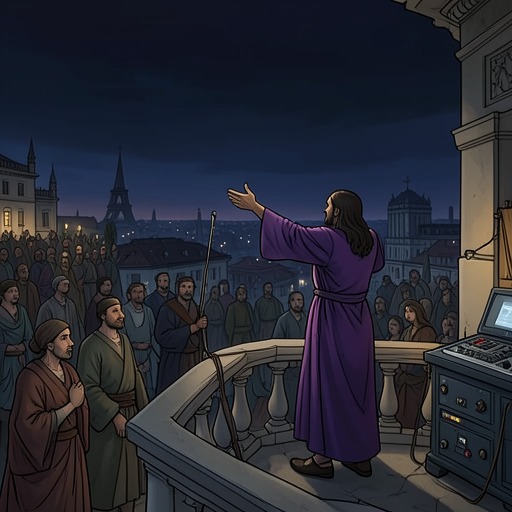
The district’s religious landscape is described through the difference between public and hidden practice. Vinicius and Petronius discuss Pomponia’s faith and Lygia’s upbringing, with Petronius noting that Pomponia has never been seen making offerings to the Roman gods. He has heard that Christians are accused of grotesque beliefs and crimes, but finds those accusations hard to reconcile with Pomponia’s virtue and her treatment of slaves. Vinicius, in turn, observes that the household of Aulus is exceptional in how it treats them. Their conversation makes the Trans-Tiber’s Jewish temples a point of comparison: Vinicius wonders why Christians gather secretly when Jews can make offerings there openly in daylight.
Chilo supplies a hostile explanation for the Christians’ concealment. He says that Jews are their bitterest enemies and that Christians also hide from a populace that accuses and hates them. His account is not a neutral map of the district, but it clarifies the social pressures shaping its religious geography: visible places of worship do not mean that all communities can safely use them, and Christian assembly is presented as exposed to suspicion from more than one direction.
A Place of Search and Shelter
The Trans-Tiber becomes a concrete destination in the account Chilo gives Nero. He admits that he helped Vinicius search for Lygia and pointed out the house where she lived among the Christians. Vinicius had brought Croton, a wrestler hired for protection; the attempt to seize Lygia ended in a confrontation with Ursus, who overcame Croton, while Lygia’s intervention prevented Ursus from killing Vinicius. Chilo’s story identifies the district not merely as a hiding place but as the setting where Vinicius’s pursuit meets the community protecting Lygia.
The account also establishes that Lygia’s refuge is connected to a wider Christian household rather than to an isolated hiding place. She lives among Christians in the Trans-Tiber, and Ursus is present as her protector. The district thus provides a setting in which the community’s practical loyalties become visible: Lygia is sheltered there, Vinicius enters with hired force, and the attempt to take her away fails. Its safety is real but conditional, sustained by concealment and by the people prepared to defend her.
The Great Fire and the Return
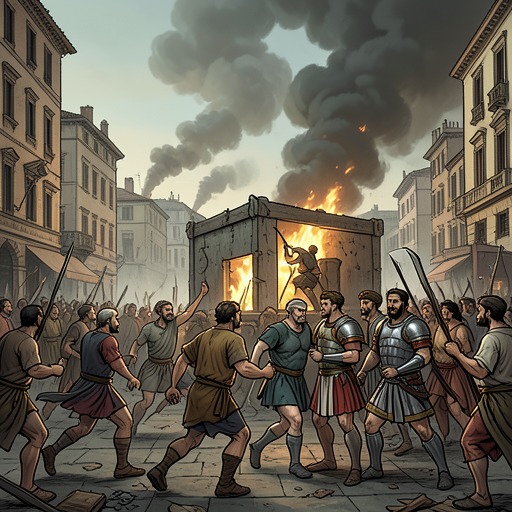
During the Great Fire, the Trans-Tiber is threatened as the flames spread through Rome. The narrative describes new fires breaking out at places distant from the principal blaze, and the wind eventually turns the fire back toward the river. It consumes what it can in the district and then ceases to advance there. This interruption makes the area’s fate part of the larger pattern of flight, destruction, and uncertain shelter: the fire’s path shifts, and survival depends on where it reaches and where it stops.
The district’s survival has a double consequence. After the fire, Lygia and Linus return to their former house there, which had been spared along with much of the Trans-Tiber. For those who have lost their homes, a surviving dwelling offers a place to resume life; for people under threat, however, returning to a known address can undo the protection of flight. Petronius recognizes this danger. Because Lygia and Linus have returned to their former home, they are easier to find than they would have been among the displaced crowds, though he hopes the Palatine does not know where they live and believes Vinicius may reach them before the imperial agents do.
From Refuge to Target
That hope proves entangled with the machinery of persecution. Petronius suspects Tigellinus will cast his net across Rome to seize as many Christians as possible, and he considers what resistance might mean if the Praetorians come for Lygia. He is willing to spend men and money to oppose the plan, while recognizing that armed opposition to the Praetorians would amount to defiance of Nero. The Trans-Tiber’s role has therefore changed: the same district that sheltered Lygia now contains a known house that can be identified to the authorities.
Petronius later tells Vinicius that Lygia is in prison and that her arrest is not explained by Christian belief alone. He connects it to Poppaea’s hostility, recalling that Poppaea had earlier tried to blame Lygia for the death of her infant daughter by accusing her of witchcraft. He further reasons that Lygia’s being the first prisoner and the authorities’ discovery of Linus’s house show that she had already been followed. The district is not said to cause her arrest; rather, the return to a familiar home gives persecution a location to target, while personal hostility supplies an additional motive.
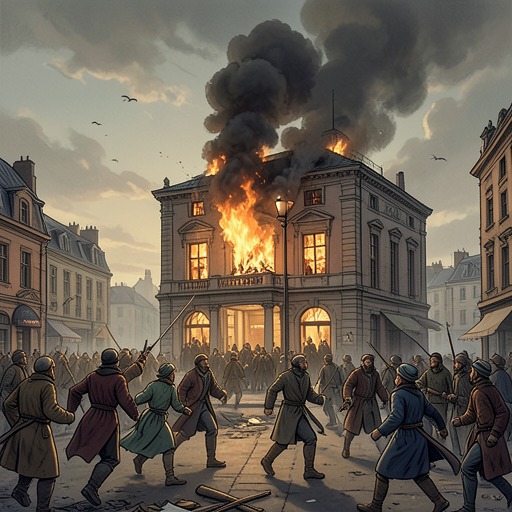
The city’s reaction turns that targeted suspicion into a public cry. As crowds hear that people accused of setting the fire have been seized, the chant demanding that Christians be sent to the lions spreads through streets and among crowds emerging from the burned areas. The Trans-Tiber, spared from the fire’s full advance, is thus not outside Rome’s crisis. Its surviving homes remain within reach of the accusations and mass anger that follow the disaster.
Narrative Significance
The Trans-Tiber district binds together three conditions in the story: religious difference, refuge, and vulnerability. Its Jewish temples stand for worship that can be performed openly, while Christians meet under the pressure of hostility and concealment. Lygia’s home there becomes a tangible refuge, yet the fire’s aftermath makes returning to it dangerous. The district’s survival preserves shelter and community, but also fixes the fugitives’ whereabouts at the very moment that imperial power and public anger turn against them.
That tension makes the district more than a backdrop. It gives physical form to the uncertain boundary between safety and exposure: a place can escape the flames and still be caught in the political disaster that follows. For Lygia, the Trans-Tiber is at once the home to which she can return and the address through which those pursuing her can reach her.