Vindex and Galba's revolt
Quo VadisVindex and Galba's revolt is the political uprising that ends Nero’s confidence in the permanence of his rule and sets the final crisis of his reign in motion. Its significance lies not only in the challenge posed by rebellious forces, but in the contrast between a growing emergency and an emperor absorbed in performance, acclaim, and imagined solutions. As news accumulates, the appearance of imperial power persists in public ceremony while its practical authority begins to fail.
Causes and Early Expectations
The revolt begins with the rising of the Gallic legions under Vindex. At first, Romans do not regard it as a decisive threat: earlier military revolts had not necessarily changed the government, and Nero is only thirty-one. People also struggle to imagine a successor because, they believe, the descendants of Augustus have all died. The image of Nero as a Hercules seems to some to make his power unassailable. Yet this confidence rests on habit and spectacle rather than on any demonstrated ability to meet the crisis.
The political setting is already profoundly unstable. The narrative describes a world in which people have little security in either life or property, law has ceased to protect them, and public virtue and family bonds appear to have collapsed. Reports of Nero’s triumphs in Greece reach Rome alongside the impression that bloodshed and theatrical excess have become the ordinary condition of life. Under these circumstances, the revolt challenges more than the emperor’s command of the legions: it unsettles a society that has come to regard his rule as inescapable.
Nero’s absence initially makes the crisis worse. While he is in Greece, Helius and Polythetes govern Rome and Italy in a manner described as even more murderous than Nero’s own. Nero does not want to leave Greece. He moves to Naples only after Helius warns that further delay could cost him his dominion. The delay shows the gulf between the urgency of political events and the emperor’s attention to them.
Nero’s Response to Vindex
At Naples, Nero continues to play and sing while reports of danger grow. Tigellinus warns him that this revolt differs from earlier rebellions: Vindex is a tested soldier, and his ancestry connects him to the old kings of Gaul and Aquitania. Nero answers that the Greeks are the only audience worthy of his song and insists that art and glory are his first duty. His response reduces a military and political danger to a question of artistic recognition.
The turning point in his attention comes when word reaches him that Vindex has called him a wretched artist. Nero then sets out toward Rome, not because he has accepted the substance of Tigellinus’s warning, but because the insult reopens the personal wound inflicted by Petronius and recalled after Nero’s stay in Greece. The episode makes the revolt’s political force inseparable from Nero’s vanity: a direct affront to his artistic identity can move him where warnings about the possible loss of power could not.
On the road, Nero sees a bronze group portraying a defeated Gallic warrior and takes it as a favorable omen. He enters Rome in the triumphal chariot of Augustus. An arch of the Circus is demolished to make way for the procession; the Senate, knights, and crowds come out to meet him, while a public chorus hails him with divine and victorious titles. Crowns and the names of the cities where he has triumphed are displayed behind him, along with tablets recording the masters he has defeated. Nero is so elated that he asks the Augustians how Julius’s triumph could compare with his own. The spectacle briefly presents him as secure, even as the uprising continues to gather force.
Public Acclaim and Hidden Opposition
The triumph is not a reliable measure of popular consent. By evening, inscriptions on temple columns and walls accuse Nero of crimes, threaten vengeance, and mock his artistic reputation. A phrase circulates that he sang until he roused the Gauls. The contrast between the crowds’ ceremonial acclaim and the hostile writing appearing across the city reveals a public mood that cannot be contained by the procession. The Augustians become alarmed, while ordinary people, uncertain about what will happen, hesitate even to express their hopes.
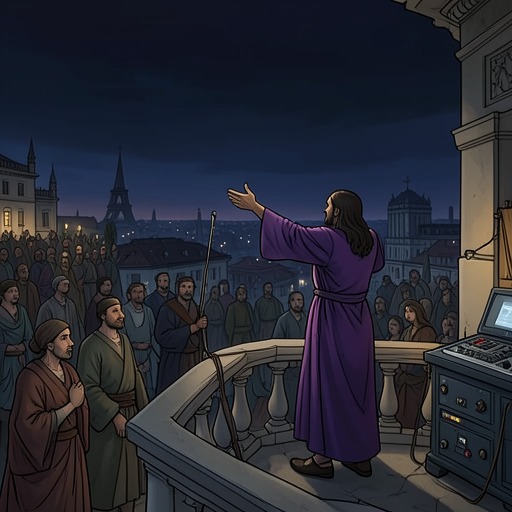
Nero nevertheless remains focused on performance. He occupies himself with new instruments and trials of a water-organ on the Palatine, and imagines that promises of future spectacles can ward off danger. Those near him begin to lose their composure as he searches for dramatic language and multiplies plans rather than preparing the means to defend his rule. His schemes swing wildly: he considers going to meet danger, equipping young enslaved women as Amazons, and leading legions east. At another moment he imagines defeating the rebellious soldiers through song, with the legionaries moved to tears and a new golden age following his performance.
Other fantasies expose the same inability to settle on a course. Nero alternates between calling for blood and imagining that he could be content to rule Egypt. He recalls a prediction that he would rule in Jerusalem and pictures himself earning his daily bread as a wandering minstrel, honored as a poet rather than obeyed as emperor. These are not effective responses to the revolt; they are incompatible imagined futures that turn political danger into material for theatrical self-dramatization. Meanwhile, the threat continues to grow in the west.
Escalation and Collapse
When news arrives that Galba and Spain have joined the uprising, Nero’s agitation intensifies. He breaks objects at a feast and issues orders that even Helius and Tigellinus do not dare to carry out. Among his proposals are killing Gauls living in Rome, burning the city a second time, releasing wild animals, and transferring the capital to Alexandria. The scale and caprice of these ideas mark a decisive change in how his former associates regard him: even those implicated in his earlier crimes begin to see him as a madman.
For a time, events seem to turn back in Nero’s favor. Vindex dies, and disagreement among the rebellious legions appears to weaken the revolt. Nero responds with fresh feasts, triumphs, and sentences, as if the threat has passed. But the reversal proves temporary. One night a messenger arrives with news that soldiers in Rome itself have raised the standard of rebellion and proclaimed Galba Caesar. The news brings the challenge from distant forces into the imperial city and makes Galba’s claim an immediate fact of political allegiance.
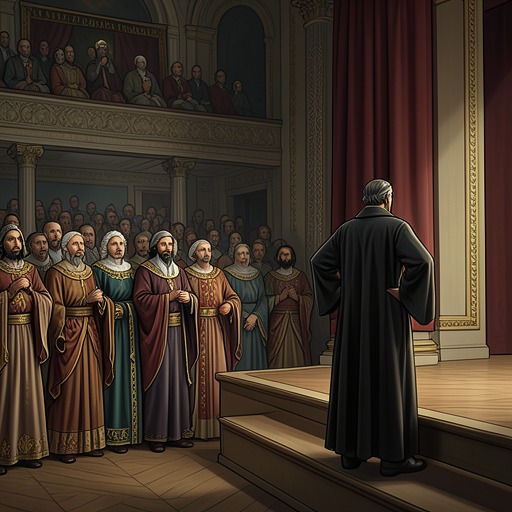
Nero wakes to find that the night guard has disappeared and the palace is empty. Enslaved people are plundering what they can carry, and he wanders through the palace in fear, crying out. His freedmen Phaon, Sporus, and Epaphroditus eventually come to help him flee. Even then, Nero tries to imagine that mourning dress and an appeal to the Senate, delivered with all his eloquence and actor’s skill, might restore his position. The episode closes on that last misjudgment: as the instruments of his rule vanish around him, he still treats political survival as another performance whose audience can be won by speech.
Narrative Significance
The revolt’s progression is framed through a sustained collision between political reality and spectacle. Nero’s triumph in Augustus’s chariot appears to confirm his supremacy, but the hostile inscriptions, the spread of rebellion, and the final proclamation of Galba expose the insecurity beneath the public display. The same emperor who imagines that song can conquer soldiers cannot reliably interpret the warnings of his advisers or prepare for the loss of power.
The crisis also connects the revolt to the novel’s wider picture of a Rome damaged by fire, hunger, and disorder. The post-fire city is filled with displaced people, shortages, and public anger; Nero’s government appears unable to restore security or sustain authority. The revolt therefore arrives in a political world already weakened by catastrophe and distrust. Its decisive consequence is not simply that Nero faces opposition, but that the opposition reaches Rome itself and leaves him isolated in the palace, still appealing to a vanished political order as if eloquence could summon it back.