“The Jews have ruined Germany. People, awake!”
ReunionThe antisemitic slogan at the center of this entry marks the moment political hostility becomes personal for Hans Schwarz: a printed notice is placed on his desk, and his refusal to accept it leads to a fight and further isolation.
From Public Rumor to Classroom Intimidation
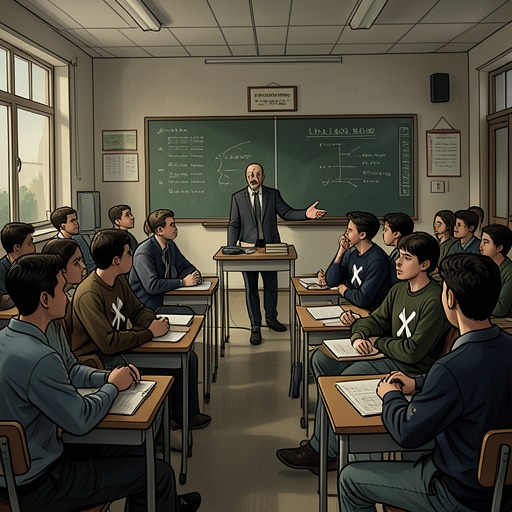
For a time, political unrest seemed distant from Stuttgart. Minor incidents and hostile markings appeared, but ordinary life continued, and Hans and Konradin von Hohenfels treated politics as a concern of adults. That sense of separation eroded as the town filled with political posters and processions of unemployed people. At school, the change became immediate after the arrival of a new history master, whose lecture about concealed forces prompted an argument among the boys. When Hans entered, he heard repeated references to Jews; Bollacher then challenged him to leave for Palestine and stuck an antisemitic notice on his bench. The slogan was no longer a rumor encountered at a distance but a piece of propaganda used to mark Hans as an outsider in his own classroom.
Refusal, Conflict, and Abandonment
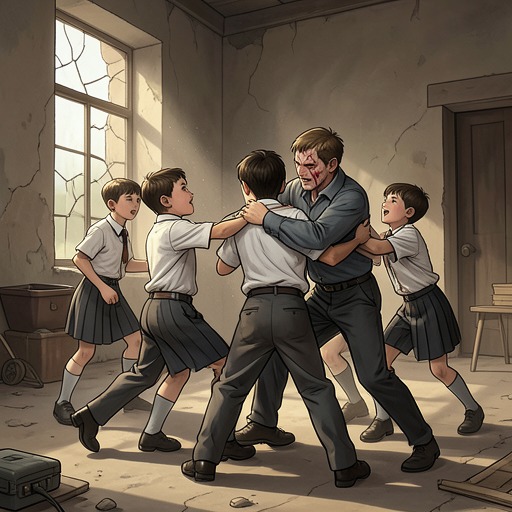
Hans tells Bollacher to remove the printed notice. Bollacher refuses and threatens him if he tries to take it away himself. The confrontation has become a test of whether Hans will accept the label the paper imposes on him: he is frightened, but when the other boys, including Konradin, rise to watch, he strikes Bollacher. Their scuffle is untrained and disorderly, yet Hans understands it as more than a personal quarrel; he is standing against the antisemitism that has entered the classroom.
Bollacher loses his footing and becomes wedged between two desks just as Pompetzki arrives. Once free, he accuses Hans of attacking him. Hans explains that Bollacher had told him to go back to Palestine, but Pompetzki treats the expulsion as friendly advice rather than an insult. He tells both boys to sit down, says they can fight outside if they wish, and returns to the lesson. The teacher’s response gives the slogan’s classroom setting an institutional dimension: the hostility is not checked, but recast as something Hans should tolerate.
That evening Hans waits until everyone has left, still hoping Konradin will stay to help or console him. The street is empty. Hans then avoids Konradin, reasoning that being seen with him would embarrass him and believing Konradin will appreciate the separation. The printed notice thus marks not only a public rejection but a break in the friendship Hans had counted on. His isolation widens: few people speak to him, Muscle Max no longer asks him to demonstrate his abilities, and even the older teachers seem to have forgotten him. The struggle over a small piece of paper ends in a larger loss of belonging.
A Private Rebuke to Public Exclusion
The slogan’s force lies in how it turns an accusation about the nation into an instruction about who may belong. Hans Schwarz’s father had regarded the family as rooted in Stuttgart and Germany, and had trusted that his service in the First World War and standing as a respected doctor would protect that belonging. A later antisemitic notice outside his surgery tested that confidence in public. Rather than retreat, he stood beside it in his officer’s uniform and decorations, including the Iron Cross, First Class. The crowd’s hostility eventually focused on the Nazi displaying the notice, who left and was not replaced. The scene offers a counter-image to the classroom paper: exclusion is made visible, but so is the father’s refusal to accept it silently.
That public gesture did not restore the security Hans’s family had believed was durable. A few days later, while his wife slept, his father turned on the gas, and both parents died. By then Hans had been sent from Germany to the United States, after his father described the departure as temporary and insisted that the family would remain in its home. In retrospect, the printed slogans and notices are not isolated insults: they belong to the political pressure that breaks the family’s confidence in its country and leaves Hans in exile. After his parents’ deaths, he avoids Germans and German books, trying to forget; the paper on the school bench thus stands at the beginning of a history whose consequences reach far beyond the classroom.
Belonging and the Slogan’s Retrospective Meaning
The slogan’s accusation depends on a definition of Jewishness that Hans Schwarz’s family had not used for itself. Hans understood the family as rooted in Stuttgart, and described their order of belonging as Swabian, German, and then Jewish. His father rejected Zionism, regarding Palestine as no more his own country than Germany was another people’s ancestral possession. The notice’s demand that Jews be treated as alien therefore collided with a settled sense of home, not with a family that had already chosen to leave it.
That collision also exposes the limits of the father’s confidence. He expected the political crisis to pass and believed Germany would not abandon the inheritance he associated with its culture and history. The school notice gives that national hostility a blunt, portable form; the later notice outside his surgery extends it into public life. Read across these scenes, the slogan is more than an insult directed at Hans: it is an attempt to recast belonging as a privilege that Jewish citizens can be stripped of, even when their attachment to Germany is longstanding.