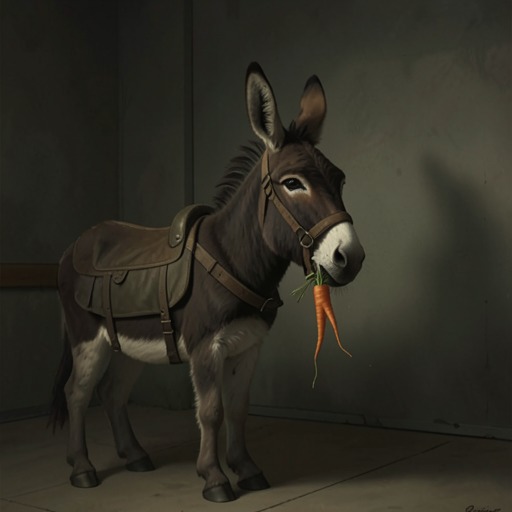
Donkeys
Rich Dad Poor DadThe donkey is the central figure in a parable about how fear and desire can direct human choices while obscuring where those choices lead. In the image, an owner dangles a carrot before a donkey pulling a cart: the animal pursues the promised reward, while the owner chooses the route. The book uses this unequal arrangement to explain how people can mistake the next paycheck, raise, or purchase for freedom, even as they remain caught in a cycle they have not examined.
The Donkey and the Carrot
The parable is introduced by Rich Dad as a picture of people who chase paychecks, pay raises, and job security under the influence of desire and fear. The donkey sees only the carrot; its owner, by contrast, knows the destination. The image turns an abstract warning into a question of perspective: the danger lies not simply in wanting something, but in pursuing it without seeing the larger pattern that governs the pursuit.
Mike connects the carrot to the baseball glove, candy, and toys he began imagining when offered a pay raise. Rich Dad extends the comparison into adulthood, when the desired objects become a new car, a boat, or a large house intended to impress friends. The changing scale of the reward does not alter the structure of the trap. Fear pushes a person out to work, desire beckons with the next prize, and the pursuit can continue without delivering lasting security.
Fear, Desire, and the Trap
The donkey image belongs to Rich Dad’s argument that fear and desire can control thought when a person does not understand money. A raise can intensify desire before the worker has paused to consider what the offer is doing to his judgment. Rich Dad therefore treats the boys’ decision to delay their reaction and think as an important counter to being ruled by emotion—not as an escape from having emotions, but as a way to use them deliberately rather than let them decide.
Rich Dad says that ignorance magnifies both fear and desire. Even people with substantial money may become more fearful as they grow richer if money remains an illusion of safety or fulfillment. He suggests that a person who could see the whole picture might reconsider chasing the carrot. In the same discussion, the narrator recalls that school can provide essential training for work and service, but for many people it becomes an endpoint rather than a beginning. The donkey parable thus distinguishes learning a profession from learning to question the financial habits that can govern a life.
The Image Reappears as a Warning About Pessimism
Later, the book’s warning against cynicism develops a related image: the “Chicken Little” who announces that disaster is imminent. Doubt, whether generated within a person or amplified by friends, family, coworkers, and media, can immobilize potential investors and cause opportunities to pass. The donkey and the alarmed chicken are not the same figure, but they serve a related purpose: each makes an emotion-driven response legible, one through the pursuit of reward and the other through retreat from imagined danger.
The account of Richard gives that warning a concrete financial consequence. In 1992, after seeing a two-bedroom townhome in a Phoenix resort community priced at $42,000 while similar units cost $65,000, Richard bought the property with the prospect of putting down $5,000. He then withdrew after a neighbor who was not an investor told him it was a bad deal. By 1994 the unit rented for $1,000 a month, or $2,500 during peak winter months, and it was worth $95,000 in 1995. The episode presents fear and doubt as more than private feelings: they can redirect action and cost someone an opportunity.
The book also contrasts unexamined warnings with analysis through its discussion of tax-lien certificates. The narrator says these were secured by real estate and enforced by state law, yielded 16 percent, and lacked liquidity; people who had never used them nevertheless warned that they were risky, often citing a friend or an investment magazine. The recurring lesson is not that every apparent bargain is safe, but that warnings should be examined rather than accepted as a substitute for understanding. Against the donkey’s fixed pursuit of a carrot, the book urges readers to look beyond the immediate lure or alarm and consider the wider financial picture.