Rich Dad
Rich Dad Poor DadRich Dad is Mike’s father and Robert’s formative financial mentor, a businessman who turns ordinary work, pointed questions, and deliberate pressure into lessons about money. His decisive teaching is that financial independence depends not simply on earning more, but on learning how money works and acquiring assets that generate income. Against Poor Dad’s emphasis on education and secure employment, Rich Dad offers a practical education in ownership, financial literacy, risk, and choice; the two boys’ adult lives become evidence of how his instruction can carry across generations.
Identity and Background
Mike’s father is introduced through the contrast between his business activity and the modest setting of his home. When Robert visits to ask for lessons, the small, tidy house has a worn wooden floor and old furniture, while employees pass through it on business: a warehouse manager, restaurant managers, and a construction supervisor. Mike’s father owns warehouses, a construction company, a chain of stores, and three restaurants. His work is not confined to a single job or workplace; it is a network of operating businesses and people.
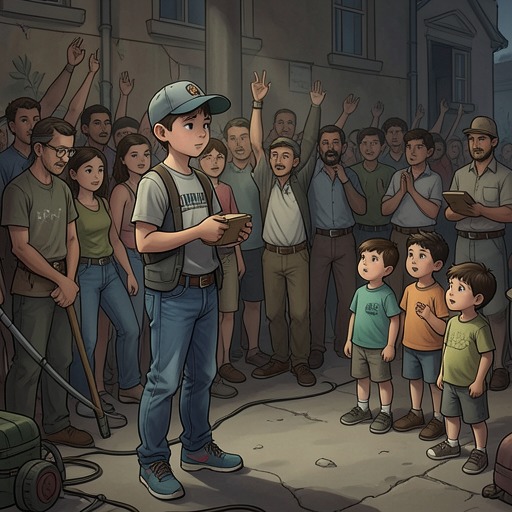
His first offer establishes his method. He will teach Robert and Mike only if they work for him, explaining that he can teach faster through work than through a school-like arrangement of listening. He gives them ten cents an hour for three hours every Saturday. When Robert hesitates because he has a softball game, Rich Dad repeats the choice between accepting and leaving. Robert and Mike accept, and the lesson begins with routine, tiring labor in one of Rich Dad’s neighborhood superettes. The low wage is not presented as a market lesson alone: Rich Dad uses the boys’ frustration with it to make them examine their own responses and assumptions.
Teaching Through Work and Challenge
After Robert complains that ten cents an hour is unfair, Rich Dad refuses to treat the wage as the central problem. He asks what Robert is learning and directs his attention to the thinking “between your ears.” In his account, workers commonly respond to dissatisfaction by quitting for another job or waiting for higher pay, while expecting that a larger paycheck will solve their financial difficulties. Rich Dad argues instead that a person must learn to think differently about money. The boys’ anger becomes useful when it produces energy and questions rather than simple resignation.
This lesson becomes his first principle: the poor and middle class work for money, while the rich have money work for them. Rich Dad contrasts his teaching with Poor Dad’s advice to study hard, get good grades, and find a safe job with good benefits. He does not dismiss education; he distinguishes between education for employment and education in how money works. In his view, fear and the desire for security often direct people toward wages, while financial learning requires initiative and sustained thought.
He also challenges the idea that a raise alone resolves money problems. Poor Dad, despite having an excellent education and a high-paying job, still struggles with bills because, Rich Dad says, he never learned about money at school and believes in working for it. More income can also lead people into more debt. The boys’ low-paid work therefore serves as a practical demonstration of a broader argument: financial habits and understanding matter more than income considered by itself.
Financial Literacy and Building Assets
Rich Dad’s teaching extends from earning to financial literacy. He gives Mike and Robert a foundation by making accounting simple: first pictures and words, then numbers. The boys learn to follow the movement of money and understand the basic ideas before facing more complex analysis. Mike later uses that foundation to manage his father’s billion-dollar empire; Robert’s business remains smaller, but both begin with the same accessible instruction. Rich Dad’s method makes financial knowledge teachable to children rather than an obscure subject reserved for professionals.
The central rule he gives them is to know the difference between an asset and a liability and to buy assets. Its simplicity is part of its force: people may struggle financially, he argues, because they mistake liabilities for assets. The principle reframes wealth as a matter of what money-producing resources a person owns, rather than the appearance of prosperity or the size of a salary. Robert later applies this distinction in advice to young people: build an asset column before marriage, home-buying, children, and debt make financial choices harder.
Rich Dad’s approach also treats business knowledge as broader than technical skill. He encourages Mike and Robert to learn about many aspects of business, work with people smarter than themselves, and bring different abilities together. This differs from Poor Dad’s preference for specialization. In the book’s account, specialized expertise can make a worker increasingly dependent on a narrow role, whereas knowledge of systems, people, cash flow, sales, and communication creates more options. Rich Dad’s own method of teaching by involving the boys in business is an early version of this wide-ranging education.
Habits, Risk, and Resilience
Rich Dad’s principles are expressed not only as ideas but as habits. When Robert describes Poor Dad paying bills at the start of the month and usually having little left, Rich Dad contrasts this with paying oneself first. He says that even when funds are short, he prioritizes his asset column; the pressure of creditors and taxes then forces him to find other income, work harder, and think more actively about money. The teaching is not that bills need not be paid, but that the order of payment can shape a person’s motivation and financial behavior.
He also teaches the boys to treat fear of loss as something to manage rather than a reason to avoid investing altogether. Rich Dad does not claim that winning means never losing. He uses the story of the Alamo as an example of a defeat that became a rallying cry, and returns to it when he is nervous before a major deal. The point, as Robert recalls it, is that a loss can make a person stronger and more alert; the difference lies in whether failure inspires further learning or defeats the person who experiences it.
His advice about giving links financial conduct to generosity. Rich Dad gives money to his church, charities, and his foundation, and believes that people should give what they want to receive. Robert presents this as both a principle of reciprocity and a practice Rich Dad maintained when money was short. He also taught young people his approach to business, treating instruction itself as a form of giving. The book connects this generosity to Rich Dad’s broader conviction that learning and wealth grow through circulation rather than through waiting until there is an effortless surplus.
Relationships and Legacy
Rich Dad’s influence is defined by its contrast with Poor Dad, Robert’s highly educated biological father. The two fathers offer competing models: one advises Robert to work for a corporation, the other to own one; one emphasizes becoming a smart person, the other learning how to hire smart people. Robert’s access to both perspectives makes him compare their advice and choose for himself. Rich Dad is therefore not simply a replacement father but the source of a second education that forces Robert to think critically about the assumptions he inherited.
His relationship with Mike makes the mentorship explicitly intergenerational. In 1990, Mike takes over his father’s empire and, Robert says, runs it better than his father did. Mike and his wife are very wealthy, and Mike is grooming his own son to succeed him, as Rich Dad groomed Mike and Robert. The succession turns Rich Dad’s instruction into a living business inheritance: the lessons pass not only through advice but through a working enterprise and a deliberate preparation of the next generation.
Robert’s later account of his own retirement gives the mentorship a second outcome. In 1994, he retires at forty-seven, while his wife is thirty-seven, describing retirement as the freedom to work or not work while wealth continues to grow. He compares accumulated assets to a tree that, after years of care, develops roots deep enough to provide shade without constant attention. Robert chooses retirement while Mike chooses to run the empire, but both outcomes are presented as made possible by the financial foundation Rich Dad helped establish. Through their divergent choices, Rich Dad’s significance lies less in prescribing one destination than in teaching them to create alternatives to dependence on a paycheck.